
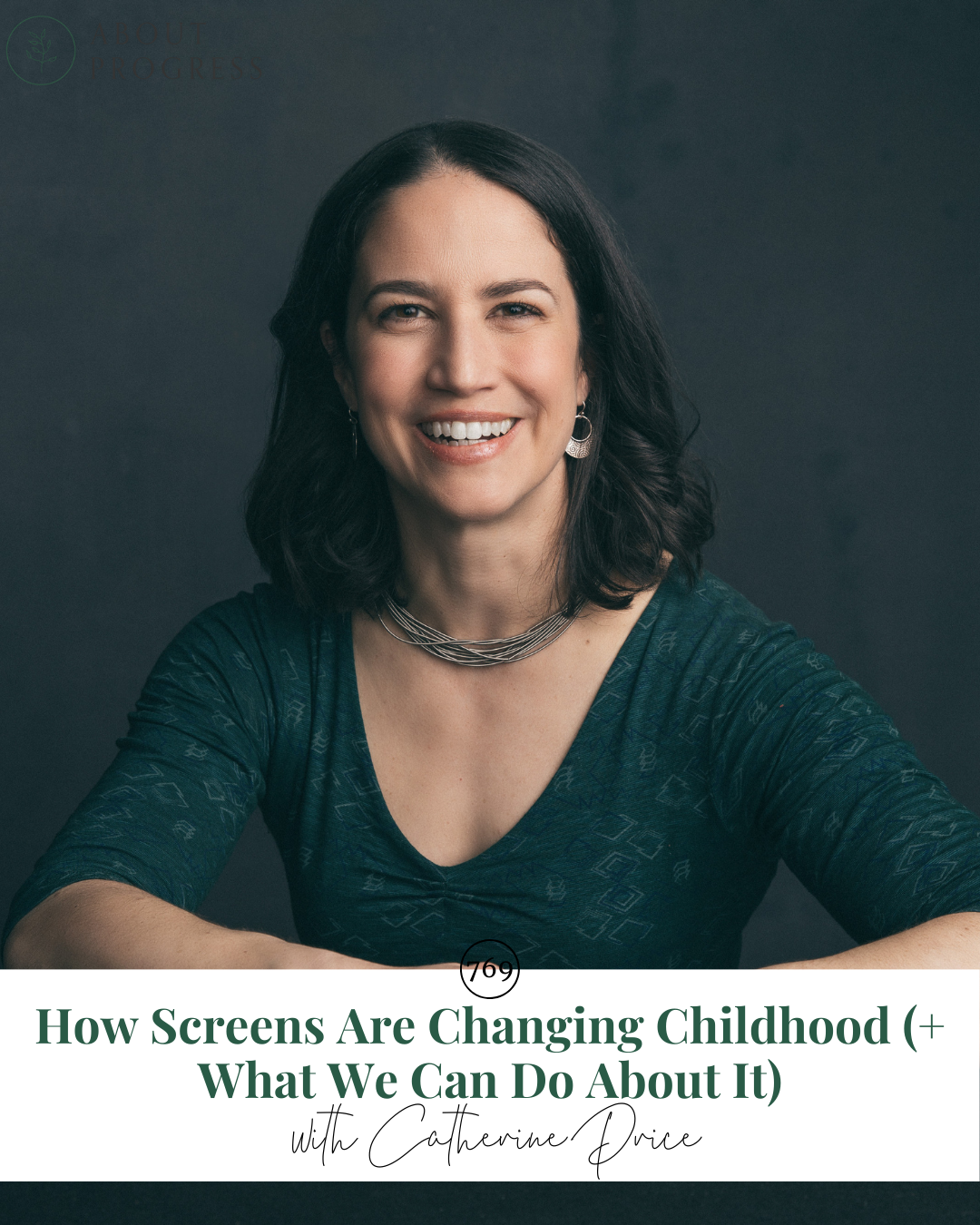
How Screens Are Changing Childhood (+ What We Can Do About It) || with Catherine Price of The Amazing Generation
Mar 23, 2026
As parents, it's easy to feel overwhelmed by the technological temptations that our children face daily. I recently spoke with Catherine Price about her latest book, "The Awesome Generation," a powerful guide for families aiming to cultivate a healthier relationship with technology, especially for kids. Technology is pervasive, and while it's reshaping childhood, it’s vital that we guide our children to use it wisely.
It’s about balance and taking small, collaborative steps as a family to navigate this digital age. What do our kids gain when they look beyond the screen? A whole world of possibilities where they can reclaim their time for hobbies, adventures, and moments that create lasting memories. Let’s help them become the pioneers of change, choosing to live life fully, beyond the digital realm.
Past interview with Catherine on the Power of Fun.
Join the Supporters Club to keep About Progress around for good.
Join the Book Launch Committee for behind-the-scenes and first peeks at all things book.
About a few other things...
Sign up for the Go Getter Newsletter to get Progress Pointers in your inbox every Wednesday.
You can listen to the episode below, on Apple Podcasts, or on your favorite podcast app. If you like the show please share it, subscribe, and leave a review!
SHOW NOTES
Catherine's Instagram, Website, Book
Access exclusive supporter benefits
Sign up for the next Sticky Habit Intensive
Book Launch Committee
Leave a rating and review for the podcast!
Lend your voice and experience + be featured on the show HERE
Join Monica on Facebook and Instagram
Songs Credit: Pleasant Pictures Music Club
Transform your space now. Go to https://www.quince.com/monica for free shipping on your order and 365-day returns; Get organized, refreshed, and back on track this new year for WAY less. Head to Wayfair.com right now to shop all things home; Join Masterclass for 15% off at masterclass.com/progress
TRANSCRIPT
Catherine Price: we are all being affected by technology. We are all in this together. The other side is really tech companies that are trying to profit off of stealing our lives from us. And so that reframing, I think is incredibly powerful and it's been wonderful to see that young people are.
Open to that as well.
Monica Packer: Hi, this is Monica Packer and you're listening to about progress where we are about progress made practical. If you are a parent today, chances are you have had this kind of moment. Your kid is talking to you and you realize that you are only half listening because you are looking at your phone.
Parenting in this age is full of so many layers of extra challenges thanks to technology. When do we get our kids smartphones? How much video game time is too much? What safeguards can we put in place to ensure our kids are okay online? But what's easy to forget is that as hard as it is to parent during these technologically advanced times, it's even harder to be a kid.
Imagine being an adult where your childhood memories are based around screens. Think about what you would miss out on from instruments learned to relationships built to fun. Had if there was always a device calling your name. Consider for a moment the pressure kids face socially to be online, and then how doing so creates so much for them to navigate emotionally and time-wise too.
We all know this. Truth screens are dramatically changing childhood, so what do we do about it? Today's guest is Catherine Price. She was previously on about Progress to talk about her bestselling book, the Power of Fun. Catherine's most recent book, the Awesome Generation combines her expertise on Tech-Free Living with Jonathan Haidt, her co-author and his groundbreaking insight on how screens are Missha Kids' Childhoods.
The Awesome Generation is a graphic novel style book designed for ages nine on up and their caregivers. I bought it myself, read it, and so have three of my kids all unprompted.
I was so transformed by how this book honestly teaches the truth about technology, while inviting kids and their caregivers to do things. Another way that I begged Catherine to come back on the show. Catherine has spent years studying how technology affects our lives, and in this conversation we talk about what parents need to know and how screens are influencing kids', friendships, confidence, and even how they experience childhood itself.
While we definitely had to get real and share the hard to share the facts, this conversation is not to shame or inspire fear. I found plenty of hope in what Catherine has to share from how she has seen kids themselves are starting to question the role technology plays in their lives to real shifts.
She's witnessing from entire communities who are binding together to protect their kids' childhoods. If you've ever wondered how to help your kids grow up with a healthier relationship with technology, this conversation will give you so much to think about. In fact, this is an episode I highly recommend the whole family listens to together.
Catherine Price is an award-winning health and science journalist, speaker, and number one New York Times bestselling author of books including how to Break Up With Your Phone, the Power of Fun, and The Amazing Generation co-authored with Jonathan Haidt. Her work has been featured in publications
including the best American science writing, the New York Times, the Washington Post Slate, and popular science among many others, and her TED Talk on Fun has been viewed more than 5 million times. My conversation with Catherine is coming up after a quick break for our sponsors. I.
Monica Packer: One of the things I did not have on my almost 40 bingo card is more allergies. Since I already have some kids who tend to struggle with allergies in general, I am now joining them in noticing the great difference between having good versus poor air quality.
This is why we love Air Doctor in our home. It's the only air purifier we use , and we are in good company. Air Doctor won Newsweek's Readers Choice Award for best air purifier with Air Doctor, we notice reduced allergy symptoms as an entire family, fewer odors around the home,
the cleaner air for my kids brings me a lot of peace of mind, as does the extra protection during wildfire season, air doctors, powerful three stage filtration captures particles about 100 times smaller than what typical air purifiers can remove.
Air doctor captures airborne contaminants that you do not want to be breathing in. Dust, pollen, mold spores, pet dander, wildfire, smoke, bacteria, viruses, odors and more, it has a whisper, quiet operation.
It's not loud like others on the market. And the auto mode feature is a big favorite of mine because it automatically kicks into different modes as needed, as well as an easy change filter reminder. So I don't have to guess when it's time to change my filter.
We are part of the 98% of Happy Air Doctor customers who say their home's, air feels cleaner, safer, and healthier. Head to air doctor pro.com and use promo code Monica to get up to $300 off today Air Doctor comes with a 30 day money back guarantee.
Plus a three year warranty. An $84 value free get this exclusive podcast only offered [email protected]. A-I-R-D-O-C-T-O-R-P-R o.com using promo code Monica.
Monica Packer: catherine Price a warm welcome back to about progress. I.
Catherine Price: Thank you so much for having me.
Monica Packer: Your last interview was so popular that we've aired it multiple times and I've recommended your book The Power of Fun to Everybody I know.
I think your latest book is a conglomeration of the Power Fund, how to Break Up with Your Phone, as well as Jonathan, he's book The Anxious Generation, which I love too. But we need to start with kind of leveling with the understandable amount of fear that I think all adults have, especially parents though, about this uprising generation of kids and teens who are. Having their lives significantly altered by technology, especially like screen use, particularly with social media, video games, um, everything like that. We need to begin with the truth, and it's not because we're trying to shame people or make them afraid, but we do need to actually understand what is happening and what is the impact.
So let's begin there. What do you think is the most helpful for parents to be aware of in terms of the effects that experts are seeing on kids with technology as it currently is?
Catherine Price: Yeah, I think the most important thing to recognize is that many of these products are objectively not safe for kids. That's kind of the bottom line. There's been a lot of writing done and a lot of research around specific effects that various types of technology have had on kids and have had on Gen Z, which is later teens and young adults showing very strong correlations and likely causation between use of things like smartphones and social media, and increased rates of things like depression and anxiety.
That's a very important conversation, and you can actually find plenty of evidence of those things happening if you speak to young adults and older teens. About their own experiences in their own lives. But I think one thing that hasn't been emphasized as much That all parents who are listening should be very aware of is that these platforms are not designed to be safe for children and they are not safe for children.
So when I give official talks about smartphones and social media, video games and kids, I actually show a little diagram, a little map of where the evening will go, where it starts in kind of like vague powerlessness and unease, which may be where some listeners are right now. And then we go into sort of a pit of existential despair.
But I always say, then we'll come out on the other side with some positive. Inspiration and practical things you can do. But there is a real serious pit that, that we need as adults and as parents to recognize we can't keep our heads in the sand about some of the risks that are present for our children when we allow them to spend a lot of time on screens.
Monica Packer: Mm-hmm. So when you say not safe, like they are not designed to be safe for kids, what are some of the specifics there that parents may not know?
Catherine Price: Yeah, there's a lot of specifics that are important for parents to know. First of all, when we're talking about social media and video games, which are two of the biggest issues for young kids and teenagers, many of those apps, in fact, all the social media apps are literally designed to be addictive.
They are designed to use the same techniques as slot machines. To hook our kids and us into spending as much time as possible on them with the specific purpose, not of connecting people or making the world a better place, but of making more money for the companies that make these apps.
Monica Packer: Yeah.
Catherine Price: So that's one thing to recognize that you are giving your child access to a product that has been designed to be addictive.
Many of these tricks, as I said, are deliberately modeled after slot machines, which are the most addictive machines ever to have been invented, to the point that no state allows anyone under 18 years old to play the slot machines in a casino because they're so addictive. So I'd say that's one thing to recognize.
You can see the results of that addiction when you look at the sheer amount of time that many young people are spending on these apps and adults as well. One recent survey found that. The average American teenager is spending about five hours a day just on social media and YouTube, not schoolwork or anything else you might do on a screen, but just social media and YouTube.
And if you do the math, that adds up to two and a half full months, a year of 24 hour days, or about four months a year. If you're talking about just waking hours. And when I do talks to kids, I point out two and a half months. Is your whole summer break and four months, a year is a third of your time alive.
So imagine that you got outta school in June and then you did nothing. You didn't sleep, you didn't eat, you didn't spend time with friends. You just looked at social media and YouTube. That is how much time you're spending. So I think that can be a real eye-opening calculation for young people and adults.
But another way in which these platforms are objectively just unsafe. Are there ways in which they allow predators access to our children? This is where we get into the deep, dark hole
Monica Packer: Yeah.
Catherine Price: of existential crisis. We have, as Jonathan Heet points out, I think very beautifully in his book, the Anxious Generation.
We really have overprotected our kids in real life over the past couple decades and drastically underprotected them online. When I started to dig into this, it got really dark, really fast. So I would say that. It is a big picture thing to keep in mind. We worry about the creep at the playground, right?
But in reality, those people are now online. If you want to do bad things to kids, you do not need to leave your home. You go onto to Snapchat, you go onto Instagram, you go on to TikTok, you use or video games, Roblox. Huge problems with strangers contacting kids. So that is something that. Parents need to be aware of that.
There are very, very, very real dangers out there for our children on the internet. And so you might know that your kid is physically present in their bedroom, but you actually have no idea who's talking to them. You have the issue of pornography, of incredibly graphic, inappropriate imagery and videos being shown to our children, and this is having a huge effect on how young people view sexual relationships. It's actually truly horrifying to think of.
Monica Packer: Hmm.
Catherine Price: The problems this is causing with relationships, with self-esteem, with how young people relate to each other, what they're, what they think of as a healthy relationship with someone else.
You have the issue of drug dealers actually targeting our children on these apps. Literally sending messages proactively to children to sell them drugs, there was actually a study done by the Tech Transparency Project that found that you could buy drugs on Instagram and just two clicks, which.
Disgustingly is fewer clicks than it takes to log out of Instagram. But TikTok and Snapchat are also used as drug dealing platforms. It's also not just an issue of our children buying drugs, which no one wants, but a lot of those drugs are laced with dangerous substances, which has led to a lot of children dying as a result of drugs that they purchased online.
Again, from their bedrooms. They never had to even leave the house to a drug dealer. May have approached them. And then you have a huge issue of sextortion, which is basically the horrifying practice of adults. Convincing kids to send them some kind of compromising photo and then threatening to share that photo with everyone they know.
Unless the kid sends more photos or in some cases sends money. There's also a financial extortion that's happening in this way. There's a PSA that was put out by the New York FBI office. If anyone wants to really worry about Roblox in particular, that explains how this happens. This has resulted in an alarming number of deaths by suicide, by young people, sometimes within hours of first contact by these predators where young people are filled with so much despair and honestly their brains are not developed enough to recognize, to really make wise decisions where they will actually kill themselves.
And I've spoken to parents to whom this has happened. That's horrifying. You now have the growing problem of AI where young people are using AI tools to create deep, fake videos and photos of classmates and adults in their life, like inappropriate photos and videos, and using that to bully each other.
There's now potential legislation around this issue, but I mean, the cat's outta the bag. This is gonna be nearly impossible to stop, and now you have the issue of chatbots that are designed to engage our children and adults in relationships, whether it be friendships or in many cases, romantic relationships.
And first of all, that is not good for humanity if our children's first friendships or romantic relationships are with a piece of computer. And second, there have been cases already in which these AI chatbots, which are being put into all sorts of other platforms, I mean, meta has made a point of putting more into Instagram.
They're actually encouraging kids to do things involving self-harm, eating disorders, and in some extreme cases, suicide. So there are serious issues. I would also really, really stress to parents listening that your social media feed is not the same as your child's. If you looked at my social media feed, I mean, I don't care about social media.
I hate social media actually, but you'd see just like things about smartphones and kids, that's all there is in my feed these days. Maybe some local events, but it's pretty innocuous if you look at a young person's feed. You will see a very different, very different picture. There was a expose done by the Wall Street Journal a couple years ago that it was a video expose that showed how TikTok in particular spins people into rabbit holes of content where you might be looking at a video that is just about healthy eating, or maybe you have a bad day, and so you pause for a split second on a video that expresses some kind of theme involving sadness or mental health, and you get spun into these rabbit holes of self-harm.
You know, again, suicide or eating disorders, bulimia, you know, thin inspiration is a thing. It's kind of inconceivable to think how different this stuff is that our kids are being shown again, by these algorithms that are designed to addict them. The companies do not care. And that would be the last thing I'd say in this kind of.
Monica Packer: Yeah.
Catherine Price: Tirade is that the companies don't care. This has been proven again and again and again. They are fully aware of the risks that their products pose to children. There have been numerous documents that have showed up in lawsuits against these companies. And there's been documents that straight up say that the number one priority for the companies is not child safety.
Instead is trying to get as many young people onto their apps and platforms as possible and to maximize the time that they spend on those apps. And if anyone wants to learn more about that, John Heet and his research team just came out with a new website, which is meta's internal research.org that actually compiles a lot of this research from these lawsuits into one place.
And a lot of the whistleblower documents. So you can see with your own eyes what these companies are doing to children and how aware they are of what they're doing to children, and they are not taking adequate steps to protect them. So anyone listening should be both honestly frightened for their children in terms of what happens on these platforms, but also outraged at these companies.
Monica Packer: Thank you for being willing to share about. The worst case scenario, I think. But the thing about this is it's not just the worst case scenario in terms of rarity. It is too common,
Catherine Price: It is too common. It's too common. Yeah.
Monica Packer: yeah, it's way too common. Let's say we're still speaking to the parents or like we have really great boundaries in place, a lot of oversight, but their kids are still spending a lot of time on them, and that's when I come back to a lot of what I feel the amazing generation communicates is. Even if the dangers, those very real dangers weren't omnipresent or even present in their tech use, they still have a great deal of loss
Catherine Price: Mm-hmm.
Monica Packer: tech use. You already mentioned a loss of time, but also loss of relationships, a loss of self-esteem, a loss of social skills. I, I was just wondering if we could also paint that picture too, like even if you feel like you have the dangers. well controlled and under your purview,
Catherine Price: Mm-hmm.
Monica Packer: what, what will the kids see in their day-to-day lives that they are losing out on?
Catherine Price: Right. Well, that's a great question, and I would say, first of all, it's extremely difficult, if not impossible, to mitigate all those dangers.
Monica Packer: Mm-hmm. So we have like a
Catherine Price: Yeah,
Monica Packer: sense of security, of thinking like, I've got it. I,
Catherine Price: we do. Kids are very smart. I mean, a lot of times this bad stuff, we'll find them, but they can also go searching for stuff themselves. So I would say if your kid has any access to any internet enabled device, you gotta.
Do the research into parental controls, which are a pain to set up, and I would really recommend getting a third party platform or third party tool.
Monica Packer: Mm-hmm.
Catherine Price: Yeah. There's ones, um, that parent parents have told me about, like Bark and Canopy are two that people like, but there's a number of these parental controls.
Out there that do a much better job and are easier to set up than the native controls within apple and Android products. So it's real, but it's really hard to protect kids online. So with that, if you somehow do do that
Monica Packer: Yeah.
Catherine Price: to answer your question, that doesn't actually solve the problem.
And what I appreciate about that question is that I think what you're getting at is actually. One of the most important things we should be considering, both for our children and for ourselves, which is the opportunity cost of all this time that we are all spending on screens.
Monica Packer: Yeah.
Catherine Price: the reality is we only have 24 hours a day. We're not even awake for most of them, but let's say we've got 16 hours a day, you can't get more time and you can't get time back once you've spent it. It is truly a finite resource and it is our most valuable resource, time and attention. And so if you spend an hour or two hours, five hours in some cases on social media, that's.
That many hours that you cannot spend on anything else. One thing that John and I did in the Amazing Generation is we, we solicited anecdotes from young people, from teenagers and young adults to ask them about their own experiences on screens and what they wish they had done differently and what, what advice they have for the younger generation, you know, to try to choose a different path.
And so many of these young people said, I really regret. All the time I spent staring at screens instead of interacting with my friends.
Monica Packer: Yeah.
Catherine Price: person said, I really wish that I had spent time with my grandfather
Monica Packer: Mm-hmm.
Catherine Price: I was younger, before he died. Instead of playing video games when he was over, a lot of young people commented on the things they would've done, the skills they would've developed, the experiences they had.
If they had not spent all that time on screens, they might have learned how to play the guitar or speak a different language or just have adventures. And I've actually had in-person experiences where I give talks to college students. There was one recently at the University of Houston, and I remember asking the audience like, well, why did you choose?
'cause it was a voluntary talk. Why did you choose to come hear me talk at like four 30 in the afternoon on a Thursday? And this young man raised his hand and he was about 22 years old. He's like, I want to be an educator. And one of my goals is to help young people avoid what happened to me, which is that I feel that I wasted my entire youth.
Monica Packer: Oh
Catherine Price: On my phone,
Monica Packer: Hmm.
Catherine Price: I was like, well you are 22, so thankfully there's still hope for you. But you know, it really does get existential and, and one thing that John points out when he talks about this, and I think it's very true, he'll ask audiences to raise their hand if you have like a vivid memory from your own teenage years.
And everyone raises their hand and he's like, well, just imagine, you know, if you can conjure up at least three vivid memories from when you were a teenager. He's like, imagine that you didn't have those memories. Imagine that you look back on your teen years. And it's just empty. And you just remember looking at your phone because the reality is you're not even gonna remember what you looked at on the phone.
No one's gonna remember like an Instagram reel in 10 years. You know, what you remember is the time you spent with your friends, the time you spent with your family, the experiences you had, the time you spent playing and having adventures. Like that's what creates a meaningful life. And it's really heartbreaking to think that there is a generation of kids who have been robbed of those experiences and that unless we all take action now.
This could continue.
Monica Packer: Uh, one other thing I, I found the anecdotes were so amazing in this book, and, and I think really, . What made the book translate what they were learning, you know, and what we're learning as we read it too about like the real dangers and what's going on. And then to actually see like kids, know, to young adults say specifics about how it affected their lives, I thought was extremely powerful. Um, one of the things that you guys know in the book is that most users wish the products didn't exist like, what other products out there do people. Avidly spend a ton of time using and hate it.
Catherine Price: Yes, we, uh, we referenced this study that was done by the Harris Poll a year or so ago that surveyed people in Gen X. So this was, at that point, roughly 18 to 27 year olds and asked them about. Uh, their thoughts on some of the most popular social media platforms and then ask them explicitly, do you wish, which of these, if any, do you wish didn't exist?
And roughly half of the respondents said that they wished that one of those major platforms, like, uh, it was Twitter, Snapchat, and TikTok didn't even exist. Those are the very same platforms we were just talking about that young people in particular are spending a huge amount of time on. And the point you're making, I think, really is.
An interesting one that we bring up in the book, which is like, yeah. What other invention would you dislike to the point that you wish it didn't exist to begin with? You know, the example we use in the book is like, if you don't like bicycles, would you really wish that bicycles didn't exist? Or would you just not ride a bicycle, let alone, and then you ask yourself, well, you certainly wouldn't ride a bicycle for five hours a day.
If you hated bicycles that much, but that's what's happening with a lot of young people. And the reason is that they've been tricked and they've been trapped. And that's what one of our main messages in the Amazing Generation is, is to reveal to younger kids what these tricks and traps are so that they can avoid them.
Monica Packer: so as we are talking about the realness here, will. Super real. Yeah.
Catherine Price: I know. Sorry if we're, we're still in the pit. We're gonna get out. We're gonna go out, let's get on the pit.
Monica Packer: the pit right now. I wanna know, as someone who has written about the ills of screen use for years and help people live an actual life again, also written this book, especially geared towards children, like in thinking about our teens and young adults too. How are you doing? Like, how are you feeling about all this? Like, do you feel hopeless or do you think there is, you have a different outlook on this? That may surprise me after hearing about all the,
Catherine Price: Do you wanna be pleasantly surprised? I'm getting the sense you'd like to,
Monica Packer: to be pleasantly surprised, but I also am trying to be open to you being like, no, I am, I'm not feeling hopeful, but go ahead, share how you are.
Catherine Price: well, I'll start with the less hopeful part and then I'll, and then I will be hopeful. So this challenge is enormous and the stakes couldn't be higher and. It does terrify me to think about the effects that technology is having on children, and honestly, all of us and the influx of these AI tools should keep all of us up at night.
There's great uses for ai, just like there's great uses for other screens, but this is eroding our experience of being human. You know, there was recently an article in the New York Times about adults who had gotten into relationships with their AI companions, and in one case had quote, married.
Monica Packer: Yeah.
Catherine Price: companion.
I mean, I was just seeing a headline the other day about people who are now supposedly having again, quote children with their AI companions. Like this is like if anyone has seen the movie her with Joaquin Phoenix from 2013, which in which he falls in love with his operating system. It seems so outlandish in 2013.
My husband and I re-watched that video last year and we were like, wow, this is happening. Like this is actually happening. So I am very, very, very concerned by the effects that technology, and more specifically the effects that a very small number of companies with like a very small number of leaders are having on all of us and these things that they're putting into our lives without our consent that are harming us.
And harming our children. So I do lie awake at night. I love sleeping, but when I do have trouble sleeping, it's because of thoughts like that. So I do think like that's why the stakes could not be higher and the future of humanity is at stake. With that said, I actually am hopeful, and I haven't really felt hopeful for about this before.
The reasons I feel hopeful, there's a couple of them. One is that people are now talking about this problem and doing something about it. That was not the case. Just a couple years ago when I was pitching how to break up with your phone, I pitched it to editors back in 2016, and it came out in 2018 as the first edition.
Only one publisher was interested in it, and people kind of intuitively understood that like there was something not great about their relationships with their phone, but there wasn't a nationwide discussion about that, let alone about kids. Everyone instead was trying to get more laptops into schools and have a one-to-one ratio of, you know, kindergartners on iPads.
Monica Packer: Yes.
Catherine Price: Now we're in a very different situation. So John Heights book, the Anxious Generation, came out in 2024 that he, he says it feels like pushing on an open door, like it has sold more than 2 million copies. It has inspired phone free school legislation around the country. More than more than 41 states now have some form of phone free school legislation in action or pending.
That's amazing. We have. Australia banning social media for people under 16. They, they're no longer able to open accounts and we have a number of other countries now looking at Australia and considering doing the same thing. That's enormously inspirational to me, and clearly parents are talking to other parents about the ideas of the anxious generation and they really, there really is a movement to try to put.
Into action what John calls the four norms, which is to delay kids access to smartphones and social media. That's the first two norms. He says smartphones until at least high school and social media until at least 16. But that is in part 'cause he wrote the book in 2023 or so. And if you ask him now, he'd say, actually, I prefer it to be 18 for both.
But it really was a matter of what's practically achievable. That they're enormous to get. Phones outta schools from First Bell to the last bell, including lunch and recess. So phone free schools. And then the last norm is to give kids more opportunities for independence, responsibility, and free play in the real world.
adults are adopting those four norms and taking action on them. But the thing that perhaps gives me the most hope is the reaction that we've gotten so far to the amazing generation. So the Amazing Generation came out December 30th, 2025, so very recently. And it is geared towards, well, we said starting at nine years old, but we've heard from teenagers, we've heard from adults that have found this book to be useful.
But it was primarily meant to be really, really targeted at kids who either haven't gotten smartphones and social media accounts yet, or have just gotten these things. And the goal of the book, which seemed totally , aspirational and pie in the sky. Was to get kids to choose to adopt those four norms, delaying social media and smartphones, phone free schools, and then more independence, responsibility and free play in the real world for themselves.
And that sounded like, I don't know if we could do that, wouldn't that, that would change the world. That is, to me, the solution. Because if you don't want to be on smartphones and social media, then you don't even need legislation. I mean, I think there still should be legislation, but it's, it's, it would be.
Transformative and I am absolutely thrilled to say the response we've gotten so far from readers of the book, from parents and from kids themselves has shown that that's working. Like it's been astonishing. If you look at the Amazon reviews for this book about parents who are saying that their kids are fighting over the book, that they haven't gotten read the book themselves because their 10 and 13 year olds are fighting for it, that their kid chose to delete Roblox after reading the book that you know, their child begged daily for a smartphone before reading the book, but now wants to get a flip phone.
Doesn't want social media and doesn't wanna have phone with internet access until at least, you know, mid high school. I mean, I can't believe it. It is. So many friends have told me stories like this personally and that I've done talks at my own daughter's school for the fourth and the fifth and sixth grades, and seeing the kids' responses in real time, it just makes me think maybe this is possible.
Maybe it's a matter of just opening people's eyes to what these companies are doing to us and then presenting kids and adults with a better choice. Because nobody wants to spend their whole life staring at a screen. So anyway, I am, I actually do feel hopeful because of that. But I will say that that comes with a big caveat and a big requirement, which is that we can't sit on the sidelines like anyone listening.
We can't sit on the sidelines. We need to take collective action. We need to. Have the bravery to stand up and say, you know what? Like our family is going to wait to give these things to our kids. Our family is going to give our children more opportunities to do stuff out in the real world on their own, you know?
And then the more of us do that, the easier it will be for everybody else, but we have to do it. It doesn't work if one family in the neighborhood decides to not give their kid a smartphone or social media account. Then that kid will legitimately feel left out. But if we all do it together, we can solve the problem.
So I just really wanna say to listeners like, we can solve this problem, but we, we need to each take on the responsibility of, of doing our part.
Monica Packer: Mm-hmm.
Catherine Price: And if we do that, it will be easier than it seems
If You haven't heard,
I spent all of 2025 writing a book. and I'm so proud to say that my first draft of the manuscript has officially been submitted. There is so much work to come and the book is set to release in the fall of 2026. However, we have a new title, And with that, a way for you to get first access to what that new title is, as well as the first peak at the cover and to get exclusive behind the scenes virtual online events, celebrating its launch to act as , grassroots publicity, and to potentially be an advanced reader as well.
To get access to all of that, you simply need to be part of the free book launch committee. You can sign up at about progress.com/book committee. I've been sending out newsletters with updates. And some juicy behind the scenes, such as lately. The good news I got and the bad news I got, which is now turning into not so bad news.
And actually I think it's gonna be great news in the long run, and I'd love for you to take part again to get access to the newsletter and everything else I just shared. Go to about progress.com/book committee
Catherine Price: And
Monica Packer: Well, I was gonna remark on that, that it seems like your own level of hope has risen to go alongside the rising action people are
Catherine Price: hmm.
Monica Packer: And so, I mean, it's easy to stay stuck in the despair of what we know is happening, but as you, you just said, if we can collectively. Do something which was one of our big mottos in our community.
Do something then can feel more like we there. There, there is possibility. There is. Indeed, hope you speak to actual kids about this. The four norms are so good and I love how the book helps them become rebels to
Catherine Price: Hmm.
Monica Packer: those four norms. What have you found is really helpful in helping your kids do something to empower them to take ownership of how they want to design their tech lives and, and make their own decisions about what they're going to do.
Catherine Price: One of the ideas from the book that's really resonating with kids. After they understand how they're being manipulated, that also hits hard. 'cause kids do not like being manipulated, and they do not like the fact that many of the tech leaders don't allow their own children to use their products. I've had a little girl, like her mouth dropped open when I was talking about that during the presentation at my daughter's school, and numerous people have said that their kids showed them that page in the book showing that, you know, the CEO of TikTok doesn't let his kid on TikTok.
They're like, what? So that hits kids.
Monica Packer: starting
Catherine Price: They need to know the truth.
Monica Packer: the truth. Okay.
Catherine Price: Yes, yes. And they're very open to it. But I would say one of the parts of the book that seems to really be inspiring kids and also helping them recognize what's at stake, but in a good way, is the idea that. When kids are at this age in ear, early adolescence, they're in this period of brain development that is unlike anything before or after.
When our, when we're babies, our brains are in this state of rapid expansion and where we're growing new brain cells and new connections between brain cells is kind of like you're growing a plant and it's like you gave it a lot of fertilizers really growing fast, but in early adolescence, the brain has to decide which.
Connections to keep and which ones to get rid of. So you can imagine if you had like a hedge and now you're, you're trimming it into a beautiful topiary. That's basically what's happening in early adolescence. And the adult brain you end up with in many ways is affected and shaped by what you do when you're in the age range that this book is meant for.
So what we tell kids, and I also would encourage adults to really internalize this too, is that early adolescence is this crucial period of brain development, and on the one hand, it's this amazing opportunity. Because you can actually affect what kind of brain you're gonna have as an adult just by being really intentional about the things you do and the content you put into your brain and how you spend your time when you're a teenager.
On the other hand, it's also a vulnerable time because it leaves you very vulnerable to any company or a product that's trying to shape your brain in a way that benefits them. But kids, kids respond to both of those messages. They don't like the idea of someone else controlling their brain, but they really do like the idea of like, wait a second, I can choose how I spend my free time, maybe not their school time, but I can choose what I do during my leisure, you know, hours and I can choose to have more experiences and I can choose to develop real life skills. One example that stands out to me that I found to be particularly moving was a friend whose son is very into Fortnite.
He actually told me he played 650 hours of Fortnite in just a year, and he read The Amazing Generation and this was like constant fights about Fortnite and screen time. Yeah. And he read the book and then his mom told me, and then he affirmed himself. He's a fifth grader, that he read it and he said to his mom, he was like, you know, I've been thinking about it and I'm not really sure that Fortnite is a hobby.
You know, I like Fortnite. I'm not sure it's a hobby. I wanna have more hobbies. And so they brainstorm together. And among other things, they're now doing a family outing to the climbing gym together each week. ' cause the whole family likes climbing. And I just thought that was such an amazing insight from a fifth grader to have the insight to recognize that this thing that entertains him.
Isn't actually a hobby that's adding to his life in a way that makes him more interesting or that, you know, brings interest to him beyond just playing the game. And so one of the messages of the book, one of the points of the book and the whole last third of the book, is actually giving, as you're saying, giving kids ideas and tools that they can use to build healthy relationships with technology, where they can use technology as a tool, but not be used by technology.
And then also fill their lives with what we call real friendship and real freedom and real fun. Because what's happening right now is the companies are promising kids and adults that if you use social media, video games, all this stuff, you'll have fun and you'll connect with friends and it'll, in the case of getting a smartphone, give you more independence from your parents.
But in reality, it's not really freedom if you are using something designed to addict you. You know, if you're like taking out your phone on family vacation so you can keep up your snap streaks, that's not freedom and it's not real friendship to just have followers on Instagram or TikTok. It's real friendship happens in real life and it's not actually fun.
So that goes back to the conversation you and I had when we first met about what is true, real fun. It's not what happens on screens, it's the feeling we get when we're totally engaged and present with another person in real life, sharing a laugh, having adventures, just doing stuff together. And so I think it's really helpful once kids recognize that, wait a second, like those promises are lies again, kids don't like to be lied to, they don't like to be taken advantage of.
And once they internalize that or, or see clearly how they're being lied to. They get indignant and then. They then, what we tried to do in the book was we gave them the tools to find the real good stuff, and we framed it as a choice. We didn't want it to be lecturey or condescending. It's basically like, here's the deal, here's what's happening.
Most adults don't even recognize what's happening. Now you have the knowledge that most people don't have, and you have the tools to choose a different path, and now it's up to you. Do you want to follow the path of the generation before yours and give your lives over, essentially to the tech companies?
We call them the tech wizards in the book, or do you wanna join the rebels, which is this? Growing number of young people are choosing to stand up for themselves and live real life instead of screens, do you wanna join these rebels? And so far it's been really cool. I've actually had young kids come up to me at book signing events and introduce themselves as rebels.
Monica Packer: That would make my heart like burst outta my body
Catherine Price: Yes, it does.
Monica Packer: embodied, like my, my hope, literally personified
Catherine Price: Yeah.
Monica Packer: amazing. Uh. There's so much more I want to talk to you about, but I just want to make sure they know that amazing generation is available. Now we have our version here. It's, it's getting passed around with my kids too.
I, I read this while I was sitting to the bed trying to get my toddler to sleep. You know, you sometimes you just have to body double someone falling to asleep. Uh, that's, that's how we do it. would, I would catch myself reading this far past, he was actually asleep because I was personally so engaged by it.
It is so transparent and empowering, not heavy handed. You know, where like they sit there and think they're getting a lecture while they read. It's, it's not, not that way. And I hope every parent reads it. more importantly, their kids. I, I'm, I'm telling you, your kids are gonna love this book. Before I ask my final question, are two things. , where should they go to get the book? Where can they also go to learn more from you specifically? I.
Catherine Price: Yeah, you can get the book wherever books are sold. Uh, we have all the [email protected]. And that site also has free resources that may be useful. There's a free preview if you want to check it out before you buy it or if you wanna use it in a class context, like a classroom context, and have like a starter, you know, inspiration for the kids that's available.
There's an educator's guide, there's a community reads guide, and there's also an adult like parent and caregiver discussion guide. So those are [email protected]. Um, as I said, you can learn more about the research that the company's. Have kept from us at meta's internal research.org, and then you can learn more about [email protected].
And I, I encourage you also to check out my other books if you're interested in your own screen habits. That would be how to break up with your phone and the Power of Fun, which you and I have spoken about before. Um, so I would encourage you to check those out and I hope people would sign up for my newsletter.
I write a substack that's linked to from catherine price.com. It's called How to Feel Alive, and it is about exactly that. How do we do that? And I would also say I am also a recovering perfectionist. And so it's very much about like, how do you not take yourself or life too seriously and just try to, you know, enjoy our time on this planet.
So that's where people can go to those, those sites to, to learn more and get resource. And I also have a family resource kit. Sorry, I have a lot of resources. Um, on Catherine price.com, there's a family tech kit that I have a lot of actual, uh, resources, like the names of some of the third party parental control apps and the names of smartphone alternatives.
'cause you don't have to get your kid a smartphone. There's like a middle ground. Get them a basic phone that allows 'em to call or text, but does not have internet access or social media on it. So I have a lot of lists, uh, on there to help. And then like a suggested guidelines, a suggested roadmap for how to.
Approach screens with your kids. Um, so that's all [email protected] as well.
Monica Packer: Thank you, Catherine. And I mean, what a wealth of resources. Like that's a, that's incredible what you've actually done about this problem. You've done something. And more than just something I would say, over and over again throughout this conversation, I keep coming back to the phrase, real life. That's what we want for ourselves. You know, that's our initial conversation. Again, this is what we want for our kids. We want them to have and live a real life. Speaking of hope, which we've tried to come back to, I want to hear how you personally feel about this amazing uprising generation. Like what about them specifically is making you feel like, you know what, maybe things can change actually.
Catherine Price: I think what I've noticed in interacting with. You know, fourth, fifth, and sixth graders. And then hearing from young people about their responses to this book is just how insightful they are. I think most parents have been surprised at some point by how insightful their kids are, but I'm kind of getting this deluge of that.
It's like a fire hose of like seeing how amazing kids are. And so the amazing generation is not a fa accompli. It's not saying this generation is amazing already. I mean, they're amazing in the sense that all kids are amazing, but it's aspirational. It's like you can be an amazing generation if you choose to.
You know, fill your life with, as we put it, real friendship and real freedom and real fun. But I think what's really inspired me is that kids are open to this message. You know, kids do not want smartphones and social media. For the sake of smartphones and social media. They want it because they want to connect with their friends and they want to have fun and they want more independence, all of which are completely developmentally appropriate, by the way.
But they've just been led to believe that that's given to you through a screen. And they have older siblings and teenagers in their life who look like they're always on their phones. And so it must be fun, right? Like why would your big brother be on it all the time if it's not fun? But when you actually talk to kids and they learn more about what's going on, they're very open to this book's message.
And that has been truly inspiring to me. And they really wanna take action. I'd also say that kids of this age are very, very eager to make a difference in the world and to also stand up for themselves. They don't like injustice, they don't like feeling, you know, that they're being manipulated or talked down to.
Um, yeah, and, and I think that really also what's been very inspirational to me is this response we've gotten from parents and kids that families now feel like they're on the same side. You know, there's endless fights over screen time. I'm sure many of your listeners are engaged in daily battles. It's not that this book is gonna solve everything, but I have heard from a lot of families that it has gotten them on the same side as their kids.
And that just is wonderful to me. 'cause it should be. It's like we are all being affected by technology. We are all in this together. The other side is really tech companies that are trying to profit off of stealing our lives from us. And so that reframing, I think is incredibly powerful and it's been wonderful to see that young people are.
Open to that as well.
Monica Packer: I definitely see that. I definitely see everything you just shared. One thing I often say to my husband is like, this generation, they just don't take crap. Like they're not gonna take our crap answers. They want the truth. want to understand and they want things to be right,
Catherine Price: Yes.
Monica Packer: harness that so they can
Catherine Price: Yes,
Monica Packer: life.
Catherine Price: exactly.
Monica Packer: Catherine, we always end our interviews with a final question and it's what is one small way listeners can take action on what they learned today? And I'm thinking specifically for the parents in this one.
Catherine Price: Yeah, I mean, obviously I'd recommend checking out the book, but I think that what I would recommend is I inviting your children to help you with your own screen habits, which is very vulnerable,
Monica Packer: Yeah.
Catherine Price: and you may hear things that you don't like.
Monica Packer: Okay.
Catherine Price: But the reality is that we can't expect our kids to have good habits around technology if we can't model those habits ourselves.
And they notice. You know, they notice when we're sneaking a look at a sports score under the table or we're answering work email while we're putting them to bed. They notice I know that, 'cause I ask children when I give talks to them, has anyone ever felt ignored by their parent because of something their parent is doing on their phone?
Every hand goes up. And I do not say that to guilt or shame us because parenting is hard and the fact that everyone's hand goes up shows that everyone's doing this. But to me, that's very eye-opening as a parent. I mean, I know my daughter would say that I have an issue with my laptop. 'cause I'm like, I'm a freelancer.
I'm working all the time. Um, which is something I'm trying to work on. So I think it can help us, like it genuinely can help us if you say, Hey, can you help me with my screen habits? So find out what they think about your screen time and then say, can you help me? And if you do end up getting the book, I would recommend saying, Hey, can you read this?
And then teach me something and help me. But even if you don't read the book, you could do that with your kids. And that does two things. First of all, it will genuinely probably help you with your own screen habits in a positive way. And second, it will change the relationship with your kids. It changes what's normally a top-down relationship to something that's much more level, if not putting your kid in a slightly more powerful position than you, which is amazing for children to think you actually value what I think and what I say, and also being vulnerable with your kids, being able to ask, Hey, can you tell me how this is affecting you?
That builds trust. And so I think just opening a conversation that way where you ask your kid to reflect on how your screen habits feel to them, and that asking for their help in making changes can help your family and everyone in the family in innumerable ways. So that would be my suggestion.
Monica Packer: Amazing. I love starting there. Thank you. You know, Catherine, we've talked over and over again about how precious time is. I'm really grateful that you spent your time today here with us. Thank you.
Catherine Price: I am very grateful for the opportunity and I'm grateful to everyone who's taken time out of the data. Listen to this. I hope it was helpful, and we can do this. We just need to act together.
Monica Packer: No better note to end on than that, that's for sure. of amazing, you are amazing, Catherine. Tha.
I hope this episode gave you the hug and kick in the pants you need to grow. I know this is an episode that was heavier on the kick in the pants kind of feeling, but I. Hope in ways that ultimately create more of that hug that you and your family need. And I know it's been that way for me.
My kids saw me reading the book. They picked it up themselves and were reading it as well, my oldest three, and it's brought up a lot of great conversations for us and also helped my kids make their own decisions about how they want to move into technology themselves. My oldest is about to turn 15. We probably will be needing to get her a smartphone next year of some kind.
But with this conversation and the education we've both had, we are better prepared to make these decisions as a family. And I also see her being able to make those decisions better on her own instead of it just being, um, mom decides kind of thing. So I hope you do check out the book.
Again, it's the awesome generation. I highly, highly recommend it. And I'll just say like, we don't do all or nothing with tech. We watch a show each night. Sometimes my kids have had to watch more TV than other times. Uh, my kids play video games together , each Saturday afternoon.
So I don't want you to listen to this and also my insights on that and just think we are an all or nothing family that way. However, I will say it's so easy to get drawn into tech use with kids and also with myself that this book and this conversation
have been both really grounding and motivating for us as a family to make decisions, in ways that feel right for us as we move forward. I'll now share the progress pointers for this episode. These are the notes that I take so you don't have to, and those in my newsletter, get them in an expanded graphic form each week. You can sign up at about progress.com/newsletter. Number one, social media and gaming platforms are intentionally designed to be addictive.
Number two, the biggest issue with screens isn't just danger, it's opportunity cost. Number three, kids are in a critical stage of brain development. What they do now shapes their adult brains. Number four, families need to approach technology as a team, not as a constant battle. And number five, collective action makes change possible.
Again, an expanded version will be emailed out with a newsletter. You can sign up at about progress.com/newsletter.
This podcast is listener supported. Members of the Supporters Club. Make my work with about progress free and available to all without us having to put about progress behind a paywall. We are in need of more members of the Supporters Club. You can check it out at about progress.com/support. And there, see the three levels of supporters
and what benefits they get from more time to more content. With me, the lowest level starts at $2 a month and the highest level caps at $7 a month. I've done my best to make this affordable for you, but also not a charity because you get so much in return. Again, check it out at about progress.com/support.
You could also always support this show for free. Listening is one of those ways, but the biggest way we grow is organically. So share this show with your friends, especially fellow parents who are trying to navigate technology right now and who would need a little bit more guidance as well as other people who alongside them, are trying to do things differently with their kids.
Thank you so much for listening. Now go and do something with what you learned today.
Monica Packer: Today we get to talk about your latest book, which is a conglomeration, I think, of your first book about how to break up with your phone and also your second book. Wait, is that your first and second? I'm like, I know you are a writer and I've probably written like 10 books and now I'm
Catherine Price: Yeah. No, I, they're not my, they actually wrote a book about, I'm looking at, on my shelf. I book wrote a number of books beforehand. Most notably, a book called Vitamin. That's about the history of vitamins and nutrition, but
Monica Packer: Okay.
Catherine Price: it's a, yeah.
Monica Packer: So let me rephrase that. Okay.
Catherine Price: Okay.