
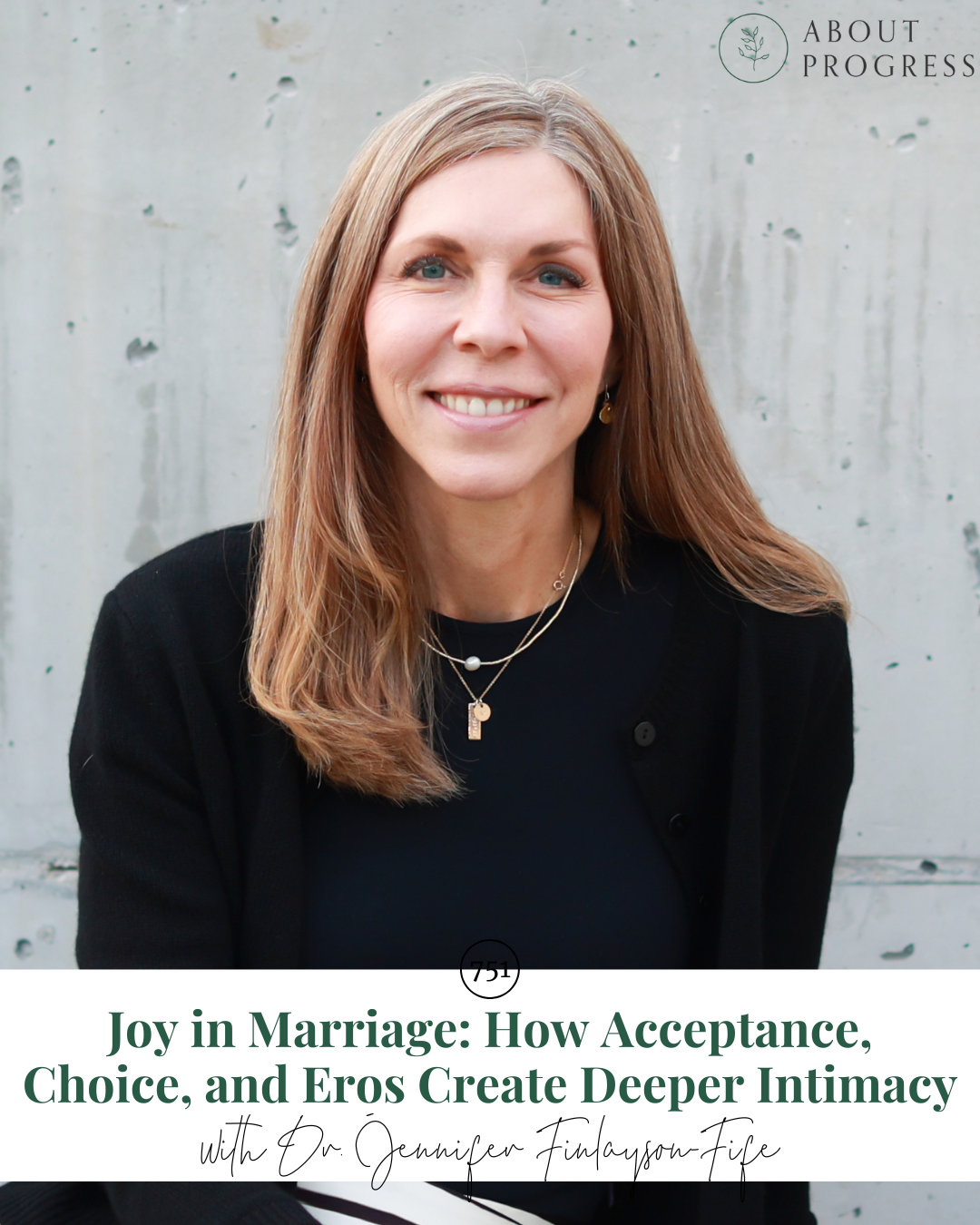
Joy in Marriage: How Acceptance, Choice, and Eros Create Deeper Intimacy || with Dr. Jennifer Finlayson-Fife
Jan 19, 2026
What if joy in marriage isn't about chasing happiness, but embracing courage? Dr. Jennifer Finlayson-Fife's enlightening perspective reshapes our understanding of joy—not as mere happiness but as a deeper, more embodied openness to love and goodness, even amidst life's challenges. This kind of joy is interwoven with eros love—an expansive, soul-reaching connection that pushes us beyond our comfort zones and into a realm of growth and self-discovery.
In my conversation with Dr. Finlayson-Fife, we explored how marriage becomes a fertile ground for joy—not by eliminating our differences but by choosing to love through them. By asking ourselves what we already know we need to do differently, we unlock the potential for profound personal growth and deeper marital intimacy, ultimately steering our relationships toward genuine joy.
Here to Stay Drive: join the Supporters Club to keep About Progress around + participate in a whole month of special prizes. A little from many makes this work sustainable!
Podcast Anni: (Still ongoing!) Celebrate 9 years of About Progress by submitting to our annual Favorite Things Giveaway! Simply leave a rating/review on Apple Podcasts. Favorite things + details on who won HERE.
1-on-1 COACHING ENROLLMENT OPEN NOW! BOOK A CURIOSITY CALL NOW to be considered for one of my limited spots for 1-on-1 coaching this Winter.
About a few other things...
Sign up for the Go Getter Newsletter to get Progress Pointers in your inbox every Wednesday.
You can listen to the episode below, on Apple Podcasts, or on your favorite podcast app. If you like the show please share it, subscribe, and leave a review!
SHOW NOTES
Access exclusive supporter benefits
Sign up for the next Sticky Habit Intensive
Book Launch Committee
Leave a rating and review for the podcast!
Lend your voice and experience + be featured on the show HERE
Join Monica on Facebook and Instagram
Songs Credit: Pleasant Pictures Music Club
Transform your space now. Go to https://www.quince.com/monica for free shipping on your order and 365-day returns; Get organized, refreshed, and back on track this new year for WAY less. Head to Wayfair.com right now to shop all things home; Join Masterclass for 15% off at masterclass.com/progress
TRANSCRIPT
Dr. Jennifer Finlayson-Fife: Joy is highly connected to love, loving and being loved. Eros love in particular, and Eros is the root of eroticism, Is not about sex per se.
Monica Packer: Mm-hmm.
Dr. Jennifer Finlayson-Fife: meaning of that word a sexuality that is life giving, It's yearning for another soul, right? It's not the hedonism of sex, it's the soul of the other person.
Hi, this is Monica Packer and you're listening to About progress where we are about progress. Make practical. Please excuse my voice. I'm just recovering from the flu, which I know is going around. While I was naturally an optimist as a kid, I definitely lost this part of me as I grew up.
I am much more of a realist now. I tend to see things as they are. I expect that life will be challenging and with that, so will work and marriage and parenting. To put it simply, I expect that nothing will come easily. And while I don't necessarily think that's a terrible outlook, the truth is, is that there's still this part of me that really wants to feel that joy is more possible, even amidst all the hard.
I think a lot of us similarly disqualify ourselves from experiencing joy because we equate joy with ease or happiness. But what if joy is actually something deeper, something more courageous and embodied and available even in the middle of strain, difficulty, and growth.
In today's conversation, I am joined with Dr. Jennifer Finlayson Fife, one of our most loved guests here on about progress, and we are talking about joy, what it really is. Why it often feels so far away and how marriage can actually be one of the most powerful places to develop joy. We explore the idea of creating an eros kind of love through intimacy and marriage.
Jennifer will define eros in the interview, but it's not just about sex. It's more about the life-giving desire that we can all embody to grow, to love with courage and to reach beyond self-protection.
We talk about why acceptance isn't the same as settling, how choice becomes the birthplace of agency and why intimacy, emotional, and sexual is less about technique and more about presence, delight, and self-respect. This conversation is honest, it's challenging, and it's deeply hopeful.
And it may go without saying, but I'm still gonna put it here. This discussion will still center around themes on sex, so keep your earbuds in if you don't want your kids listening in. If you have ever felt torn between accepting your marriage as is and wanting something more, more joyful. If you've ever felt afraid that choosing yourself might cost you connection, or if joy feels like a word that belongs to someone else's life and someone else's marriage, I think this episode will meet you right where you are.
Dr. Jennifer Finlayson Fife is an LDS relationship and sexuality coach with the PhD in counseling psychology. Her teaching and coaching focus on helping LDS individuals and couples create greater connection and passion in their emotional and sexual relationships. Dr. Finlayson Fife has created five empowering and highly reviewed online courses designed to give LDS individuals and couples the tools requisite.
To creating healthier lives and stronger intimate relationships. She's also the creator and host of Room for Two, A Popular Sex and Intimacy Coaching podcast. While Jennifer specializes in a community that is centered in the LDS faith, I know what you hear today will apply to anyone who grew up with religious ideology behind them, especially Christian.
That episode is coming up after a quick break for our sponsors.
Enrollment is currently open for just a short period of time for my private one-on-one progress coaching. What is progress coaching? It's one-on-one coaching designed to help you transform in your identity, habits and fulfillment and ways that are both deep and practical. Past clients of mine have seen major progress in rediscovering who they are outside of their roles, participating less in people pleasing, breaking cycles of all or nothing.
Perfectionism. Learning to better control, numbing out behaviors, managing their stress, clarifying their values, creating and holding to loving boundaries for themselves and so much more. Spots are extremely limited, and I plan to only open up coaching once this year. My spots always sell out as well. If you are curious about progress coaching with me, you can sign up for a curiosity call where we both arrive.
Curious to see if I'm the right coach for you and your needs. You need to sign up for that curiosity Call soon via the link in the show notes as my coaching enrollment will end at the end of January. So again, go to the show notes to book a curiosity call with me to potentially join as one of my few one-on-one coaching clients this winter.
Monica Packer: Dr. Jennifer Finlayson-Fife, welcome back to About Progress.
Dr. Jennifer Finlayson-Fife: Thanks for having me
Monica Packer: Our most popular guests by far,
and.
I am so grateful for your willingness to always come back here and to show up for this community.
And in large part, I know that's because you care so much about the type of women who listen and. We just, you know, have to bring that back to you because of all that you have changed for each of us individually. But today we get to talk about something you and I haven't really discussed on the show before.
And we've talked about a lot of things, and this is also the premise and even the thesis, I would say of your book that we might have joy. So we're
gonna start there. because I think this is a concept that when people hear the word joy, they automatically eliminate themselves from the conversation.
They think that's just unrealistic.
It's too out there. It's better to just accept. Life as is and as part of that marriage, as is. And we are gonna make that connection today. So let's start with your definition of joy So we can, even
set the groundwork of why it matters, which is also what we'll be discussing today.
Dr. Jennifer Finlayson-Fife: yeah. Well, I'll try hard to describe it, but I think it's a little bit challenging
Monica Packer: Yes.
Dr. Jennifer Finlayson-Fife: describe joy, but maybe let me start with what it isn't.
Monica Packer: Hmm.
Dr. Jennifer Finlayson-Fife: I don't think it's, know, happiness or freedom from suffering. I mean, happiness is a wonderful thing, but it's not just like no difficulty in our lives.
Monica Packer: Yeah.
Dr. Jennifer Finlayson-Fife: I think it's these moments that are very often embodied moments, like moments in that we experience through the body of a kind of surrender the beauty and goodness that we encounter in life.
It's, it's like something we can experience at a soul level. Of appreciation, gratitude, acknowledgement of the good, even in the face of difficulty or challenge. And I think there's a certain amount of surrender to it. Like, I think it takes some courage to, no joy to experience it because I think our egos the part of us that wants control, predictability.
Um, in some ways has a hard time letting go and allowing ourselves the vulnerability of joy.
Monica Packer: Hm.
Dr. Jennifer Finlayson-Fife: But I do think it's a, you know, that we might have joy as the book title and it comes from an LDS scripture that is God's purpose for us, is to have joy. Yet. I think sometimes as religious people, we tend to think more like life is about long suffering.
You know, life is about obeying the rules. Life is about not getting things wrong, you know, to your podcast about perfectionism. You know that Then, you know, if we overcome all our flaws, maybe then we'll deserve joy. But I think it's much more about. Developing the capacity to acknowledge and recognize beauty and love connection and to to it, to allow it to touch us.
Um, even though they may be moments that are fleeting and we can't hold onto it, you know, that loss may be connected to it even.
Monica Packer: Mm-hmm. It sounds like it transcends what is happening in our lives too, which I think is. Another factor that requires that courage piece that you shared and the capacity as well.
Um,
almost a grounded too, like it
transcends
and it grounds us at the same time, just based off of the way you've described it.
Dr. Jennifer Finlayson-Fife: Yeah.
Monica Packer: Um, so with that, I kind of wanna lean into why it's not fun necessarily.
Dr. Jennifer Finlayson-Fife: Hmm.
Monica Packer: It doesn't equate fun, but it's still worthy of pursuing.
Dr. Jennifer Finlayson-Fife: I mean, I think it comes down a little bit to what kind of world we believe in and what kind of God we believe in, you know, because of the arguments that I make in the book is that. To surrender to the beauty and goodness in life, right? Even, even amidst the loss and the long suffer and the suffering and so on, is to believe in a God that is good
Monica Packer: Hm.
Dr. Jennifer Finlayson-Fife: to believe in our own worthiness to, accept in some sense the fragility of life.
But still be able to not become cynical, to still be able to see the miraculous moments that exist every single day. And so it's a kind of a willingness to see, like, again, I think that the ego wants to be self justified. lesser part of us control. It doesn't, you know, it's very easy to. What I would say, it's very easy, for example, to be annoyed that your flight is late and that you had to sit on the tarmac for 10 extra minutes.
And believe me, I've thought all those things,
Monica Packer: Yeah.
Dr. Jennifer Finlayson-Fife: but, but rather than how miraculous and stunning it is that we can fly, you know, that we can get on a plane at all, right? To be annoyed that we have piles of laundry to do rather than be. Amazed and grateful that we don't have to go down to the creek and, and wash clothing there.
Do you know? and
Monica Packer: Yeah.
Dr. Jennifer Finlayson-Fife: an orientation to living and I think it's the, our human nature, you know, natural man use language is to be kind of entitled, you know, to be kind of either entitled or to think I deserve nothing. know, like, you know, I'm not really worthy of goodness, so I won't take it in somehow.
Distancing myself from it is safer or humble, but I think both of those are ego reactions actually. And separate us from the beauty that our souls need to cope in a world of pain and
Monica Packer: Mm-hmm.
It also seems so connected to the work that you do on identity, because when I hear you describe. What joy is and what kind of person is able to experience it. I think of a developed person, a mature person,
Dr. Jennifer Finlayson-Fife: Mm-hmm.
Monica Packer: And as with all good things, that requires some effort, so it seems like you're not born with the ability to hold duality, and that seems part of this joy construct that you're building for us. So how can someone work to make joy, not just a goal, but a right in their life?
Like What can they
actually do? Towards developing that as part of developing themselves?
Dr. Jennifer Finlayson-Fife: Well, I think, I think it is about development. Um, and I also think about disposition. So in some ways when you look at young children, most kids have just a penchant for joy, like.
Monica Packer: Hmm.
Dr. Jennifer Finlayson-Fife: They delight in the world so much, you know, they see a puppy in their face. It's just, you know, they just because it's new and if they're in a loving home, they aren't usually fearful and kind of ready for life to harm them.
And so they have a kind of trust, an instinctive trust in life and, and a kind of delight in. what they don't yet know about the world and being able to kind of experience it, you know, in a fresh way. And so in some ways, they teach us well about joy. Like a lot of times we take great joy in seeing our children's delight in the world, our young children's delight.
So I think that's true. And then, but what I think happens for many of, of us is that we start to confront disappointment. Struggle, disillusionment. Even with ourselves, with our capacity with other people, we come up against the harder things in life. You know, the parents try to protect their kids from some of that, but eventually we have to face a world that can be dark and challenging.
And I think our inclination then, or I guess what might be natural is to kind of retreat into either a kind of cynicism. Or a kind of self-protection like don't love with my whole heart because then I might be broken hearted or disappointed. And so I think that what the character or the courage is, and I think it's more connected to courage, really, is that I'm willing to not go become cynical, but to still seek.
Focus on the beauty and the good, even when there is difficulty,
Monica Packer: Mm-hmm.
Dr. Jennifer Finlayson-Fife: even when there is pain, even when there's almost a safety in cynicism or giving up, or not having faith in myself or in goodness God, you know? There's something that's pulling us forward in life, and this is what I talk about is Eros energy, asking us to expand, to reach beyond ourselves, to trust, to tolerate the process of reaching for something better.
But we have this competing pole that is to retreat, to
Monica Packer: Hmm.
Dr. Jennifer Finlayson-Fife: to demand that the world yields to us and and it's certainly an understandable feeling. Um, and some have more adversity to accommodate than others, but I think it can make us suffer more ultimately, even if it's an understandable response.
Monica Packer: I asked how right. How do we pursue it? And I think
if we were to put it in one word, based off of what you teach, it's marriage is a great way.
One of the best ways.
Dr. Jennifer Finlayson-Fife: One powerful way.
Monica Packer: Yes. One of the, and that's your specialty.
Dr. Jennifer Finlayson-Fife: Yes.
Monica Packer: So I'd like to connect what you brought up, that eros kind of love.
Dr. Jennifer Finlayson-Fife: Mm-hmm.
Monica Packer: What that has to do with joy And how, in working on our marriages and being in this endless pursuit of openness, acceptance
As part of,
that challenging our sense of selves.
Um, oh, I guess we could just keep going. I, like, I, I, the list is endless of how marriage demands of us. To hold duality to pursue something better in with the goal of being joy together. And as part of that, this eros kind of love.
Can you
connect those two things for us? Joy and
arrows?
Dr. Jennifer Finlayson-Fife: First of all, I would say Joy is highly connected to love, loving and being loved. So I'll start with that in a child's success, right?
Joy in loving and delighting in a dog. You know, I mean, right? There's, there's just loving, um, is connected to joy. Seeing beauty is connected to joy. Climbing a mountain and looking and just. The wonder of it all the, you know, the, the way that it touches our souls, right? so, so love is a powerful way, and I think Eros love, and I'll define that in a minute, is especially powerful.
Eros is according to Greek philosophy. And lots of philosophers like Plato and, and then psychologists like Carl Jung and so on have, have really, or see us Lewis, they've all grappled with this question of how to define or understand what Eros is.
So Eros is this desire to transcend ourselves,
Okay.
reach beyond ourselves, to reach for what is unknown to us, to reach for another soul. reach for divinity. Like Plato talked about it as like, not even in a sexual way, but like reaching for the highest part of ourselves towards the divine. And it is indeed that.
You know, the joy you feel like when you've done something outside of your comfort zone at the other side of it, you know, maybe you had fear, you know, I did paragliding this summer. I was, you know, just walking down to the,
Monica Packer: Oh, that seems so terrifying.
Dr. Jennifer Finlayson-Fife: I know.
Monica Packer: Yeah.
Dr. Jennifer Finlayson-Fife: You know, and then, but then when you actually do it, it's so joyful. Like, and when we landed on the other side, the amount of joy in the group that had done it, like, and just,
Monica Packer: hm.
Dr. Jennifer Finlayson-Fife: delight in having kind of experienced something that required transcending your fear. To do it. And, and so, you know, that's just one moment.
But so much of life is that like I did this hard thing. I grew, I, I achieved something, I did something, I accomplished, something I feel good about, and I have a deeper sense of joy in having done it. And so this is really connected to the self expansion, the kind of transcendence of our egos, the. The growing beyond the self we once knew, and both it expands us and we become more ourselves in the process of
Monica Packer: Hmm.
Dr. Jennifer Finlayson-Fife: right, because we're living true to our courage.
it's highly connected to courage. And so Eros love in particular, and Eros is the root of eroticism, right? Is not about sex per se. Like even though. of people will talk about erotic, and we think of commercialized and pornified versions of sex,
Monica Packer: Mm-hmm.
Dr. Jennifer Finlayson-Fife: meaning of that word a sexuality that is life giving, right?
That is, it's yearning for another soul, right? It's not the hedonism of sex, it's the soul of the other person.
Monica Packer: Hmm.
Dr. Jennifer Finlayson-Fife: And so if you think about when you first fell in love, you fell in love and you know, you were, you had that sense of attraction, right? Many people will feel like drawn to this other soul. They don't even really even know what it is about them.
They're just so intoxicating and compelling, and, and they're quite different than you, but you feel so understood by them, and you feel this sense. I can be myself with them and they take pleasure in who I am, even though, you know, I'm the extrovert and they're the introvert, or you know, you know, they're super organized.
I'm, I'm more spontaneous, whatever it is, but you have that sense of joy when you fell in love. Because there's a sense of communing with another soul and you feel it once both yourself, but also like a sense of hope and possibility and communion with another person at the same time. And so when we fall in love, we walk around usually like, just like full of joy, you know, and everybody can see it.
And um, and we all wish that that would just stay in place. Of course, it's a setup because. When introverts and extroverts start to create a life together, well then they start to be like, why don't you wanna go out more? Like, why don't you wanna have people over? You know, or the spontaneous person and the very planned person are driving each other crazy 'cause they have very different ideas about how the house should be.
And so you start realizing like, this person is not gonna make me happy. In fact, they're ruining my happiness.
Monica Packer: They're stealing my joy.
Dr. Jennifer Finlayson-Fife: They're stealing my joy, right? And, um, you know, I've been tricked. I've tricked
Monica Packer: Yeah. Yeah.
Dr. Jennifer Finlayson-Fife: and yet nothing's going wrong. And so when we're up against those invalidating differences, we tend to retreat into self-justification, defensiveness, fighting to get our way to win.
Monica Packer: The ego side that you were talking about earlier.
Dr. Jennifer Finlayson-Fife: rather than the Eros draw to this other soul that challenges you and delights you, right? And so I think in erotic love, have someone who both challenges you and to be in connection with also gives you pleasure, like a sense of wholeness that's greater than yourself. And if you have a lot of resentment because you resent all those differences so much.
Then it will kill Eros. Right. And you may say, I don't feel that attraction anymore. I don't feel that feeling about this person anymore often because it's the, the Eros love that started has been crushed under the weight of resentment and anger and, and attempts at control. But if we cannot yield to our self-justification, if we can allow the marriage to challenge us.
To help us grow, to learn how to love a person who does the world differently, to accept somebody who doesn't give us everything we desire, right? Which many of us think, wait, isn't that the point of marriage? You
Monica Packer: Hm.
Dr. Jennifer Finlayson-Fife: who gives you everything you want, and you know, and instead like, how? How do I be true to myself but also love this person who's never going to give me happiness?
Monica Packer: Yeah.
Dr. Jennifer Finlayson-Fife: never going to just gratify every desire I have. And so it asks us to move into a deeper capacity really love a person who's maddeningly different than us, but that also wakes us up to the world. And I think when you learn to really love another soul, you become capable of this love with knowledge, right?
You know them you can really accept them. And I think that. Um, it's very connected to a sense of joy that, you know, like there's always gonna be friction in an honest marriage, but also bliss, you know, friction in that, like that we are different, but it also opens us up, allows us to take deeper pleasure in one another
Monica Packer: Huh.
Dr. Jennifer Finlayson-Fife: the differences and in the ways that we are a couple.
And so I think that. The happiest people on the planet that just the research shows are happily married. And so it's not an easy thing to create. And one of the big problems with it is it takes two people. And so if you only have one person who's willing to look at themselves and to deal with their lesser selves, you know, it can be a real source of heartbreak, a marriage.
You know, I sometimes hesitate to talk about it in such ideal terms because there's many good people who aren't able to create it because they can't single handedly create that kind of relationship. And yet it's also possible if we will surrender to marriage in a way. And you have two people who are willing to do that, to look honestly at themselves, to grow.
You know, for, I'll just give an example of it, but like when I, when I first, um. When my dad was very introverted, and so when John, and so when I would talk to my sisters about who I was gonna marry someday, I was like an extrovert. And he, you know, just will tell me what he likes about me and he, he'll just, you know, and we can just talk so easily.
Okay. Well, I met people like that and that just, they just weren't, I liked them, I liked having conversations about things, but they didn't sort of grab me at a soul level. Then I met my now husband, you know, and I remember like, just on a visceral level, really drew me towards him. And, um, like if somebody had come to me and said, you're gonna marry this person, I would've been like, I believe that.
Okay. Like,
Monica Packer: Yeah.
Dr. Jennifer Finlayson-Fife: just some, and he was very quiet,
Monica Packer: Mm-hmm.
Dr. Jennifer Finlayson-Fife: very introverted.
Monica Packer: Yeah. Curve ball.
Dr. Jennifer Finlayson-Fife: he made my dad look like an extrovert. Okay. You know what I mean? So. Okay. Well, so there was, you know, when I felt fell in love with him at for, it felt very expanding and, and hopeful and all those good things.
But you know, a year into marriage, I'm like, why don't you tell me what you love about me? Why don't you say what, why
Monica Packer: Yeah.
Dr. Jennifer Finlayson-Fife: about me? And you know, I'm trying to pressure him to be what is going to reinforce me.
Monica Packer: Hmm.
Dr. Jennifer Finlayson-Fife: you know, it took me a few years, but I started realizing like I need to be less. Demanding and insecure.
Monica Packer: Yeah.
Dr. Jennifer Finlayson-Fife: can tell he loves me through his behavior. He never was that person. why am I asking him to be someone? He isn't right? And so to accept him more was to love him. Now, if he truly didn't love me, there would be a problem to deal with. But the thing is that wasn't it. I just wanted reassurance
Monica Packer: Yeah.
Dr. Jennifer Finlayson-Fife: really.
And I needed to grow into a person that could just hold onto the truth. Of who he was in my life. It was also true that John knew that about me, and he cared about that fact. And so even though that wasn't his family's style, it was not his style. on his own would make efforts to do that, right? And so that to me is like, that's how you choose across the differences.
You free each other up to care about the one that's different than you, but it comes out of choice, not coercion. comes out of courage, not
Monica Packer: Hmm.
Dr. Jennifer Finlayson-Fife: And so when you can see that those are moments of joy when you know the person did that thing, just because they care about you, not because they should, not because it's the right way to be in a relationship, you know, not because of any of those things, but like to see someone be uncomfortable for your benefit is truly, you know, is to know joy.
It is.
if You owned a business, would you sign up for continuing education to support it? What if you were or are a teacher, a beauty technician, a doctor, a photographer, a tend hygienist, or anything else? The answer is, of course, you would sign up for continuing ed because that is what all good professionals do.
So if you would answer yes when it comes to investing in a job, then why are you any different?
That's where the More For Moms course comes in. This is my More For Moms conference turned into A self-paced course made up of 25 world-class speakers who will educate you on how to be you again, in ways that are deep and practical from making sense on why you lost yourself to good intentions in the first place, to helping you explore what it would look like if you were on your own list to tactile ways to improve your everyday, from dinner, to style, to hobbies, to fun.
The More for Mom's course has it all. And now add a discount. I have slashed the price by $20, and you also get an additional $20 off as a listener of this podcast. With the code listener at checkout. When you sign up, everything for the More for Moms Conference becomes a self-paced course. You get access to all conference material from video to transcripts to audio so you can catch up or revisit all speaker sessions for years to come. And my favorite part is a More for Moms conference audio.
It's a private ad free podcast feed with all 25 speaker sessions so you can listen on the go, which is my preferred medium. Again, we just slashed the price by $20 and you can sign up for an additional $20 off with the code [email protected] slash more For moms.
It's time you invest in continuing education for you because you are a person too. Again, sign up at about progress.com/more for moms using the $20 off code listener at checkout.
Monica Packer: As we've been speaking, I've been thinking about this couple friend we had for a long time, and they seemed like the perfect match, you know, and in many ways they were. But they told us once how they had the saying between, the two of them, and the saying was, you knew who I was.
Dr. Jennifer Finlayson-Fife: Mm-hmm.
Monica Packer: they would say that to the other whatever would had this moment of like, why are you this way?
Dr. Jennifer Finlayson-Fife: Yeah. What's wrong with
Monica Packer: Yeah. What's wrong with you? And it was kind of a reminder like,
There was a point where this is what drew us together, and you did know this
about me and and it was
appealing to you and now it's
conflicting. So you you just brought up, I think the main way to get through that with, which is choosing.
Dr. Jennifer Finlayson-Fife: That's right.
Monica Packer: Uh,
so I, I'd like to lean into that some
more because as you said, two people have to choose.
Dr. Jennifer Finlayson-Fife: Yes, that's right.
Monica Packer: I feel like we could talk a whole hour on what someone should do if the other person isn't choosing. But let's table that for a moment, and let's start with two people who are not feeling joyful in their marriage,
Dr. Jennifer Finlayson-Fife: yes,
Monica Packer: and they're at this crossroads of this paradox of accepting
Each other.
while also wanting things to be better in their marriage. How does choice interplay with making both of those things possible?
Dr. Jennifer Finlayson-Fife: Well, so there, there, this is paradoxical what I'm about to say
Monica Packer: Hmm.
Dr. Jennifer Finlayson-Fife: is, and that is to say that I can't, and I never will control the other person. I, I'm never going to get them to love me or
Monica Packer: That's what you have to.
choose, you're
saying.
Dr. Jennifer Finlayson-Fife: I need to like accept that
Monica Packer: Hmm.
Dr. Jennifer Finlayson-Fife: outta the gate. Now that doesn't mean that they won't evolve or change or in response to something I may do, choose differently, that's still on them.
, At the point that you give up, trying to change, the other person becomes the birthplace of choice
Monica Packer: Okay.
Dr. Jennifer Finlayson-Fife: there's a certain amount of surrender into what is in life.
Monica Packer: Hmm.
Dr. Jennifer Finlayson-Fife: Now it's like, who am I gonna be in this? That's where we move. You know, in the book I talk about three stages of development.
The first stage is about learning, more impulse control, being able to handle our impulses. And the second stage, it's a lot more about wanting validation from others. And we need this in the beginning, right? We
Monica Packer: Hmm.
Dr. Jennifer Finlayson-Fife: to know from others something about who we are.
But where we really grow into the capacity to love another person and to be capable of intimacy and to be able to forge a soul more capable of joy a fallen world hinges on choice. It hinges on self authoring, and it is on this question of who am I gonna be in this situation? In this moment that I'm not getting the validation I want, I'm not getting from my spouse the thing I want, I can't control that.
I can control who I'm gonna be in this interaction I need to be somebody that I can respect. what does that ask of me? What does the marriage ask of me? Uh, who do I need to be to live up to my own expectations of the kind of marriage partner? Or person I would be,
Monica Packer: Hmm.
Dr. Jennifer Finlayson-Fife: not to betray myself, to live up to what I expect of myself.
And because we so easily fixate on the things the other's not doing, we have a hard time keeping our focus on that executing on that. Um, but that is where you, know, just going back to the story I told where it was like, this, this is the person I married and like it was pushing myself.
Against who I was being that I was sort of in the name of love, justifying, pressuring him to do what would kind of alleviate something in me, but in a way not know him, not see him not recognize the many good things he does, and instead like try to get him to fit into some sense of control, that I wanted to reinforce my ego rather than seeing him as he is.
So I think for me, like I was myself because I wanted to be a better partner, a better friend, a more mature woman. I wanted to like not be so needy. And so it was like, I choose
Monica Packer: Hmm.
Dr. Jennifer Finlayson-Fife: to love this person better, to be strong enough to accept him as he is now. I'm not accepting, it's not like I'm taking crumbs.
I, I knew that he loved me. Just that he operated in the world in a different way than I do. Thank goodness. I would be so bored with somebody like me. I would really find them quite certainly, I wouldn't be attracted to them,
Monica Packer: Hmm.
Dr. Jennifer Finlayson-Fife: meaning 'cause of the difference issue.
Monica Packer: Yes.
Dr. Jennifer Finlayson-Fife: that, you know, it's like stop, stop asking him to be someone he's not and love him.
And so when it's based in choice, like it actually gives you a deeper sense of self-respect and deeper. Happiness in the relationship. 'cause you stop trying to control something you can't and you start embracing the good that's already in front of you.
Monica Packer: Do you think in living that out? That's what then. Creates this feeling of safety, I think, within the marriage partnership
so that the other person can choose too.
Dr. Jennifer Finlayson-Fife: Yeah, definitely. And, you know, I think that, um, safety is in the commitment. You know, that, you know, my goal was not to make my husband feel safe or anything like that,
Monica Packer: Hmm.
Dr. Jennifer Finlayson-Fife: but the safety is, there is safety in marriage, which, you know, it comes from the recognition that you have two people who are bringing their whole selves, you know, that, that really are invested imperfectly.
being indulgent and, and bringing our lesser selves, but are not ambivalent about whether or not this is where, they're invested. Right. And, you know, couples that are happy, it doesn't mean that they don't struggle or they don't fight
Monica Packer: Yeah.
Dr. Jennifer Finlayson-Fife: they don't have conflict. I think any honest couple is gonna have differences, which is different than contempt.
It's different than hostility. Couples that are happy, and this is John Gottman has demonstrated this in his research over and over again. It's not that they're a devoid of conflict, but there is this sense that we're here for it. We're not going anywhere. There's not contempt
Monica Packer: Yeah.
Dr. Jennifer Finlayson-Fife: You don't have to worry whether or not we're still a couple at the end of this.
Right. That's the container that actually allows something new to grow in the marriage, new level of capacity. And it doesn't mean that you don't still find some of those differences difficult, even at your 50th anniversary, I think you do, you're also have become more refined and you are really a couple in that process.
Monica Packer: You're more at one like you.
You're
more of that, huh?
Oh, yeah.
Dr. Jennifer Finlayson-Fife: you truly have a friend that's joined you on this journey and there's a lot of beauty in that you know of, of having forged a marriage
Monica Packer: I think the challenge is to not equate acceptance with apathy and with
people, since we have been set up in such a certainty bound all or nothing, black and white world,
I think a lot of people will hear the challenge to accept the partner as also. That means you don't push them or bring up things that are hard or
challenge them Well, and and I would say that's.
what you teach though about with Eros love.
It's, it is in the challenging. It, it's both that the acceptance and in the challenging that we develop ourselves individually and, but we also develop as a marriage unit too. Like
we go through those same, same three stages that you teach.
Dr. Jennifer Finlayson-Fife: So like the who am I gonna be is a big question. mean is it's not apathy. So it's like I have to just accept as a given, you know, like there's an aa adage that I botch every time, but it's, it's something about recognizing what you can't change and what you can, and being clear about it and having the courage to deal with what you can.
Okay. That is an, well, it's not that easy of an adage to say, because I
Monica Packer: Yeah.
Dr. Jennifer Finlayson-Fife: it, but, but it's, it's hard to live it. It's very hard to live it. Again, the ego sees the flaws in others and wants the, the, the fantasy. Then I can make them change. And yet we never can. And the only thing we actually have, but it's a big deal, is who am I gonna be in this?
' cause let's say you, let's say you have a spouse who drinks too much, accepting that they drink that they drink regularly, and problematically is actually a big deal to accept that. Because a lot of people that are partnered with somebody with a chronic substance abuse problem are often telling themselves a story that if they hide the alcohol or if they pressure them or punish them or something, that they'll eventually change.
And all of that's wrong, that the behavior doesn't bear that out. And so sometimes to just come to terms with what is actually. Pressures the change. You know, I was working with a woman who was in a, a pretty manipulative, abusive relationship, psychologically abusive, and I was naming that for her, and she just was saying, I just don't think, you know, I don't, I don't think I'm really, I, can't remember what she was saying, but she was kind of making excuses for it.
This was quite a while ago, and I just remember saying to her, it just sounds like you're not ready. To do something on behalf of your wellbeing. You're not ready to do that yet. And there was something about me just naming what is that she would kept going along with this, that she kept staying in a relationship that she knew was bad for her.
And when she came back the next week, they weren't married, but when she came back the next week, she said, you know, I ended the relationship. I just could, I could not live with the fact that I keep. in a relationship that is undermining me to the degree that this one has. And my point is, is that wasn't, in trying to convince her, it was more in naming for her what she was doing and just saying, it sounds like you're not ready to do different.
And I wasn't even telling her she should.
Monica Packer: Mm-hmm.
Dr. Jennifer Finlayson-Fife: sounded like she wasn't, and that for her was enough to sort of see and say, I, I have to do something different for me. Accepting is actually kind of powerful because then we're living in the truth and when we're living in the truth, that's usually the birthplace of our agency.
Monica Packer: Hmm.
Dr. Jennifer Finlayson-Fife: this is what is, who am I gonna be in the face of this? It's usually our self-deception that keeps us doing the same thing over and over while telling ourselves it's gonna produce something different.
Monica Packer: You have a great example of this paradox in your book. There was a couple, I don't remember what names you used for them in the book,
um, but there
was this couple,
I, I'm sure you, you can think of Brett, who I'm gonna say. I'll
just do a quick. Summary of their story. There was a couple where it was, it was the man's second marriage.
His wife was, uh, his first wife died.
Um, they got married at first, very attracted to each other. But the, essentially the, the labor of being a caretaker in many ways. Leached the, um, joy and and passion for her, and She was no longer interested
in sex at all. And you got
to this crossroads with them where the man had to accept that
his wife was not interested
Dr. Jennifer Finlayson-Fife: In an intimate
Monica Packer: In an intimate relationship. And he
accepted that, but also changed his behavior in terms of he made choices
and his choice was, he presented that to her like, I am accepting. You are not interested in intimacy, and I've accepted that
And we,
I, I plan to stay committed to you until the children are old. But I don't think our marriage will be
Dr. Jennifer Finlayson-Fife: yes,
Monica Packer: good marriage or also we may not stay married for the long term. And, and, and so I think that paints the perfect picture of, there's still acceptance, but it doesn't mean apathy that gave her an opportunity to actually
choose for
reals.
Dr. Jennifer Finlayson-Fife: That's right. Yes,
Monica Packer: Two.
Dr. Jennifer Finlayson-Fife: it's the Katie and Eric are their
Monica Packer: Oh yeah, Mm-hmm.
Dr. Jennifer Finlayson-Fife: And um, and Eric was not trying to manipulate her,
Monica Packer: No.
Dr. Jennifer Finlayson-Fife: he was really coming to a self-determined place. I keep imagining if we go to Jennifer enough, eventually Katie will want this something will click, you
Monica Packer: Mm-hmm.
Dr. Jennifer Finlayson-Fife: for her kick in and it just wasn't I think she was Ambivalently doing the exercises because more she wanted to prove she was trying. she wanted something more exposed and
Monica Packer: She wanted to check off the boxes
of
being like a good wife, I think, and
also being performative
for the therapist in some ways. Yeah,
Dr. Jennifer Finlayson-Fife: wanted him to see her that way.
Monica Packer: Mm.
Dr. Jennifer Finlayson-Fife: and he finally just said, look, I, I keep trying to get you to want something that you don't want, at least not enough.
And maybe I need to take your no as an answer and let this be, and I'm here for raising the kids, but, but maybe when they're older, I'll make a different decision. gonna stop trying to get you to want this to be an intimate marriage. And I really did think at the time because she'd come in saying, I hate sex.
If I
Monica Packer: Mm. Mm-hmm.
Dr. Jennifer Finlayson-Fife: And I think that was all true. I think that she did feel that way. I think she felt taken from, in a way, I think she, not that he was a taker, but I think she just felt like, I can't be myself here. um, but that she was. Stunned and like she didn't actually want that.
She didn't want the removal of his attention and his focus on her, but it meant it asked something more of her. And so then in accepting his acceptance,
Monica Packer: Yeah.
Dr. Jennifer Finlayson-Fife: seeing that he was going to self-define in the face of his difficult situation, it actually opened her up to then self define more deeply.
And you know, I think she was facing that. She could see herself more clearly. She could see her martyr, inclination that she had learned from her own family and saw that she didn't want this at all. She actually wanted something different. And so when she started to bring herself to the question of their intimate relationship, they were able to create something much more soul satisfying, much more real, more intimate.
Than when she was in a resistance at the same time that she was trying or going through the exercises.
If You haven't heard,
I spent all of 2025 writing a book. and I'm so proud to say that my first draft of the manuscript has officially been submitted. There is so much work to come and the book is set to release in the fall of 2026. However, we have a new title, And with that, a way for you to get first access to what that new title is, as well as the first peak at the cover and to get exclusive behind the scenes virtual online events, celebrating its launch to act as , grassroots publicity, and to potentially be an advanced reader as well.
To get access to all of that, you simply need to be part of the free book launch committee. You can sign up at about progress.com/book committee. I've been sending out newsletters with updates. And some juicy behind the scenes, such as lately. The good news I got and the bad news I got, which is now turning into not so bad news.
And actually I think it's gonna be great news in the long run, and I'd love for you to take part again to get access to the newsletter and everything else I just shared. Go to about progress.com/book committee
Monica Packer: This, I think all brings it back to the dilemma we are in as humans and more so, especially if we are married, this choice, we have to pursue to pursue happiness or joy because I think happiness is, seems more, seems like there's less friction to just be happy or to find. That
kind of happiness in the way that it seems more achievable and
joy is harder
to come by.
And it does involve so much contradiction like we just shared. It involves being challenged and development, um, self. Self Confronting, and All these things.
that you've shared. Courage especially. But that story also is one I loved because of what was on the other side was joy for both of
them Individually. and within their marriage, and also with an intimacy too.
Um, the embodiment piece is something you said right away that joy is embodied. I think we need to connect this back to sex because of course that's what your work is. But I'm always struck by how. In your work. It's not like, let me give you the Cosmopolitan magazine tactics. Like here's the top three positions
or things you need to be doing in order to have joy.
It. It's actually so much more. I Think it's always
about the relationship. I mean,
maybe you could quantify and be like, I talk about method like 3% of the time
and 97%. it's about
this this, it's
about this stuff. So
How does it connect?
then to the sexual relationship?
Dr. Jennifer Finlayson-Fife: Well, I think that, okay, so.
Monica Packer: And this will take
another hour.
I acknowledge,
and I'm like putting this in at the
end, but like we can't
leave this. without making that connection.
Dr. Jennifer Finlayson-Fife: important. I agree. I mean, I think first of all, the, one of the things that's at the core of good sex is about enjoying your partner, taking pleasure in your partner.
It's not about serving their needs, it's not even about pleasuring them. It's about delighting in the existence of your partner that's at the core of good sex. Like,
Monica Packer: Hm.
Dr. Jennifer Finlayson-Fife: like you, glad you're here. You are my person. And so I like to be close to you. I wanna be close to you. And that's the energy that's at the core of it.
And it's just like, because you exist, I take pleasure in you. Right?
Monica Packer: Hmm.
Dr. Jennifer Finlayson-Fife: think that's the feeling that we want in intimate love. I think we long to feel accepted as we are, loved as we are, to think that our existence could give another person pleasure.
And that takes a certain capacity to see, like you can't take pleasure in another person's existence if you're busy resenting them for not being what you want. If you can't take pleasure in their existence, if you're too busy thinking about what your needs are, to just another soul. And when you can really value another soul, you can take great pleasure in just their presence, in your life, flaws and all.
And so to be capable of that and to express that through the body that I can bring my full self here, right? Remember, that's how we started out. body is our mother tongue. It's the first language we spoke. It's the way we knew we were loved and accepted. And so we, you know, eventually our parents start saying, we have to put clothes on and we can't, you know, we gotta make sure we take our hands out of our pants.
And you can't, you know, there's all these rules, like you have to, you have to conform to, and that matters. It matters for learning how to inhibit yourself. It matters for learning capacities. But I think we continue along for that feeling of meeting somebody. Who will delight in us as we are, and that just requires that we grow in our capacity to love.
But it's ultimately what we still want. And when we experience that in love in marriage, to feel, can be myself here with you, you can accept me. We have peace in each other's arms. It's less about the specific pleasures of sex and more about the ability to feel that you're at home with one another, that you can be yourselves with each other, that you can bring your full self there.
Sexuality and all your full body. That's what we want, and we're afraid of it, but our souls really yearn for it. Mm,
Monica Packer: And I think, uh, it, it, it brings back that choice element too. It's a choice to
accept on both sides
to to accept, um, gosh, let me remake, there was something about, oh. You choose to love with knowledge, like full knowledge, And that's a special
level of love, I think,
Dr. Jennifer Finlayson-Fife: Oh, it, it a hundred
Monica Packer: and earned.
Dr. Jennifer Finlayson-Fife: Yes, it is. It takes a lot of, you know, that I can really know. You not look away and still say, I love you,
Monica Packer: Hmm.
Dr. Jennifer Finlayson-Fife: you're my person. That's a big deal to create that. But it does take courage, and it's also a gift to be partnered with somebody who's willing to do that with you.
It's a gift to give another, to be that kind of person, you know? That's what I say to my kids. It's the number one thing in a good marriage is two people that will face themselves honestly and bring their best to each other. That's a big deal. Mm-hmm.
Monica Packer: that's how I wanna teach about marriage from now
on. That's
beautifully said.
Speaking of gifts, your book that we might have joy. It truly is a gift. I've read a lot of books and I've talked to a lot of people, and you've been here plenty of times, and I have to tell you, this book truly is a masterpiece.
And for anyone who is listening to this and kind of thinking of the disqualifiers that they have in their lives, or the resistance or the fear. Read the book, um, because I think that's where you're going to be able to get more guidance and also more introspection, like a guided introspection of great questions with each chapter to work through those things.
I did wanna know what surprised you personally about this whole book writing, book release process. I'm sure there are countless things, but what surprised you?
Dr. Jennifer Finlayson-Fife: I think Hmm. How long it took.
Monica Packer: Yeah.
Dr. Jennifer Finlayson-Fife: besides that, um, took a while, but I think it was, it was, I'm glad I took the time that I did for it, um, because it was a question I really cared about, like what is the relationship between sexuality and spirituality or between sex and the soul.
And so it was for me, very much about really trying to articulate and figure it out through the work I do with couples and through what I've seen in my own life and so on and, and like, how are these two things connected to each other? I think maybe the piece that surprised me the most would be found in chapter nine, um, where I wrote a lot about the body as an instrument of perception. think really thinking about the body is really fundamental to our spirituality, and I think because. Many who've grown up in a Christian tradition can think of the body as an impediment to spirituality,
Monica Packer: Hmm.
Dr. Jennifer Finlayson-Fife: right? That the body and its impulses and its feelings and the sexuality is actually getting in the way of the more lofty side of us.
And of course that can be true, like if we live indulgently, that that will work against our spiritual peace. The body is actually the way we know the deepest wisdom. It's through our senses. It's through, what we can't actually express with words, but that we can feel soul to soul. And I, I think, you know, on some level, I knew this, but I think really thinking about it and starting to write about it and to think about my experiences that have been the most.
Powerful for me are so much in the mapping that happens through the body, through sensation, through the kind of wisdom and understanding that , that the body allows us to access. And so it made me better appreciate the power of intimate love. You know, sex can be deeply damaging because of how powerful the communication of the body is.
But also loving connection. Loving sexuality can be deeply transformative in the positive sense that it can really anchor us into a deeper, um, a, a deeper grounding in the marriage. Like it's an inspiration for the marriage. I've referenced it as the sacrament of a marriage. I'm not the first one to say that, that's for sure.
But, but like that, it's so a place we can go as a couple to kind of find one another again, to feel reassured. To find a kind of liminality together, like a sense of this deeper connection through the body then go and, and do the day-to-day work. But it's a way of kind of finding the transcendent, the spiritual, and I don't mean the mind blowing sex transcendent, I mean just that sense of being cared about and known.
And I think that, our souls long for it. And so our, our efforts to try and create more ability to be at peace with one another, at peace in each other's arms well worth our trouble because we forge a place of, of deeper peace where we can be together.
Monica Packer: I loved that chapter too, and I'm gonna have to reread that.
Uh, I think that's the, that's like the next challenge in many ways, I think for us is to, to get to that place. Um, and that couple did too in the story. I think
that's what they got to. It
wasn't Even about
pleasure, it was about acceptance and delight and presence,
you know? That's what made them transcendent.
Um, we'll make sure we link to that. We might have joy for them. Um, where else should they go if they wanna connect with you, learn more from you.
Dr. Jennifer Finlayson-Fife: My website is probably the best place. My last name, finlayson fife.com. And there's free resources there. There's five, six online courses. There's a podcast where I work with couples around psychological and sexual intimacy in a marriage. Um, yeah, and we have a new course that's coming out, um, I think next week called Sex Worth Wanting.
It's a good companion to the book and where I'm really helping couples to understand what's the essence of desirable sex for men and women. Right? What is the quality of it? happening between the couple, and how do you create that?
Monica Packer: Amazing. Okay, well that will have been out to them by the time this
airs, so we'll make sure they go to the site for that. Jennifer, you know, we always end with the worst question, but a necessary question and it's just so people can take action on what they learned. So what is one small way they can do that?
Like one doable, practical way they can take action.
Dr. Jennifer Finlayson-Fife: This is what I would ask myself is, what do I already know that I need to do better in this relationship? Right? So if you're married, you know is it that I already know is a place I indulge, that I bring my lesser self, and it's a part of me that I. That my spouse doesn't like. Okay. But I also know I don't respect it either, if I'm completely honest, even if
Monica Packer: Yeah,
Dr. Jennifer Finlayson-Fife: 25 ways to justify it, that I don't respect it and then go do differently.
Doing it differently is what changes. It's, it can be hard. I mean, like I teach this stuff and there's just moments where I'm like, I don't, I don't wanna do better.
Monica Packer: I don't wanna answer that question.
Dr. Jennifer Finlayson-Fife: But it's crazy how much we resist it, because when I do push myself, you get you, you live a better life.
On the other side, you have a spouse that's more open, a spouse that's more grateful, a spouse that's more willing. take responsibility or because you've actually brought better to the moment. so it doesn't always produce a change. I don't mean that, but I, I just think at a minimum you feel deeper peace with yourself and that's worth a lot.
Monica Packer: Well, every part of this has been so refining and also hope giving. I would say. We need a whole lot right
now. I think we all need a lot more hope, and to have that within our most important relationship is a great place to start. So, Dr.
Jennifer, Finlayson-Fife, I thank you again for being here and we hope to see you again soon and best of wishes on your book and, and how it's, being received.
Dr. Jennifer Finlayson-Fife: Thank you so much, Monica.
Monica Packer: I hate the endings.
I hope this episode gave you the hug and kick in the pants you need to grow. I'll now share the progress pointers. These are the notes I took so you don't have to, and those in my newsletter will get them in an expanded version and a graphic form in my weekly newsletter. You can sign up at about progress.com/newsletter, and if you're hearing this well after when we aired it, just email me after you sign up for the newsletter and I'll email you back with the graphic.
Number one, joy is not happiness. It's a courageous, embodied openness to love and goodness, even amidst difficulty. Number two, eros. Love isn't about sex. It's about self expansion, desire, and reaching beyond your ego. Number three, marriage creates joy, not by eliminating differences, but by choosing love across them.
Number four, acceptance is not apathy. It's the starting point of agency. And number five, the most powerful change begins with one honest answer. What do I already know I need to do differently? And that's your do Something challenge this week is to ask that question, what do I already know I need to do differently and take one step to do that thing.
Remember, the expanded version of those progress pointers are available in graphic form by setting up for the [email protected] slash newsletter. I also wanted to give you a quick recommendation. I recorded a fabulous episode with Dr.
Tanit Setti years ago on Joy, and it's one of the most impactful episodes I personally come back to over and over again. She Wrote a fantastic book called Joy is My Justice, so I will link to that episode in the show notes. I think it would be a great companion episode to what you heard today.
And as always, I wanna thank Dr. Jennifer Finlayson Fife. Jennifer's always so generous with our community and shows up here every single time I ask, and that does not go without great appreciation on my part. This podcast is listener supported. Members of the Supporters Club make my work with about progress free and available to all.
And they also get access to three levels of exclusive benefits for more time to more content with me, including my private premium, ad free podcast, more personal, where I lean into the personal side of personal development. It is always so fun to release that weekly episode and if you like about progress and you wish you had more of it in your earbuds every single week.
Sign up as a bestie or ride or die level of the Supporters Club. You can always support the show for free this year. The best way you can do that is by leaving a reading and review on Apple Podcasts. We are celebrating 10 years this fall, and I always host a favorite things giveaway around that time.
And when you leave a rating and review on Apple Podcasts, you automatically get submitted to that giveaway. So do that now on Apple Podcasts. And second, most important way to support the show is by sharing it with a friend.
So pass this episode on to someone who you know, needs to hear it. Thank you so much for listening. Now go and do something with what you learned today.
Dr. Jennifer Finlayson-Fife: You know, like the AA adage, I never get this right, but please help me to accept the things I
Monica Packer: I can change. Yeah. And the courage to know the difference
is that it? The, the something, the courage to do both of us have not been
at AA meetings. I think it's the wisdom.
Do you wanna say it again?
Dr. Jennifer Finlayson-Fife: You wanna see it again. Yeah, exactly. So it's like a, please help me to have the, um,
Monica Packer: Like, should I Google it?
Dr. Jennifer Finlayson-Fife: the things I cannot change.
Monica Packer: I think that's
it.
Dr. Jennifer Finlayson-Fife: gosh.
Okay. Anyway. And the something to. I really need to reread it. Okay. But, you know. Okay.
Monica Packer: I'll take it all out. It's okay.
Dr. Jennifer Finlayson-Fife: Okay. I'll just say it again. So