
The Practice of Attention: How to Stop Scrolling in a Distracted World || with Cody Cook-Parrott
Mar 09, 2026
In today's fast-paced world, finding focus can often feel like an impossible feat. Cody Cook-Parrott shared that when our attention is scattered due to overstimulation and technology addiction, we unintentionally lose a part of ourselves. Addressing this requires us to step away from shame, gently asking what we might be avoiding, and experimenting with practices that reclaim our attention through small, intentional changes.
Through Cody's insights, we learn that being present starts with small actions—whether it's logging out of social media, turning off your phone for a few hours, or taking conscious walks. Such practices help center us, improve our health, and revitalize our ability to show up in our lives. As I work towards intentional living, I invite everyone to explore these practices and experience the profound benefits of being fully embodied and present.
Book Launch Committee aboutprogress.com/bookcommittee
About a few other things...
Sign up for the Go Getter Newsletter to get Progress Pointers in your inbox every Wednesday.
You can listen to the episode below, on Apple Podcasts, or on your favorite podcast app. If you like the show please share it, subscribe, and leave a review!
SHOW NOTES
Cody's website, books
Access exclusive supporter benefits
Sign up for the next Sticky Habit Intensive
Book Launch Committee
Leave a rating and review for the podcast!
Lend your voice and experience + be featured on the show HERE
Join Monica on Facebook and Instagram
Songs Credit: Pleasant Pictures Music Club
Transform your space now. Go to https://www.quince.com/monica for free shipping on your order and 365-day returns; Get organized, refreshed, and back on track this new year for WAY less. Head to Wayfair.com right now to shop all things home; Join Masterclass for 15% off at masterclass.com/progress
TRANSCRIPT
Cody Cook-Parrott: The word I use a lot for our attention is fractured. And when our attention is fractured, we're losing that energetic sovereignty, that feeling of independence.
Monica Packer: Hi, this is Monica Packer and you're listening to about progress where we are about progress made practical. Have you ever picked up your phone for just a second and then suddenly 20 minutes are gone? If you're anything like me, a busy woman juggling a lot of responsibilities, your attention can feel completely fractured.
Not because you're lazy or undisciplined, but because you're overwhelmed, overstimulated, and honestly just trying to cope. It doesn't help that. One of our most common coping mechanisms our phones are literally designed to distract. So what do you do when your life is less about being present and paying attention, and more about being scattered and scrolling?
Today's conversation goes far beyond productivity hacks or unrealistic platitudes, like just use less screen time. Instead, we're talking about something much deeper, how our distraction heavy world is affecting our sense of agency, our embodiment, and even our health, and what we can gently do about it.
My guest, Cody Cook-Parrott calls attention to practice something we can experiment with, reclaim and rebuild without shame. In this episode, you will learn how to start doing that in very small, doable ways.
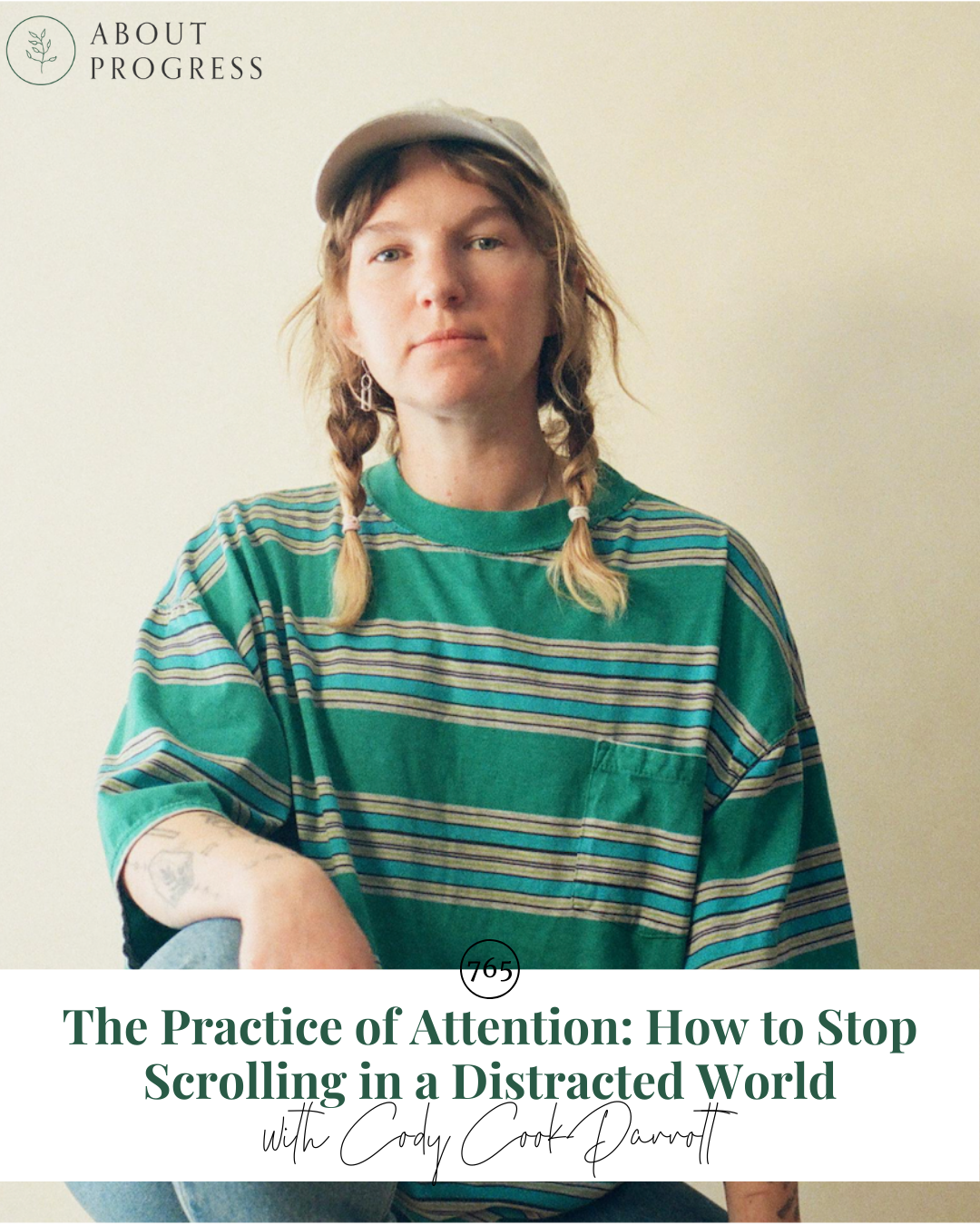
We will explore how to reclaim your attention through practice, compassion and small experiments, and how doing so can change your health, your relationships, and your ability to truly show up fully to your life. Cody Cook-Parrottt is a writer and artist living on the Leia Peninsula in northern Michigan, they teach classes about writing, quilting and creative practice. They author the weekly newsletter Monday Monday, and are the host of Common Shapes Podcast. Cody is the author of the books, how to Not Always Be Working and Getting To Center. Their work has been featured in the New York Times Vanity Fair Dance Magazine and the Huffington Post.
That interview was coming up after a quick break for our sponsors.
.
Monica Packer: Do you want your life to look and feel like yours? Maybe you know you do, but you don't really know how the do something list is your answer. The DSL helps you uncover and discover what makes you, you and all outside goals and resolutions. My first list now, 10 years ago changed my life and the DSL has gone on to change hundreds of women's lives.
It is never too late into a year to make your own. To learn how. Get my free DSL training. It includes the DSL guide, A workshop with video and audio options and examples of real DSLs from women in our community. Again, that is all free for you, so get your training today and head to about progress.com/dsl.
Again, get your free DSL training by going to about progress.com/dsl.
Monica Packer: Cody Cook-Parrott. Welcome to about progress.
Cody Cook-Parrott: Thank you so much for having me.
Monica Packer: I am really eager to dig into this conversation today because it is so needed and it's a conversation we've been having for years. And if we look at any technological advance over time, like we've been having it over and over and over about where our attention lies, but I find it's. I don't think there's any harder time in history terms of our attention. Although we talk about it often, it's easier to just kind of bury our heads in the sand and kind of la la, la like plug our ears, pretend it's not really happening, but we're missing the effects that this distraction heavy world, are really having on us.
And I wanted to begin there. I know this is the yucky way to begin, but we're gonna get to the good stuff. How is our distraction heavy world deeply affecting us in ways that we may not be truly acknowledging in our lives?
Cody Cook-Parrott: Hmm. Yeah. I love starting with the yucky stuff. Um, that's, I like, I like going right into the mud. Um, you know, I feel like what comes to mind is
Monica Packer: I.
Cody Cook-Parrott: the, or the, the question I am always asking myself is, what am I avoiding? And it's like, I think that's so often what. Comes through in phone addiction or addiction to digital spaces or technology is, you know, I'm trying to self-soothe.
You know, it's a, it, it is a tool that works, to regulate the nervous system in some ways. And so. I start there because I, I want listeners to know, like, if you're already like, oh no, is Cody gonna talk about like social media addiction or, you know, it's like, yes, I am, but I don't want anyone to ever feel shame, because I think that blocks us from really healing from some of these patterns is to just feel really bad about it.
Because it's not our fault. These apps and technology are designed to keep us hooked and to keep us seeking dopamine. And so, yeah, I like to start with just gently asking the self, like, what am I avoiding? And that could be as simple as like. Cleaning my room or, uh, or much bigger, like doing my taxes from two years ago, you know, or, um, or like looking deeply at like a childhood wound or something in one of my relationships.
Um, and so, yeah, I like to start there because I think that usually speaks to. Helping me find a replacement, like, oh, maybe I could read some fiction today, or go for a walk, or, you know, starting to look for those, those other options.
Monica Packer: I am with you. We don't wanna lead with shame, although we have to lean into the yuck a little bit so that we can fully understand why we would want things to actually change in ways that are beneficial to us. So you just spoke to one of the reasons why we get into it so easily we get swept up because it is. A way we can self-soothe and to function in this really hectic kind of world. It's, it's a way to help us avoid hard things, but really that avoidance creates problems in and of itself. Can you speak more to what those problems are? And then we're gonna talk more about what's on the other side of trying to get better about, uh, on our attention spans.
Cody Cook-Parrott: Yeah, you know, I think you really spoke to it. Um, the, the. The world being so hectic and just, you know, we're almost always on our phones, witnessing war and pain and our personal lives, you know, the, the, the pain in our own neighborhoods, you know, and what's happening internally for us. And I feel like the problems are really, we don't have a lot of infrastructure for like community care and it's easy to get just swept up in like the aloneness. Especially I think about my friends
Monica Packer: Hmm.
Cody Cook-Parrott: are parents or who are caregivers to their parents and you know, there's such a weight and such a responsibility and they often feel like they have to do it alone.
, And so. When you go into social media or check in, even with the news, it can be twice as overwhelming and it's so easy to feel like, well, what can I even do about this? I, I feel helpless. And then you just like keep scrolling and keep being so it's this like loop pattern that kind of is like the problem fueling the problem.
Monica Packer: I'm glad that you didn't start with how it makes us get off task. It lessens our productivity and makes us so that we're like doing things we shouldn't be doing. Although we all know that. We all know that. But the deeper symptom at play here is this aloneness that we're all dealing with, and the loneliness that comes from that, the loss of community. You've also made a connection for me, as I, you know, was researching you. It spells the loss of agency. I wanna talk more about that too. What's that cost and what does it look like?
Cody Cook-Parrott: Thank you for bringing that language in agency. I feel like. The word I use a lot for our attention is fractured. And when our attention is fractured, we're losing that energetic sovereignty, that feeling of independence. You know, we're feeling this reliance on tech and digital spaces and.
I always kind of joke that I'm like in the anti productivity space, even though I write self-help books about work and practice, but I, it is true that the less I'm on my phone, the more I can show up. That's sort of how I talk about it. It's like, it's not about like I'm gonna be better at my job or more productive.
It's like, no, but when I am on my phone less and looking at social media less. I can show up with a clear mindset and spirit for the work that I wanna do in this world.
Monica Packer: It's really, , interesting to me that not only is it a loss of agency, it it, it, it equates a loss of self,
Cody Cook-Parrott: Yep.
Monica Packer: because you don't feel like you're alive and showing up to your life and, and living it in a way that is intentional in what you want. And that's actually. The goal of this conversation is to help people move towards all of those things, being more intentional and alive, and showing up to their lives in ways that they're choosing to get there.
First, though, I wanna learn more about your story
Cody Cook-Parrott: Hmm.
Monica Packer: coming to terms with you, understanding just how fractured your attention had to become the prices you were paying for that fracturing.
Cody Cook-Parrott: You know, I had an internship at the Grand Rapids Press when I was in high school, and you know, I've been writing since I was in high school, and my dad actually recently reminded me that I wrote a column in the Grand Rapids Press about . Blog Addiction, like Live Journal and Tumblr and Zenga. So it's been 20 years literally of me keeping an eye on this and being like, Ooh, this is, something's off here.
Something's off About how much we're reaching towards these digital spaces. Um. But you know, I grew a huge following of 80,000 followers on Instagram and had a really successful shop for many years in Michigan. And, um, you know, put out multiple books and classes and, you know, just had a kind of shiny social media presence and, and was totally addicted to it.
You know, it was like, I just. Addicted to it in like the slot machine way, like where I would barely even be registering what I was looking at. It was just like, refresh, refresh, dopamine, hit dopamine hit I struggle with some different mental illness things and it would really trigger my depression.
Um, and so. I would deactivate, I would make rules, you know, I would like try all these different things. I would have my virtual assistant run my social media, but like I always took it back. I always got addicted to it again. And so I finally this year decided to delete it permanently. Um, and so I deleted my Instagram account, uh, not just deactivate.
I did delete it. Um, and so I don't currently use any social media. I am here to say I miss it sometimes. Like, I like seeing what my friends are up to. I like the beauty of sharing, you know, I've been sober for almost 15 years. I love sharing my, like, sobriety day every year and like, you know, there's all these kind of things that are positive about it, but overall it was, I mean, it was really killing me.
I, I, it, it mirrors some of my addiction to alcohol in terms of like.
Monica Packer: Hmm.
Cody Cook-Parrott: everything to stop and realizing the only real way to stop was to just leave it all together. Um, so yeah, that's kind of my story around tech addiction. And I'm still, you know, I'll, I'll refresh the Gmail app a few too many times on my phone.
You know, I'm still, um, always working through what is my, like digital recovery look like. But yeah, that's sort of my little,
Monica Packer: Mm-hmm.
Cody Cook-Parrott: story of tech addiction.
Monica Packer: Before we talk more about what life has been like then, because I'm really interested in hearing that. You know, oftentimes what we teach on on this podcast and in this community is to not go for the all or nothing route, but of course there are some things that require more drastic changes, and that's when you obviously had to make for your health. I totally understand that. Um, I'm curious if that drastic of a choice is something that you find most people need to make in order to be less tethered and less fractured, or is there another way that can still help with that .
Cody Cook-Parrott: Beautiful question. I mean, most of my. I, you know, I just taught a three week class called Offline Practice, and most of my students are looking for ways to use social media in a healthy way. You know, I'm I, I feel like. I would guess maybe a third would like to quit altogether. But I would say the majority are not trying to necessarily quit altogether.
They wanna rely on it less , but it's not necessarily the end goal. I was talking about with some peers the other day is that, you know, sometimes restriction. Can lead to more obsessive thinking. So sort of like what you said, that like the all or nothing approach.
Sort of like how I'm anti-D diet culture, you know, it's like, it's so easy to be like, oh, I'm gonna never eat carbs, and then all you're thinking about is bread. You know? It's like that's not, it's not always the right move to like take something out completely. Maybe my like spicy hot take is I do think more people need to fully leave.
than they admit to themselves. Like when I, I read someone's newsletter the other day and they've been talking about their Instagram addiction for years, and I don't know them well enough, so I didn't say anything, but I, I, I felt that feeling like I wanted to email them and be like, girl, deactivate, delete.
Like, you have a successful business as a freelance writer. Like you don't even need it. Like just. It's so clear, like, but it took me 20 years, you know, it took me, it took me seven years of writing publicly about Instagram addiction. I wrote a little zine, a couple, uh, in 2018. Um, so yeah, that was eight years ago, um, about my Instagram addiction and, you know, it took me five more, six more years to.
To delete it so it It takes what it takes. But yes, I do think more people could stand to leave than maybe they're honest with themselves about it.
Monica Packer: Oh, for sure. And, and we're hearing that more and more. I mean, they're showing that app usage is starting to go down, fascinatingly enough.
Cody Cook-Parrott: Yeah.
Monica Packer: uh, I think people are wanting to go more analog and, and step away from a lot of technology in general. But I think it's, it's interesting to hear your take on, why quitting social media was the right choice for you. And it, and it could be for the people who are listening today. It's, it's really hard, I would say, to get addicted to something like, listen pod to podcasts.
Cody Cook-Parrott: Yeah.
Monica Packer: easy as it is to addicted to social media, uh, the, there is some, like, you know, there's some layers there about what the benefits are.
So I wanna come back to your story for you, that was the choice you needed to make. And for many people it'll be the choice they need to make too, or even just a healthier relationship. As you've been working with people, what's been on the other side? Like why has this mattered?
Cody Cook-Parrott: You know. You used the word health and I'm not one to usually pick a like word of the year, like that always kind of feels cheesy to me, but I just kind of accidentally picked it and was like, I think my word is health this year and I actually uncovered, it was a couple months after I was done with social media and I was dealing with.
A lot of fatigue and a lot of brain fog and some stuff that I kind of already deal with. And it was just really ramped up and I got some blood work done and, and discovered that I'm severely iron deficient
Monica Packer: Hmm.
Cody Cook-Parrott: and needed , an emergency iron transfusion. 'Cause my numbers were really, really, really low.
And I, I don't know if I would've even noticed.
Monica Packer: Hmm.
Cody Cook-Parrott: if I was Still on social media because I think it just. Burned me out all the time. Like I, it just always wiped me out that it just felt normal to like, look at my phone so much and then be kind of fatigued. And so when I took that away and was like walking and doing Pilates and.
Eating well and still feeling bad. I was sort of like, okay, something's off. Like something's not totally right and I'm happy to say that slowly but surely my ferritin and iron levels are returning and you know, I am feeling a lot more energy. And so yeah, I feel like health is really what is returning to me is just like taking care of myself.
Taking care of my dog, being more present with my girlfriend at home, you know, just like being more present in my life, having more interests. Um, hobbies are important to me. My knitting practice, like getting more into knitting again and. The other thing that's interesting is like, it's actually much easier now for me to listen to the news.
I can hear the horrors of the world and, and ask myself like, oh, maybe I should include something about that in my newsletter, or look for a mutual aid effort that is connected to something that they're talking about, you know?
Whereas like on Instagram, when I would like see the news, it would just freak me out and overwhelm me, and it all happened so fast. You're looking at like someone's knitting project and then. The, the horrible things that are happening in the world and then someone's online class and then the horrible things that are happening in the world, you know, it's like you're taking it in, in such a like, fragmented way.
And so I find that I am actually much more informed not being on social media than I ever was being on social media. And I think that was a big fear, was like, oh, I'm not gonna like know what's going on or, or know how to like be of service and. I'm here to tell you, you can still figure it out even if you're not on social media.
If You haven't heard,
I spent all of 2025 writing a book. and I'm so proud to say that my first draft of the manuscript has officially been submitted. There is so much work to come and the book is set to release in the fall of 2026. However, we have a new title, And with that, a way for you to get first access to what that new title is, as well as the first peak at the cover and to get exclusive behind the scenes virtual online events, celebrating its launch to act as , grassroots publicity, and to potentially be an advanced reader as well.
To get access to all of that, you simply need to be part of the free book launch committee. You can sign up at about progress.com/book committee. I've been sending out newsletters with updates. And some juicy behind the scenes, such as lately. The good news I got and the bad news I got, which is now turning into not so bad news.
And actually I think it's gonna be great news in the long run, and I'd love for you to take part again to get access to the newsletter and everything else I just shared. Go to about progress.com/book committee
Monica Packer: I love hearing that. You know, we talk about how yoga is a practice, meditation's a practice, having like a journaling practice, all those kinds of things. I think that word is not often applied to attention.
Cody Cook-Parrott: Mm-hmm.
Monica Packer: Attention as a practice. So if there's both. A way and an outcome we're shooting for. It seems like it's one and the same thing.
It's to get in the practice of attention,
Cody Cook-Parrott: Hmm.
Monica Packer: what your book is about. And I was hoping you could give us a couple gems from the book of how people can lean into the practice of attention in ways where they can begin to see some of the benefits that you're talking about.
Cody Cook-Parrott: Yeah. For me, using the word practice specifically with attention is about my commitment to anti perfectionism, my training is as an improvisational dancer. That's what I got, my BFA in, and then I. Now a lot of my teaching is improvisational quilts, and we always say, , there doesn't need to be straight lines, no rulers, no rules.
You know, it's, it's, it's all about not being a perfectionist when you're looking at these shapes and how they fit together. And so I really apply that to attention because kind of circling back to. Not leading with shame is leading with practicing. So, you know, in the book, one thing that's really important to me is laying out a digital detox.
Like, here's exactly how to structure it. Here's how to track your attention. There's, there's a whole chapter called the attention audit that brings you through like, okay, where's my attention going every week? How do I wanna pivot? And then going through a digital detox. The suggestions are very gentle. You could try a digital detox for a day, you know, or a week or a month. Or you could deactivate, you could just log out. You could take it off your phone. You know, there's all different ways to approach it, and that's why I think of it as a practice or the other language I use a lot as like experiment.
You know, it's just, it's all an experiment. You're just experimenting. It's not life or death, uh, you know. And like I mentioned for myself, it can be really serious on our mental health, but the other thing in the book that's sticking out to me is, the chapter on hobbies. Like, I feel like that's something really important to me and is encouraging people to find hobbies, finding them myself, you know, getting more involved in my local community, like you mentioned.
I think people. If I were to predict a trend for 2026, it's like more, more analog, more in person, you know, just back to the people and our communities, and so that's another part of the practice. And then. Movement. You know, I write a lot about walking and swimming and uh, Pilates is a big part of my life.
And just finding ways to move the body and, you know, if anyone's listening, who's a wheelchair user or a scooter user, or a cane user, you know, even just like sitting by a window and feeling the breeze or doing slow motions with our arms. You know, just anything that like gets the blood flowing, I think.
Really impacts that practice of attention and, and regaining it.
Monica Packer: As part of that practice, I wanna go back to what you brought up about how your life looks now. And everything you described really strikes me as someone who is actually in their body and that's what I want to. Learn a little bit more about, because as we talked about, the practice is both the way and the outcome. It's like one and the same. So how can embodiment be used to do that?
Cody Cook-Parrott: I wanna like go back in my book and edit the practices. The, what did you say? The way and the outcome.
Monica Packer: Yeah.
Cody Cook-Parrott: I love that. It's, it gave, it gave me chills. I was like, oh, that's so good. Um.
Monica Packer: Yay.
Cody Cook-Parrott: Yeah, it, it's, I think that's what's coming to mind is, is there's the process and then there's the end result sort of, or you know, I don't even think of it as an end result as much as like, I'm in the practice.
I was a dancer before I could walk. . It's my fir, it's my first language really. Like it's my first memory of communication is just moving my body. And so I didn't really have to like learn embodiment in the same way that I think others have to kind of figure that out.
It just, it was, it's always been a part of me, but I think that entering into embodiment as a practice can be as simple as sitting and breathing. You know, I. Sometimes don't always have as like rigorous of a meditation practice as I feel like I should. But sometimes even if I just sit and like stare at the wall for a little while and like take in the sights and the sounds of even my house, you know, that really helps.
I think embodiment can be scary. I think circling back again to what we're avoiding is like we're often avoiding being embodied no matter what the actual avoidance is. So if you're avoiding. Cleaning out your car, running an errand, you know, texting someone back.
That to me are all signals that we're not like in our bodies or feeling safe in our bodies. And so, yeah, the book really, really outlines a lot of different practices for embodiment, whether that's like creative practice getting into an art making modality. Movement, hobbies. You know, I talk a lot about prayer and meditation.
I don't identify as a religious person, but I'm a very spiritual person. Finding a relationship with a higher power or something greater than ourselves, I think has really been pivotal for me, specifically in, you know, my recovery and my sobriety. So yeah, embodiment is, is everything to me.
Yeah.
Monica Packer: Yeah, I can see that and I can see how that is the practice. That's, that's one of the benefits. But also the, the tool sets of practicing attention is learning how to actually feel and take things in and, and, and be there. , Which is admittedly really difficult for me, and I'm sure so many of my audience listening. I, I, I wanna just add on to that a little bit more if we can. Can you think of one, one way you use embodiment in a regular way? Like as a habit almost or as a ritual, , that helps you that?
Yeah, what's coming to mind?
Cody Cook-Parrott: I mean, this is very specific to me, but I do try to practice Pilates almost every day, and whether you do yoga or Pilates or just wanna stretch. I always say the ritual is just rolling out the yoga mat. Like don't even get ahead of yourself on what am I gonna do? How many sun salutations, how many rounds of crunches or this thing, or will I do it for five minutes or 20 minutes?
If you have any time just putting a yoga mat on the floor. I think that rectangle is a little portal of care and just getting on it and moving intuitively, watching a video on YouTube, you know, hiring a one-on-one coach, whatever level you wanna bring it to is great.
But for me it's really. Trying to just roll out that yoga mat and, and get on it and just move intuitively and it, I have chronic spine pain, so it's like it really helps my spine pain. And that is something that has also gotten much better since I'm not on social media because my spine is a little more upright and not so bent over, uh, on my phone.
So.
Monica Packer: You know, I was remembering how they say so often why we get the best ideas in the shower is because we're actually like there
Cody Cook-Parrott: Yep.
Monica Packer: we're where we are, so. I love your very personal example of that. Having a way to have a touchstone for you to there and giving yourself just that, rolling out the mat like that, that ritualistic opportunity each day to be grounded.
And maybe that is someone like, I'm not gonna. Blasting music while I'm in the shower, or I'm gonna actually wash the dishes when I'm washing the dishes, or I'm going to eat my lunch and really eat it. Like even if it can be that kind of habit too, I think that that's something I'm realizing for myself. That's one small way I can try to be embodied in a moment of my day and how those moments add up to a practice
Cody Cook-Parrott: It's reminding me that I often drive in silence. Because I get a lot of ideas when I'm driving. Yeah. I mean, don't get me wrong, I love to listen to music and podcasts and audio books while I drive also, but like if I'm just doing like a 30 minute drive across the peninsula or something, I'll sometimes just not listen to anything and just kinda be in my own thoughts and it's nice.
Monica Packer: So maybe that's where we can start is even just trying to find, um, moments like that, , again, this is me challenging myself because I am an avid audiobook listener and it's almost how I get everything done
Cody Cook-Parrott: Yeah, I mean, totally. Yeah.
Monica Packer: You know? So more task, like a home related stuff, but I'm like, sometimes that, that, that could be a little different.
That could be a little different. Just here and there. Um. also wanna go back to your book. Um, first can you tell us the book title, where you want people to go to, to get it? And then I want to also hear what has surprised you about maybe the writing of this book,
Cody Cook-Parrott: Hmm.
Monica Packer: um, that you think people should know? I.
Cody Cook-Parrott: Yeah, thank you. The book is called The Practice of Attention, and you can find it anywhere. Books are sold pretty much, but if you wanna go to my website, which is just cody Cook-Parrott.com, then you can find the links to bookshop, Amazon and Barnes and Noble. And I'm a big fan of bookshop, but of course, shop wherever you want and.
You know, the thing that surprised me or that happened was I, I was still using social media in part of the process of writing the book, and it was on my third round of edits that I read the book out loud, beginning to end, and I was like, I have to delete my Instagram. So I like to say that I have tested the book and it does work if you wanna delete your Instagram.
, But it was, yeah, it was kind of wild. I, I read the whole thing through and was just like, it would look kind of crazy if I promoted this book about my Instagram addiction and healing it on Instagram. So what's the point of like, staying on it? Uh, so. That was one thing. The other thing was I had a really beautiful process that really changed my life of waking up really early when I wrote it.
So, you know, I think a lot of people, their biggest complaint is not having enough time for. Fill in the blank. And I was saying that to a friend who's a novelist here in Northern Michigan, and she said, what are you usually doing between five and 7:00 AM? And I was like, uh, sleeping. And she was like, maybe that's when you should wake up to work on your book.
So I spent a long time going to bed at 8:00 AM or 8:00 PM and then waking up between five and six and writing. And so that surprised me. I never thought I would be that diligent or that like disciplined about writing in that way, but it was really special. And I don't always do it now, but I do really love getting up before the sun.
So.
Monica Packer: That's so great to hear. Before we ask our final question, where can they go then to, I know not Instagram, but you do have a writing community, like a, an email list. Are you on Substack? Like where else can they go? Should they just go to your site? I.
Cody Cook-Parrott: Yeah, if you go to my site, the, there's a whole page about my newsletter and how to subscribe. It's actually not on Substack. It was for many years. Then I left Substack because Substack started feeling too much like social media.
Monica Packer: Ah.
Cody Cook-Parrott: So, um, there is a paid version, but yep, everything's on my website. My podcast is there, my newsletter, my upcoming classes that I'm teaching.
And yeah, that's kind of the hub for all of it, so.
Monica Packer: Well, one of the hobbies that I want to get into is quilting, so I should
Cody Cook-Parrott: Oh
Monica Packer: that out.
Cody Cook-Parrott: yes, definitely.
Monica Packer: Im improvisational, quilting,
Cody Cook-Parrott: Yep, exactly. You got. Yeah,
Monica Packer: Cody, we always end our interviews by asking our interviewee to share one small way listeners can take action on what they learned today.
So what would that be?
Cody Cook-Parrott: that's beautiful. One small way. I feel like , do something that feels a little risky. Like if taking, if deleting Instagram off your phone feels a little scary, do it. If. Not listening to music when you're driving today feels a little scary. Do it like trust yourself. Trust that you are safe in your body and in your life to make like a risky tech decision and just try it for the day.
No, even, even give yourself a couple hours of like no Instagram on your phone and see what happens. The other, okay, I have one other, I have a bonus. I have a bonus one. Try turning your phone off and seeing how it feels. And I know, especially for our parents listening and anybody who feels like they need to have access to, you know, or need people to have access to them, that can be scary or not always possible, but try to find.
A time when it is possible, maybe when you're with your family or just with the people who would need to get ahold of you. Trust that anybody who needs to get ahold of you can when you turn your phone back on. But I feel like we forget that there is an off button and, uh, you can just take a break from your phone, whether it's for an hour or a couple hours.
So that's my, that's my bonus step. You can try.
Monica Packer: There is an off button
Cody Cook-Parrott: There is an off button.
Monica Packer: perfect statement to end this. And also it really aligns with what you shared about how practicing is really about experimenting. So yeah, let's experiment more with
Cody Cook-Parrott: Yeah.
Monica Packer: could look and feel. thank you very much for spending the time with us today. It was a pleasure.
Cody Cook-Parrott: Thanks so much for having me. Whoop.
Monica Packer: Well done.
I hope this episode gave you the hug and kick in the pans you need to grow. I'll now share the progress pointers. These are the notes I took so you don't have to, and those in my newsletter, get them in a graphic expanded version.
You can sign up at about progress.com/newsletter Number one, distraction is often about self-soothing. Number two, attention is a practice, not a personality trait. Number three, start with gentle changes. Number four, embodiment restores focus. And number five, reclaiming attention leads to better health in all its forms.
Again, an expanded version will be available with the newsletter. Set up at about progress.com/newsletter. This podcast is listener supported. Members of the Supporters Club Mgme work with about progress free and available to all. No paywall, no dramatic increase in ads.
In return, they get access to three levels of exclusive benefits or more time to more content with me. I invite you to join the club by going to about progress.com/support. And take a sneak peek at my favorite benefit, more personal, my private premium ad-free podcast for two levels of the Supporters Club.
And it all starts at just $2 a month.
You can always support the show for free. The number one way we grow is by word of mouth so share this episode with a friend , who you think would like it. Thank you so much for listening.
Now go and do something with what you learned today.
Monica Packer: Cody Cook-Parrottt is a writer and artist
living in Le living on the Liana, living on the Liana Peninsula, living on the Le.
Yeah,
Monica Packer: living on the Leia Peninsula in northern Michigan,