
You’re Not Bad at Money! How to Build a System Instead of a Budget || with Rebecca Palmer
Jan 26, 2026
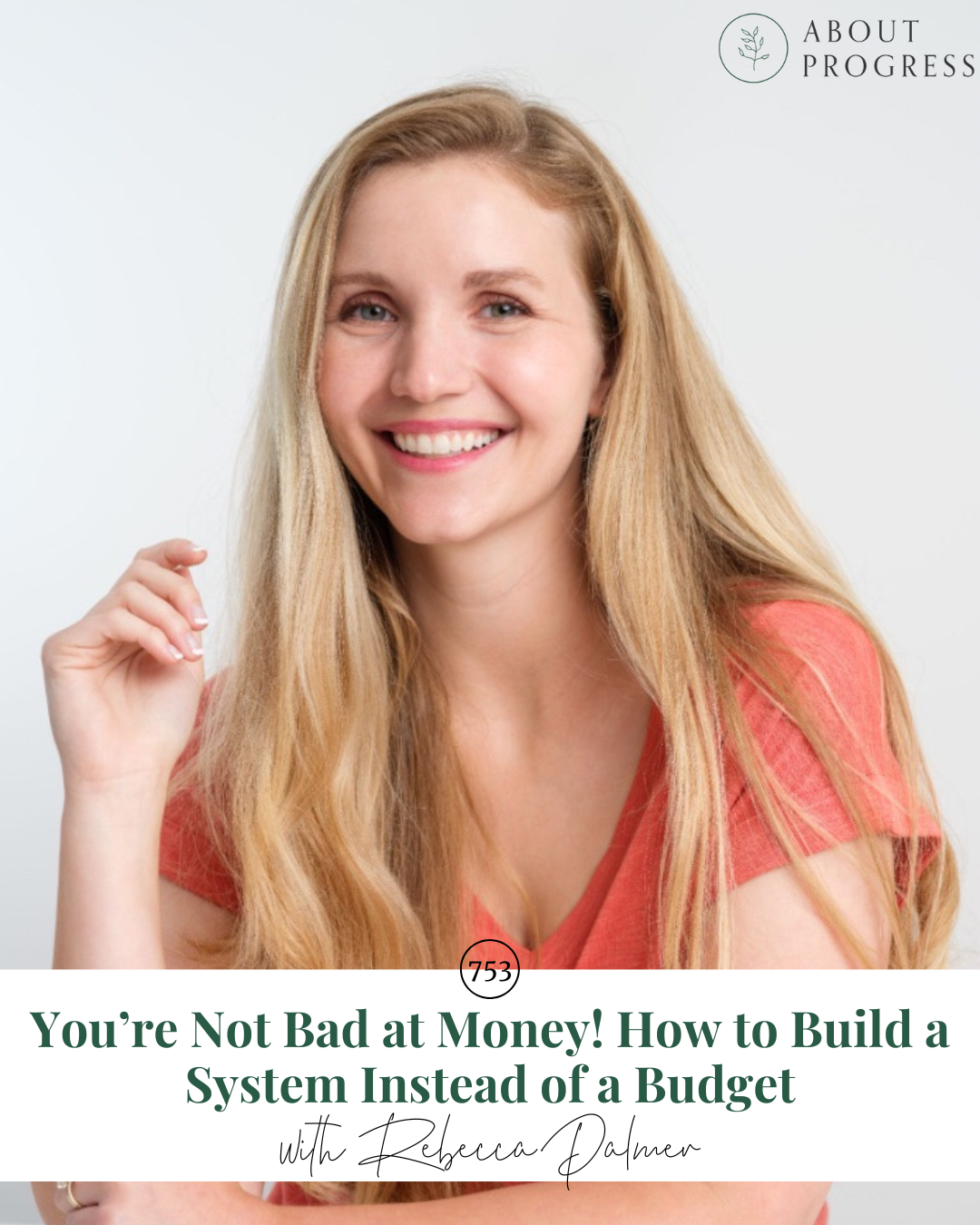
Navigating the labyrinth of personal finance can often feel overwhelming, especially with societal pressures and the constant barrage of advice from various "experts." I myself have struggled with the anxiety of managing budgets and feeling as though I'm constantly missing the mark. Thankfully, Rebecca Palmer, a seasoned financial advisor, has shared insights that have reframed the way I view money. She highlighted that much of the stress stems not from personal failure, but from the systems that aren't designed to work with our unique lifestyles. In this episode we learn how to shift focus from attempting to perfect rigid systems to creating personalized systems that truly support our financial goals, leading to a more peaceful and grounded financial life.
Here to Stay Drive: join the Supporters Club to keep About Progress around + participate in a whole month of special prizes. A little from many makes this work sustainable!
1-on-1 COACHING ENROLLMENT OPEN NOW! BOOK A CURIOSITY CALL NOW to be considered for one of my limited spots for 1-on-1 coaching this Winter.
About a few other things...
Sign up for the Go Getter Newsletter to get Progress Pointers in your inbox every Wednesday.
You can listen to the episode below, on Apple Podcasts, or on your favorite podcast app. If you like the show please share it, subscribe, and leave a review!
SHOW NOTES
Access exclusive supporter benefits
Sign up for the next Sticky Habit Intensive
Book Launch Committee
Leave a rating and review for the podcast!
Lend your voice and experience + be featured on the show HERE
Join Monica on Facebook and Instagram
Songs Credit: Pleasant Pictures Music Club
Transform your space now. Go to https://www.quince.com/monica for free shipping on your order and 365-day returns; Get organized, refreshed, and back on track this new year for WAY less. Head to Wayfair.com right now to shop all things home; Join Masterclass for 15% off at masterclass.com/progress
TRANSCRIPT
Rebecca Palmer: for anyone who's feeling like they have tried and they can't do it. Or like there's something wrong with them. It's not you you are not the problem And if there's a problem, it's your system. You don't need to be better. You just need a better system.
Monica Packer: Hi, this is Monica Packer and you're listening to about progress where we are about progress made practical. Let's face it, the topic of money brings up a lot of complicated feelings for even the most money savvy among us. Feelings of fear or discouragement, insecurity, scarcity, and anxiety. I know all of us are feeling these things even more these days.
Thanks to tumultuous economic times that we are in and how we are seeing those times reflected on our receipts and in our bank accounts. I was raised in a very frugal household that taught me the value of a dollar, and even then. I find that navigating money on a day-to-day basis is a really anxiety fraught thing for me, mostly because I carry this constant question mark over if I am doing things, quote unquote, right. This is especially true when it comes to budgeting. Budgeting is something I have had a fraught relationship with as an adult, Even though I'm not naturally a spender, I'm in the position of being the main spender in our household.
So I have found fastidious budgeting to be more despairing than helpful. To be honest. If you're in a similar boat, if you find yourself thinking, I'm just bad at money. If you are carrying around that big question mark, am I doing this right?
And if you've really struggled to know how to manage your money well without falling for , the nickel dime, kind of budgeting. Today's episode is going to be both a salve and a guide for you. I am speaking with Rebecca Palmer. She's a financial advisor who will help us understand why budgeting often fails, how our financial world is actually designed to make overspending easy, and the simple systems that can help you do better and feel better about your finances.
Without tracking every dollar or relying on willpower. Rebecca Palmer is the head of financial guidance and co-creator of Fruitful, a financial technology startup and a mom of two. With over a decade of experience in financial advising , behavioral strategy, and product design, Rebecca helps people build money systems that actually work
using clear plans, smart habits and tech that make follow through feel doable. At Fruitful, Rebecca leads the development of tools and expert guidance that take the stress out of money and supports everyday life. That interview is coming up after a quick break for our sponsors.
.
Monica Packer: This month I'm running here to stay the 250 supporters drive. This is a community effort to help about progress, not just reach its 10 year anniversary this fall, but to truly be here, to stay, to keep this podcast running at a bare bones sustainable level, covering things like hosting, editing, and production, not including paying me.
We need to reach 250 supporters. That's the number that allows the show to remain free for everyone without putting episodes behind a paywall or dramatically increasing our ads. Joining starts at just $2 a month, and it really does make a big difference. Supporters get access to things like quarterly ask me Anything, nights, a private reading diary and our yearly garden party, plus more at higher levels. For my private premium ad free side podcast, more personal and twice yearly exclusive online gatherings, including a private workshop and a book club
just to make this extra fun this month, new supporters are receiving surprise. Thank you gifts, and I'm raffling off. Favorite thing, packages every week drawn from all supporters. You can see the prizes and sign up at about progress.com/support. If this podcast has ever helped you feel less alone or a little more grounded,
this is a meaningful way to help keep it going, and if supporting financially isn't possible right now, listening, sharing, and leaving a review truly helps. More than you know, you can sign up for the Supporters Club at about progress.com/support, and thank you for helping make about progress here to stay.
Monica Packer: Rebecca Palmer, welcome to about progress.
Rebecca Palmer: Hi guys. Excited to be here.
Monica Packer: Well, it's about time. I've known you for many years. I've learned from you and uh, I just have these visible memories of being back during the pandemic times with my husband pouring over the financial workbook you had out at the time, and you've transferred your work to another work that is also very related, and we get to benefit from that today.
So I'm really eager to dig into our conversation about managing our finances, and this is a very. And I would say surprisingly, but you're probably gonna tell me not so surprisingly, layered topic. So I would like to begin with just laying the groundwork that I think all of us believe we know what it quote unquote takes to save money.
We just spend less and. more money in a bank account, then we get stuck in the how we get tripped up on systems and budgeting and how-tos, and it's surprisingly, again, like I said, difficult. So how and why do you see this coming up?
Rebecca Palmer: This is a great question. We talked to thousands and thousands and thousands of people, you know, from their twenties to like 45 ish is our, our typical demographic all across the country. In different career stages and life stages, little kids, single, older, working, not, um, solo, like partnered across the whole spectrum.
And what we hear from everyone is, I'm overwhelmed. I've tried to do this so many times. I feel like I'm the problem. Right? Like there's so much shame and confusion and they're also just bombarded with advice nonstop. Influencers don't always help here, right? Like, we're, we're being told to do A, B, C, and then another person is like, no, no, no, X, y, Z.
And you're like, how in the world am I supposed to know what to do with my life and my situation? Because the truth is that, you know, financial progress and peace and wellness is, it's not just math, it's it's life. There are life factors in there too. And, um, it can be hard to know what to do. I think the other truth is that this entire system that we live in, in the US it's wired for that financial stress and confusion and debt.
Um, and I'll try not to get like too mad about it, but like we're not taught in school how to manage money. We're not set up to save, we're set up to accidentally overspend, right? It is so easy to spend money that you don't have. And we were also born in this world where. Consumerism is just the water that we swim in, right?
And so we don't, we don't have what, like our grandparents or our grandparents, grandparents had generations before us, which is the simple truths of like, Hey, if you don't have money, you can't spend money. We're like, ah, just, yeah, just buy it. Like if you want it, just buy it. And um, we have all those cards kinda like stacked against us.
So for anyone who's feeling like they have tried and they can't do it. Or like there's something wrong with them. It's not you like it's, you are not the problem here. And if there's a problem, it's your system. Which is why we like hyper focus on systems because if we don't build a system for you that's sustainable and works for like your life and your rhythms and your family, then you just get the default US American financial system, which will just, you know, lead you down that path.
So. You don't need to be better. You just need a better system.
Monica Packer: You know, one of those standout statements for me was, it's not just math, it's life. And it's kind of reassuring to hear one that we're not alone and feeling like I should know better. So why, why is this so hard? And it's because we are set up to overspend. I mean, you and I are just coming off of Amazon Prime Week, you know, prime Day week. And uh, I was thinking when you talk about our grandparents, like they had catalogs. They had stores like that,
Rebecca Palmer: Yeah.
Monica Packer: had to go to, it took a lot more work to spend money. And I just mean
Rebecca Palmer: Mm-hmm.
Monica Packer: physically literally, it, it had to involve them moving their bodies and placing
Rebecca Palmer: Yeah.
Monica Packer: and going into the mail.
So it's reassuring. But then you talked about money systems and that's when my brain starts already firing, like on all neuro pathways. 'cause it's like scary. All the things I don't know. So can
Rebecca Palmer: Yeah.
Monica Packer: even just start by defining what you mean when you say. Like a money system. What? What do you mean by that?
Rebecca Palmer: That's a great question. So there are different budgeting methods and um, a budget is not a system. A budget is like the numbers that you're aiming for. Budgets are goals, budgets are not systems. But we hear people talk about budgeting methods a lot. They talk about cash envelopes or this app or that app, or.
Like why a or Dave Ramsey or spreadsheets or like, whatever. It's mon our, um, none of those are systems. That's all after the fact. What happened? Or like, if you can be smart enough to check it in the middle and like redirect yourself in that moment of making the decision, maybe you can like shift your behavior, but it's really, passive, uh, and it's just after the fact.
Monica Packer: passive
Rebecca Palmer: A budget is passive.
Monica Packer: Got it.
Rebecca Palmer: And a system is proactive. A system is like, let me set up literal bumper guards and automation that will send this money in the places that I want it to go before the money lands. Right. So you put like yourself in control. Of where you want this money to go, and you give yourself backup.
So you take like willpower and memory and overwhelm, like we're juggling a million things. We're not gonna rely on our willpower or our little spreadsheet to decide whether or not to buy the thing in that moment. Like we need bumper guards. So a system is like technology. Like, what are the bumper guards?
What kind of accounts do you have set up? What kind of automation do you have set up? Um, how, how much friction exists in certain activities, right? Is it super, super easy for you to spend money that you don't have or did you put some, like some little bumper guards there that will help you out?
Monica Packer: Uh, so you're talking about bullying, which is so,
Rebecca Palmer: Yes.
Monica Packer: you know, appropriate for you have little kids and you go bullying or if you need them yourself. But yeah, so it's just the barrier that prevents, you know, things overflowing, overspending. So you talked about systems being proactive. Is there, I'm sure there's as many systems as there are people too,
Rebecca Palmer: Yeah.
Monica Packer: but perhaps, and I'm hopeful there's a good place to start in terms of systems that you think the people who are so overwhelmed and that this starting line that they keep returning to because they keep feeling like they're failing, that would help them get started on the right foot and be able to keep going from there.
Rebecca Palmer: Absolutely. Yeah. So here, here's exactly what I would do first. Um, I would figure out what your total income is. Then I would figure out what your bills are using, uh, air quotes for anyone on the podcast. But that's not just bills, but it's, uh, variable utilities. It's your rent or mortgage. It's your childcare costs, it's your car payment.
Anything that you have already obligated yourself to pay for, like, it might, it might vary, but like you've already decided you're paying for it. And subtract that. So see what's, what's left over. After you take away the things that you can't control, um, then you have flexibility there and whatever is left, part of it can go to day-to-day spending groceries, gas, chopping, new socks, diapers, whatever it is, and part of it can go to goals.
So the first thing that you need to do is figure out those like really simple components. Do not over stress or overcomplicate exactness in these numbers. Broad numbers are fine. Round numbers are totally fine. Um, the system that we find works the best for most people is actually really, really simple.
It is as simple as separating that, spending money for gas, groceries, diapers, all that stuff from the bills money, like literally two different accounts. So you're not doing your day-to-day spending outta that same account that you need to pay your mortgage or that you need to pay the nanny or anything like that.
And by doing that, you remove the need for all of the tracking. You don't have to categorize your transactions, you don't have to worry about how much you spend on groceries. You don't have to do all of this mental math that otherwise you have to do thinking like, oh, do I have to have enough to pay this?
Have I spent too much? How much have I spent? Because it really doesn't matter. Like all of this talk in in budget culture about like spend this much on groceries and this much on entertainment. Like, doesn't matter. It's your money. Spend it however you want to. But you have this much, and as long as you just stay within the bounds of that much, everything else will run on autopilot.
So separate the two, that's the first one. Um, how you separate it can be as easy as a direct deposit switch, um, at your, or a direct deposit split at your payroll level, right? If you hire like a W2 employee, it can be a recurring automated transfer. Maybe you get paid on the first and the 15th, and so you set up.
Recurring transfers on the first and the 15th. Um, something simple like that. We have fruitful, we have some slicker technology, but like simple works too. So separate that money and then automate some of the savings. Um, I was actually laughing like a year ago. I was talking to one of my coworkers who, whose background is not in finance.
She's a pro product manager, and she was like, hold on, hold on, hold on. So you're telling me. That basically the only secret here to like actually doing better financially is hiding money from yourself. And I'm like, you're not wrong. You're not wrong. Um, you, you gotta spend it somewhere, right? Put yourself in control of what you spend your money on and those day-to-day decisions.
But take yourself out of the driver's seat when it comes to paying your bills on time. Automate that. When it comes to contributing to that 5 29. Automate it, contributing to the retirement account. Automate it. You, you need less to do, not more so automate everything you possibly can.
Monica Packer: Yeah, a lot of these I've already put in place thanks to your guide that we worked through, so I
Rebecca Palmer: Yay.
Monica Packer: oh, yes, yes, I'm doing that. Yes, I'm doing that. But also there are things I'm like, oh no, I'm not doing that, and I'm thinking more about the percentages. Would be kinda helpful. Like is there a certain, I like that you're not, like in budgeting, you don't have to say this much for entertainment or you know, you can only spend this much on clothes for per each child per
Rebecca Palmer: Mm-hmm.
Monica Packer: or school year, like that kind of thing. But is there overall some wise percentages to aim for in terms of what most people need to spend on \ non-negotiable bills, and then\ spending and savings does, or is that not even a factor that I should be wondering about?
Rebecca Palmer: There are, there are some rules of thumb here, but like doing your own math on your own goals is always gonna be better than a rule of thumb. For, you know, to have some kind of marker out there. Um, if you are able to, for example, consistently put 10% of your income towards retirement, like long term, taking care of future old you like, you like, that's a pretty good baseline.
You're probably gonna be okay. You can get more nuanced, but like 10, 15%, you're probably on track there. That can be part of this general, like kind of 20% of your income going towards goals. It gives you enough margin on your working life, right? To like actually be able to save and, um, invest and to put money away for hard times, right?
So if you can, if you can make space for 20% of your income for savings, you're doing great. Like if you can make space for 5%, start there, right? Like start somewhere and keep going.
Monica Packer: Mm-hmm. Uh, I, I'm noticing that you're using the word goals instead of savings a lot, so maybe that speaks to a bit of a mindset shift. Why, why is that the, the word you like to use? I.
Rebecca Palmer: Yeah, I think, um, I like to start with intentions actually for, for people and what they wanna do with their life, because sometimes we get, we get tricked into assuming other people's goals, like on our own life, right? To, to buy this or to do that, or to retire at this age or to. Travel, like you really gotta think through, like, how do I actually want to live my life?
What are my values? What are my intentions for my time in this world? Like, and start with that first and then find goals that align with that. Um, and I say goals instead of just savings because, saving is one like technical way of getting to the goals, but there's also investing. It's another technical way of getting to the goal.
It could be paying off something. It's a way of getting to a goal. So there, there are lots of different things that you do with the money, but you are absolutely right that like you have to have space for it first. And that's usually what people think of when they say savings. Like make space.
Monica Packer: Mm-hmm. And automating that, like you said, yeah, you're hiding the money from yourself in a, in a way where you're able to at least start at even 5% and gradually build up. I, I like how doable that is. Uh, are there any other systems that maybe they should consider? Once they have these things in place, like is there a good, is it wise to have a system to check in? Um, do they need to have a system to track where their money is going? Or as long as they know like, this is the account for spending. So when it's gone, it's gone, or, I, this is where I get lost on the tidal waves of all the advice
Rebecca Palmer: Mm-hmm.
Monica Packer: of, you know, how to manage money.
So would you
Rebecca Palmer: Yeah.
Monica Packer: actually wise to consider?
Rebecca Palmer: It's good to be organized, so you probably need a centralized place where you can see everything. Highly recommend that being like linked accounts so you don't have to do this manually. We don't want any manual work here if we can avoid it. Um, there are lots and lots and lots of places that, that do this. Rual does this, lots of places do it. Um, somewhere where you can connect all of your accounts and it's just one really, really easy screenshot. Of like, what's going on in your life, what are all the balances? So you don't have to put more time into looking into it. I don't think you actually have to track all of your expenses, which is like a pretty radical thing to say.
This is like very anti typical, typical, um, financial culture for me to say. But the reason I say that is because over the past 10, 15 years now of me doing this with people in their day-to-day lives, I have not found that to be sustainable for folks. Like they just can't. Continually categorize things, even if they have a cool app, you know, that helps them categorize things a little bit.
Um, it's, it's too much. They get really excited about it. They do it for a few months and then they fall off the wagon, and then they feel shame because they feel like they're supposed to be able to do it. Like no one can do it.
Monica Packer: me right now. I mean, this is why I have thought I've been bad at this forever, and then like, I'm like, actually no, I'm not.
Rebecca Palmer: No, you're not, you're not.
Monica Packer: not as bad as I think I am. It's just because that old standard really is so. Exhaustive
Rebecca Palmer: Mm-hmm.
Monica Packer: unsustainable that you just, yeah, like you said in the beginning, you're set up to fail.
That's nice to hear. So a centralized place, it's more all the accounts like, so the savings, spending, retirement, like all those accounts in one place just to check the polls
Rebecca Palmer: Mm-hmm. So you can stay organized. A lot of getting started. Setting up systems is just, feels a little meta, but I'm gonna say it anyway, like getting in alignment with truth about your finances. Some people are terrified to even look at their credit card statements, right? So like just get the numbers somewhere.
Take away the power of looking at the numbers by making it so easy to look at them and so easy to them that it's
Enrollment is currently open for just a short period of time for my private one-on-one progress coaching. What is progress coaching? It's one-on-one coaching designed to help you transform in your identity, habits and fulfillment and ways that are both deep and practical. Past clients of mine have seen major progress in rediscovering who they are outside of their roles, participating less in people pleasing, breaking cycles of all or nothing.
Perfectionism. Learning to better control, numbing out behaviors, managing their stress, clarifying their values, creating and holding to loving boundaries for themselves and so much more. Spots are extremely limited, and I plan to only open up coaching once this year. My spots always sell out as well. If you are curious about progress coaching with me, you can sign up for a curiosity call where we both arrive.
Curious to see if I'm the right coach for you and your needs. You need to sign up for that curiosity Call soon via the link in the show notes as my coaching enrollment will end at the end of January. So again, go to the show notes to book a curiosity call with me to potentially join as one of my few one-on-one coaching clients this winter.
Monica Packer: So this keeps coming back to the deep layers that we have attached to it. The shame, the fear. I am curious about your own relationship with, with money, and I mean you have such a wise but it seems also practical outlook on how to manage finances. Is this something that. You just did naturally as a kid, or what's your own story with all this?
Rebecca Palmer: Yeah, that's a great question. My, my mom is very thrifty. She is always the first person to be like. I have what I need, like, we're good. You know,
Monica Packer: Yeah.
Rebecca Palmer: my parents were very normal, right? We, I got, uh, my first job when I was 14. I've had a job ever since then in one way or another, one size or another. And I think that is really helpful, like getting a lot of practice with money.
Um, I do it with my own kids now, even if they're, you know, seven and five. Give them a lot of practice. But I too, fell victim in my earlier years to that idea that , I didn't know enough or there were like, hidden strategies out there, or like these secret codes that I didn't know about and I thought that education was the answer.
And um, you see that now with like all the courses and all the advice and all the different, you know, download this thing and that thing and pay for this. Like, there's just so much stuff that people try to sell you. And that's what they're really trying to do, is just trying to sell you something. And, and so I did what a lot of people do.
I like got serious. It turned out that I really, really like, like organizing money. And so I dove into it head first in my personal life. But what I actually really found is that it's not that complicated. You do not need to be a financial planner to be. Crushing your goals. You don't, you don't need to be tracking your grocery spending to be on track to send your kids to college.
Like you don't, you don't actually need to do any of these things. The, the people that were really winning at personal finance who feel calm and confident weren't the ones with the complex strategies and the most knowledge. These were the, the people that had the simplest systems and they were consistent.
They weren't mean to themselves and they didn't have crazy high expectations for flawless execution. They didn't have line by line budgets necessarily either, but they had things that like they could pull off. And I feel like I actually hear this a lot in your podcast and I know like some of the books you love, it's all about not like.
The best possible way to pull off, uh, that habit, right? Like it's not running the seven miles today. It's like putting on your tennis shoes. Like
Monica Packer: Yeah.
Rebecca Palmer: if you put on your tennis shoes and you do that consistently, like it's gonna be fine 'cause you're gonna get practice and you're gonna figure out how to do this, um, over the years, and people are just really, really hard on themselves and in my experience most of the time.
Folks are doing the best they can with the information that they have and with the world that they grew up in, and the families that they grew up in, and the circumstances they find themselves in. And so, you, you gotta let go of the limiting beliefs here a lot. I've talked about that a lot before.
I know. And just figure out like, what is one little thing that I can do? Let me automate that one little thing. And prove to myself that I can do it, and then we can go to the next little thing.
Monica Packer: Mm-hmm. And actually that was something I was gonna ask. You've, you've helped so many people work through these layers. Is it really, does it really just come down to that, you know, challenge, noticing what the beliefs are? Challenging them, doing things differently and that's what helps 'em form a new relationship with money.
Rebecca Palmer: Yeah. Yeah. I think there we talk a lot about feeling better, right? Our goals, you know, with this company and just in general are helping people. Do better and feel better financially. And sometimes we get tricked into doing little things that like kind of make us feel better, but don't actually make us feel better.
Like big, capital F, capital B feel better. And I think that's because the thing that's gonna make you feel better is doing better, right? So when you actually start to see progress, you're gonna feel better and it's gonna take a little time. You're gonna mess it up for sure. You're gonna accidentally overdraw an account or blow money on a random purchase.
Right. Whatever it is. Um, and that's fine. Like you don't have to be perfect. Systems do not require perfect people. They're actually great for imperfect people, which is why we love them so much.
Monica Packer: That's so much more hopeful, especially when you think like, I just have to start, the most important thing from what I'm drawing from what you've taught us today is the most important thing is making sure you automate savings. And then work with what's left. And if the percentage needs to be lower right now because it needs to be lower, that's fine.
But as long as you have a percentage automated to a savings account, that's a good place to start. Is that, right? Is that the
Rebecca Palmer: That's a great place to start. It's a great, it's a great idea to, uh, keep money out of your line of vision, right? So if that's like a 401k contribution or something that you don't even see, you're not gonna miss it. Like, so the more you can, the more you can set that up, the better off you're gonna be.
Monica Packer: So Rebecca, we've talked about how to, crunch the numbers, but in a different way, how to automate, how to have your accounts all in one centralized space. Um. What percentages to consider for having a goals account, um, and or maybe goals in mind and how you're gonna do that, whether it's investing and saving or paying off debt. Is there anything else, systems wise that they should have in mind, A target to move towards?
Rebecca Palmer: Yeah. Some other, some other tips here, especially for folks that. Have found themselves accidentally overspending. So whether that means you're in debt or you're just spending more than you would like to be spending, um, that is to introduce some more friction into those like automatic easy spending ways because that is the world that we were given when we were born.
Um, some easy things that you can do is, uh, freeze your credit online at the three bureaus. Just freeze it. It's actually great for fraud reasons too. It takes like 10 minutes.
Monica Packer: Didn't
Rebecca Palmer: can lock.
Monica Packer: Oh
Rebecca Palmer: Oh yeah. It, it's super easy. The websites are not even terrible anymore. They're pretty decent, which is good. what that means is that you can't, and no one can take out more lines of credit in your name.
So that's like loans that you didn't take out. But it's also like your impulse to open a credit card at TJ Maxx, like, also like, taken off the table, which is nice. Um, so freeze your credit. As long as you're not buying a house, you. You don't need it available to anyone. Um, you can also lock your credit cards.
A lot of apps, you know, a Chase or a Amex or whatever it is, will have a little toggle. You can actually lock your card. So I wouldn't, I would not play the credit card hacking game. In my experience, it didn't work for people. Yeah, for anything, for any kind of points, I guarantee like cash savings and a smooth system that simplifies things is worth so much more than the credit card points.
Um, most of the time the people that we see who are really, really into the points have credit card debt payoff. There are some exceptions of people that have just like got a smooth system. They use a credit card, they pay it off from their spending account, and it's fine. But, um, but I would think twice about the the points.
So pick one card. If you have the other cards for emergencies, great. Maybe for booking that flight. Great. Um, but lock them when you aren't using them and keep them out of your wallet. Delete them from your Apple wallet. Put them in your closet. Like you just need a little bit more friction in here. The, uh, the most effective thing that I have found even in my own life, right?
Like, I am not immune to this. I do this for a living, but we, you know, we have a spending amount. And we use it, we run to Trader Joe's and everyone wants the snacks. And we get all the snacks, right? And later in the month I'm like, oh, well we're getting down to the bottom of our spending account, but I need to buy this X, Y, Z thing.
Um, instead of just grabbing my credit card, I force myself to use the card associated with my spending account and move money in from savings. So, like, if I am gonna go over my own limit, I force myself to face the reality of that coming out of savings. Instead of putting it on a card, which really just like procrastinates the, the reality of like where it has to come from eventually anyway, and that is so, so, so unhelpful.
So I would, I would try those things too.
Monica Packer: So when you say card, are you saying like a debit card for an account or are there certain like credit cards that people know that's our spending one and maybe we pay it all off each month because that's just what's works for us or because we like we need to build our credit or. Even though they're not trying to credit sh um, what's the word, like credit hop to get all the points everywhere.
They're, they're trying to stay in one pla place and it is nice to like have a hotel paid for every time they go out to visit grandma and grandpa,
Rebecca Palmer: Yeah,
Monica Packer: with the cash rewards. Um, what, what did you mean by that card?
Rebecca Palmer: Yeah, for sure.
Monica Packer: Question that way.
Rebecca Palmer: Oh, no, you're good. I, I live in this world, so we can, we can totally talk about it. So if you are paying off debt or have really struggled to build up savings, I would put the credit cards away.
Monica Packer: Okay.
Rebecca Palmer: Not for the rest of your life like, but for now, like use a debit card. It is fine. My favorite thing about debit cards are the instant balance updates.
It drives me crazy, the delay in balance updating on credit cards. Even when I use them now, I'm like, why can't this just be simultaneous? It leaves you in a constant state of not knowing how much you've spent, and that benefits the credit card companies and not you. So if you need to start with a debit card, start with a debit card.
The reason people use credit cards is because of the. Rewards usually, like you said, it's nice to be able to, to book that flight or pay for the hotel. With the rewards. I would give yourself flexibility on picking a card that gives you probably cash instead of points. Points are getting real tricky, especially these days.
Monica Packer: Mm-hmm.
Rebecca Palmer: and we, we actually found that this question was such a big question for our members. That we built like an entire product around it. So , the card that we ended up building gives you rewards like a credit card and it runs on credit rails technically. Um, but the available limit on the card is tied to the balance in your account.
So what that means is you get,
Monica Packer: that's
Rebecca Palmer: the 2% back that you would get with a credit card, but you can't go into credit card debt with it. Um, so we're, we're just like shaking up a whole bunch of things left and right, but pick one card. Start with a debit card if you need to. But just keep it simple. Don't let anyone trick you into like optimizing things too much.
Monica Packer: Mm-hmm. Yeah, you can see I'm starting to ask all those questions too, like the
Rebecca Palmer: Yeah.
Monica Packer: But again, coming back to those basics, I, I love the systems that you introduced to us as, as guard rail rails of, of managing our, our finances, as well as other ways we can introduce friction and. But it really does come down back to the heart of, I think, why you do this work and it's trying to help people to live, gosh, what's the word you said?
Better? It wasn't better. Feel better.
Rebecca Palmer: Yeah. Feel better. Do better. Think about money less. That's our entire goal. Think about money less, not more. You don't need to be thinking about it more.
Monica Packer: Yeah.
Rebecca Palmer: do any better if you're thinking about it more. Um, the other idea that I had is, um, when you have that spending amount and you've separated that spending money, you set up some of those systems, sometimes you still kind of have to change.
Some behaviors and some habits to stay within that, in that spending amount. Um, I like to think of, you know, inertia, like an object in motion will stay in motion from middle school science. We have kinda like our own spending inertia. Like we don't even really know what it is. We couldn't even really articulate it.
We know how often we go to Costco and how much we roughly spend when we buy groceries and how often we travel. Like this is just normal to us. If we wanna do something else, we have to interrupt our routines somehow, so the bumpers help. Um, they give you that hard line. But another really, really helpful thing to do is to examine your, your routines and your rhythms.
So don't think about the transactions and the numbers. Think about, uh, a normal week for you. When are you shopping? When are you spending, when are you making financial decisions? What about over the summer or over the course of the year? Like, examine your routines and your rhythms. Figure out what you think is not worth it or what you wanna change.
And you have to give yourself like a replacement routine or a replacement rhythm, because in the absence of it, you're just gonna do it again. So you need, you need a replacement.
Monica Packer: Okay. That's another great, fascinating next step to move towards and something I'm gonna be even being attentive to as I move throughout my, my day and my weeks, like to think about, okay, what, what are my rhythms that tend to be where and how I spend money enough because it's bad because we're tracking
Rebecca Palmer: Yeah.
Monica Packer: rhythms.
Right?
Rebecca Palmer: Mm-hmm. Mm-hmm.
Monica Packer: okay. One last. Nitty gritty question then for you. We talked about the centralized space. Where you can come and check in on all your accounts, how often would you think is wise to do so? Um, at least in the bare minimum.
Rebecca Palmer: I check my spending account every time before I spend money actually. Um, but it's not like a loaded thing. It's like a two seconds. Yep. Money's there because I'm married, so I'm not the only one spending outta it. Like, um, when it comes to your investment accounts or retirement accounts or savings accounts, I think if you just check before you spend even periodically, a few times a week or something, that's enough visibility on the rest of everything else.
, If you have enough spending cushion in there that you like, don't really need to check that often. Once a month is totally sufficient. This just doesn't have to be a, another job or like a part-time job on your shoulders. You, you can keep it simple. There aren't like active strategies that you need to be pulling off in the day-to-day to do well financially.
It's really about automating contributions towards your goals, making that easy, and just staying within kind of the, the spending ish limits that you set for yourself by making it easier for yourself.
Monica Packer: Fantastic. tell us about Fruitful. What should
Rebecca Palmer: I love. Yeah, fruitful. So fruitful is a financial membership. If you wanna do this on your own, you can do it. You know everything that you need to know. People are are smart and they're capable, and they're strong and they're wise, and they can totally do this. If you want help setting up a money system, that's like what we built.
So we have certified financial planners that help people not just set up the money system, but also with the advice. And we do it all. We set it all up on autopilot for people. So that's spending cards, savings accounts, investing portfolios, like the whole thing. We set it up on autopilot. And you get a person,
Monica Packer: person A, you
Rebecca Palmer: Uhhuh.
Monica Packer: after like going through it all, but that's really, that's really nice. Yeah.
Rebecca Palmer: Yeah, it's very different than anyone else who's gonna give you financial advice. Most people try to sell you products and we're like, that's slimy. Like, let's just pay for membership. And you get an expert that will help you set up the system that actually gives you a shot at pulling off the things that you want to do and the things that you know you need to do, um, and talking, talking to someone about money.
The other problem is that. People don't have anyone they can talk to about money. Right. You, it's a little loaded. Even with your spouse, you certainly can't talk to your friends about it. You can't talk to your parents about it. Like who are you gonna talk to? Um, so that is what we do. We have a new membership tier.
Which is less than $50 a. And you can also try the whole thing for free for 30 days. So A CFP will set up the whole money system for you, and it will be ready to go and you can decide like, Hmm, do I wanna give this a go or do I not?
But in either way, like you have the blueprint and you get to, you get to give it a shot.
Monica Packer: And so does it have education as well? Has a centralized space to connect your accounts. You said something about that, um, other products too for them to check out. It sounds
Rebecca Palmer: Yeah, totally. Anything that you need to do with your money, you can do in one spot with Fruitful. So there's an app to organize it, to message your financial guide to get advice, um, access to your accounts. Obviously, investment accounts, savings accounts, spending accounts. All of the cash accounts are in 5% API too, which is.
How it should be. Most banks make money on your money sitting in those accounts overnight, and they lend it out to other banks and they make money overnight on those funds. And so because we don't charge like account fees or things like that, we just do the membership fee, we turn back around all of that to the members.
So it's earning the most, it's centralized, it's simplified, and you have a real human to talk to who is. Not judgmental, like understands how expensive houses are these days. This is not like your dad's friend, like who's gonna talk down to you, and we just try to keep it really, really simple and get people set up and like back to living their life so they can focus on what actually matters.
Monica Packer: Okay, fantastic. So where should they go if they want to learn more about Fruitful?
Rebecca Palmer: The best place to go is just fruitful.com. It's all there.
Monica Packer: Great. Rebecca, thank you so much for this incredible but indeed practical advice. I feel a lot more hope. I'm gonna sign off and go check out my accounts 'cause I feel the urge to do that now, like in a positive way. Um, but it's been such a lovely time. I appreciate you very much. Thanks for being here.
Rebecca Palmer: Happy to be here.
I hope this episode gave you the hug and kick in the pants you need to grow. I'll now share the progress pointers. These are the notes I took so you don't have to, and those in my newsletter, get them in an expanded version and in a graphic form in our newsletter.
You can sign up at about progress.com/newsletter and this really is one you're gonna want the progress pointers on. Number one, if money feels hard, you are not the problem, your system is. Number two, budgets are goals. Systems are what make them possible. Number three, separate your spending money from your bill money.
Number four, automate savings first, even if it's a small percentage. And number five, add a friction where you tend to overspend. Again, the progress pointers will be an expanded version of that and detail some of the tips she has underneath each of those pointers. You can get that about progress.com/newsletter.
This podcast is listener supported. Members of the Supporters Club make my work with about progress free and available to all, and they also get access to three levels of exclusive benefits from more time to more content. With me, we're about to do our big drive for this, the here to stay drive.
If you've been considering joining the Supporters Club, now is the time. Go to about progress.com/support to sign up and you can always support the show for free. This year, we'll mark 10 years of about progress. The best thing you can do to support that is leave a rating and review on Apple Podcasts and doing so will automatically submit you to our annual favorite things giveaway in the fall.
Thank you so much for listening. Now go and do something with what you learned today.
And,
and so I have found, so I have found. Fastidious. I have found fastidious budgeting.
Monica Packer: So I have found fastidious budgeting to be more despairing than helpful.