
Better Sleep for Moms: A Sleep MD on Sleep Anxiety, Bedtime Routines, and Healing Your Sleep Relationship || with Dr. Angela Holliday-Bell
Jul 13, 2026
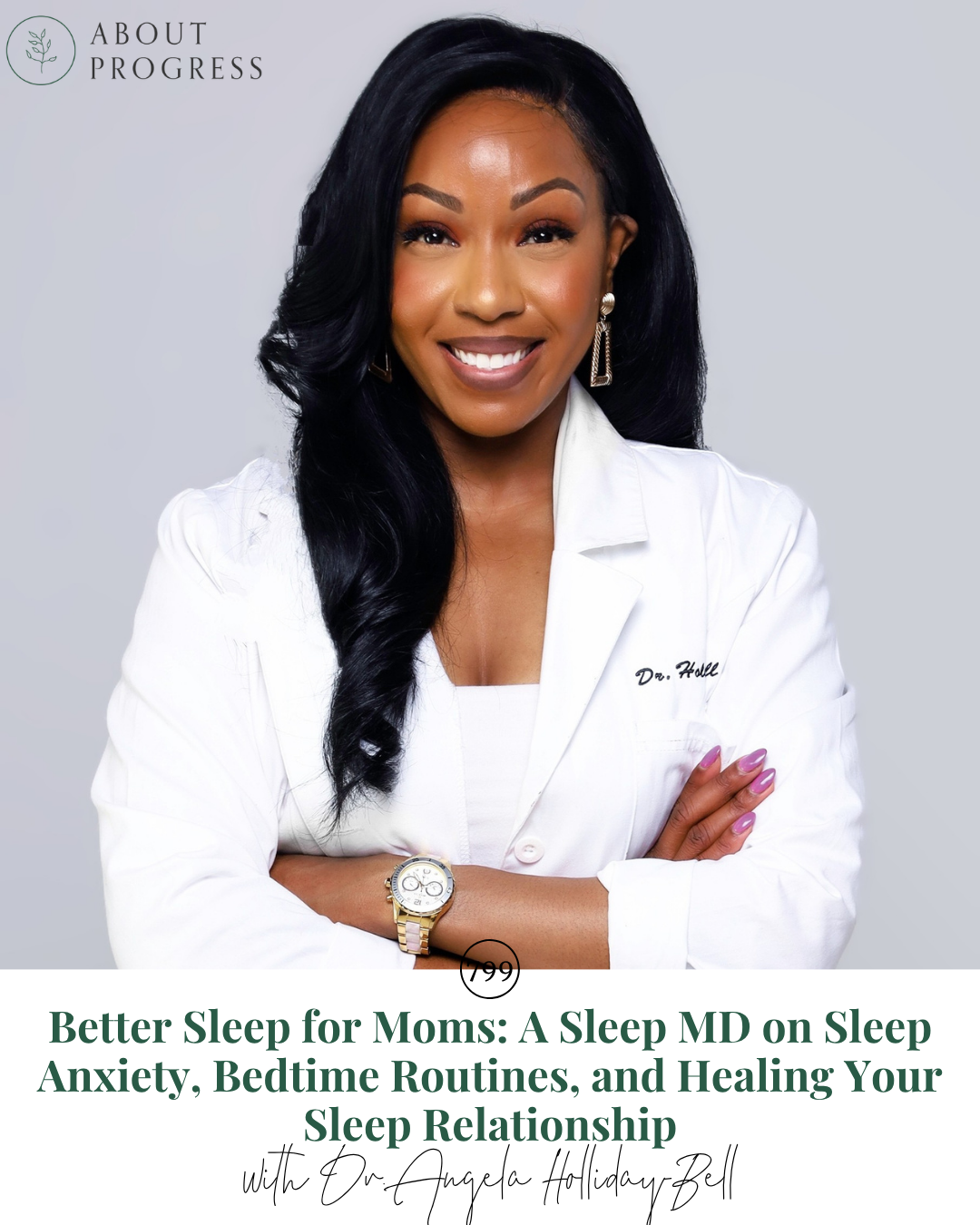
I recently chatted with Dr. Angela Holliday-Bell about why moms should prioritize their own sleep alongside caring for their children. She shared how our relationship with sleep is akin to any other important relationship—it needs nurturing. From the eye-opening concept of "sleep anxiety" to the practical tips on redefining our nighttime routines, our conversation unveiled how small changes can bring about big transformations in our energy and clarity. For more enlightening tidbits, like why charging your phone across the room can be a game changer and the benefits of red lights during night feedings, make sure to tune into the full session on the About Progress podcast. Dr. Holliday-Bell's expertise and insights might be just what you need to reclaim restful, rejuvenating nights.
Dr. Holliday-Bell's The Sleep Savvy Mom’s Guide: Real Sleep Solutions For You & Baby, Instagram and Website
Complementary episodes: 3 Actionable Ways to Optimize Your Sleep
Get 50% off last year’s More for Moms Archive Pass with code LISTENER at checkout.
Preorder Sticky Habits book today!
Join the Book Launch Committee for behind-the-scenes and first peeks at all things book.
Join the Supporters Club to keep About Progress around for good.
About a few other things...
Sign up for the Go Getter Newsletter to get Progress Pointers in your inbox every Wednesday.
You can listen to the episode below, on Apple Podcasts, or on your favorite podcast app. If you like the show please share it, subscribe, and leave a review!
SHOW NOTES
Access exclusive supporter benefits
Book Launch Committee
Leave a rating and review for the podcast!
Lend your voice and experience + be featured on the show HERE
Join Monica on Facebook and Instagram
Songs Credit: Pleasant Pictures Music Club
Go to Quince for free shipping on your order and 365-day returns. Get your teen Knix with code “PROGRESS.”
TRANSCRIPT
Monica Packer: Hi, this is Monica Packer. This month on About Progress, I am bringing you a special series featuring select sessions from last year's More for Moms conference.
Last year, I created this online gathering for mothers who know there's more available to them than simply surviving motherhood. More happiness, more fulfillment, more fun, more progress. This conference was born out of my own experience as a mom who loved her family deeply, but still found herself feeling depleted, at times resentful, and almost always disconnected from herself.
I have learned that when moms have more in their lives, they have more to give, not because they're sacrificing less, but because they're finally including themselves on their own priority lists. Right now, this month, I am neck deep in prepping for the second round of the More for Moms conference.
So throughout July, I am sharing a small handful of some of my very favorite sessions from last year's conference right here on the About Progress feed. These conversations are practical and encouraging. They are deeply relevant for any mom who wants to feel more like herself again. If you love what you hear, good news.
You can get instant access to all twenty-five conference sessions from twenty twenty-five's conference with the archive pass. This includes lifetime access to all videos, transcripts, a private podcast feed, and speaker resources, all ad-free, which will be different than what you hear this month as I have to put ads on any episode that airs on the About Progress feed.
You can use the code LISTENER right now at checkout at aboutprogress.com/moreformoms to get an additional fifty percent off the archive pass, which has already been discounted, so it now amounts to ninety-four cents for each speaker session. The content for 2025's conference is set to officially archive this August so I can make room for 2026 content.
Use the code LISTENER at checkout at aboutprogress.com/moreformoms to get lifetime access to all of the soon-to-be archived content. I cannot wait for the new content coming your way, and also hope that you'll take advantage of this discount and get that archive pass.
It's linked for you in the show notes. \ It's now time to share one of my favorite sessions from last year's content. That speaker session is coming up after a quick break for our sponsors Dr. Angela Holiday -Bell, a big welcome to the More for Moms Conference.
Dr. Angela Holliday-Bell: Thank you. Thank you so much for having me.
Monica Packer: I know every mom who sees the title of the session is gonna be like, click, click, click, click, click. Because it, it's almost like synonymous with motherhood is exhaustion because we go through so much sleep-wise, and I know you are in the thick of it right now with a baby of your own. Um, but you are also.
This is your expertise. You're a medical doctor who helps people with their sleep. So you do this all the time, and it may be obvious, but I wanted to start with the obvious. Why is it that we as moms have this dramatic shift in our relationship with sleep as we become mothers and as we move through motherhood?
Dr. Angela Holliday-Bell: Oh yeah, that's a very loaded question. And honestly, it starts from even prior to uh, having the child, even with pregnancy, there's so much that shifts in the mom, uh, down to the biology of it. There are hormonal shifts that significantly. Impact your ability to sleep. And I think, um, in terms of how we navigate the world and society, there's so much pressure to be everything to everyone, particularly your child. There's a mental load that comes with it. There's a physical strain that comes with it. And for most mothers, you just accept this life of sleeplessness and this life of exhaustion because you feel like that's what comes with motherhood. And so, um. Although, yes, there's new baby who needs your attention all the time and they're waking up to feed and all those other things Separately from that, most moms just accept that their new reality is that they're not gonna get sleep.
So they're something that is on the bottom of the priority list because you feel like it's an
Monica Packer: Hmm.
Dr. Angela Holliday-Bell: goal in addition to all of the things physically, literally, emotionally, socially working against you in terms of getting your rest,
Monica Packer: So it seems like we're almost set up to fail, which can feel a little depressing, but also it's kind of helpful to know, oh, this isn't just a moral failing on my part. It is biology. It is social expectations. I wanna talk about. Sleep relationship, I've, I've heard you talk about that we have our relationship with sleep and I never thought of it that way, and since that's the premise of our conversation, can you break that down a little bit?
What does that even mean?
Dr. Angela Holliday-Bell: 100%. So I always tell people one of the most important relationships you'll have in your life is the one between yourself and sleep, or yourself and your bed thing surrounding your sleep, and you're building that relationship every single night, whether you realize it or not.
Monica Packer: Hmm.
Dr. Angela Holliday-Bell: And the reason I say this is because your thoughts, your feelings, your interactions with your sleep impact how sleep goes for you. And so if you think of it like relationships you have with anyone else, your spouse, your friendship, you have to nurture that relationship, right?
Monica Packer: Okay.
Dr. Angela Holliday-Bell: toxic relationship that brings about a lot of stress and anxiety, it becomes more and more broken and it's difficult to restore. If it's a healthy, loving relationship that makes you feel good and energized, then it's gonna be better and healthier, right?
So you have to think about all the things you're doing. During the day and the night that's impacting the status of that relationship. Is it a toxic one? Is it this constant battle and
Monica Packer: Okay.
Dr. Angela Holliday-Bell: or
it is something that's healthy and then becomes restorative?
Monica Packer: Ooh. I love that way of looking at it because it helps me see it differently and also in ways that help me understand why it is so complicated, because relationships are so complicated, period.
Dr. Angela Holliday-Bell: A little complicated. Yes. and.
there are different season of relationships and stages of relationships, right? So in one stage of life, the relationship might be great, and then something changes, and then it becomes a little more broken or distorted. And the same thing happens with your sleep.
Monica Packer: Okay, so I'd love to hear you tie that back to moms in particular and how their relationships with sleep can become toxic, or if they were a Facebook status. Maybe complicated. I haven't been on Facebook forever. Is that what it used to be like? It's complicated.
Dr. Angela Holliday-Bell: yes.
Monica Packer: the status.
Dr. Angela Holliday-Bell: about the
Monica Packer: I know I did too. It just came to me.
Dr. Angela Holliday-Bell: but yes, it becomes complicated and a and a lot of times it become strained.
Monica Packer: Okay.
Dr. Angela Holliday-Bell: Um,
there's distance within that relationship, right? A lot of times. Moms are not, uh, pouring into that relationship or prioritizing it because now there's this new relationship with your baby and a new dynamic at home with your spouse. And so that sleep relationship becomes more distant and, and set to the side, and you're not really fueling it the way that you need to or building it up. For a lot of moms. Even if they're wanting more sleep, it can be, it can become a toxic relationship. And then now there's this anxiety and stress surrounding sleep.
Now I'm not able to fall asleep and, and even if I do, I know that it's gonna be broken. So I'm more alert because I have to wake up in the middle of the night. And so now what used to be this beautiful, healthy, symbiotic relationship becomes strange because it's rots with anxiety of what is a night gonna bring?
Well, how am I gonna feel in the morning? So it's definitely a strained, complicated relationship. And you are so heavily involved in your child's relationship with sleep, so it's this very, very complicated mess of things. Um, and what is unfortunate is even after that initial strain is over from a baby waking up every two to three hours, unfortunately the mom's relationship with sleep remains complicated
Monica Packer: Mm-hmm.
Dr. Angela Holliday-Bell: because she's never learned how to mend it and make it healthy again.
Monica Packer: Ooh. Okay. I would like to talk about that more because I'm sure a lot of moms who are here are like, but I don't have a baby anymore, but my sleep is so bad and my relationship with sleep is both strained and maybe toxic. Uh, I'm anxious about it. How does that happen then? Like how does like even after a baby is done or the toddler's napping or whatever sleep issues we have, so for some people it's a very long time with certain kids.
Uh, and that's better. How is it still lingering this relationship?
Dr. Angela Holliday-Bell: a good way to kind of make a comparison is, uh, if you're in a relationship, let's say with a, a mate and you never really learn how to navigate issues or problems or arguments, and so you fall into these habits that are toxic, that are not great for, um, making progress for communicating. And so even if the initial strain or whatever caused that to occur is over. Fallen into these bad habits of not being able to communicate, maybe snapping at each other, and those things are gonna continue even if the initial strain is over. Same thing goes for your sleep. For some women people, we need therapy to really understand how to redefine that relationship with sleep.
So they fall into these. I don't wanna say bad habits, but these habits that are harmful to sleep as a way to just survive this, this stage of newborn toddlerhood or whatever. And then they never go back and fix those things. Um, and so it becomes this snowball effect and they don't even really understand or know what it's like to have those healthy habits anymore because they. Been in survival mode for so long. This is what I do to get by. And so oftentimes we have to unravel all of those things that you've gone through, that you've learned that those mechanisms that you've fallen into just to make it through in order to reestablish a healthy relationship.
Monica Packer: What does that look like? Then what would, what would they be looking for to understand? Oh, that's a toxic habit with my sleep. I'm sure some are internal, some are external, but I just wanna give them some markers to look for.
Dr. Angela Holliday-Bell: The biggest thing I see, and I would say this as a mom of a three month old who is, is in the trenches. I started out my pregnancy and journey as a new mother with the mindset that I deserve to sleep. I think for moms, we look at our baby, our child, and they deserve sleep, and how can we take care of their needs and we have to feed them, we have to do all those things.
And you completely forget that you're still a human. Your sleep knee did not dissolve because you have a baby. Um, and that you too deserve rest and to feel, um, taken care of and. And to fill your tank with sleep, that's gonna look a little bit different now because we have some more challenges, but you still deserve that.
So I think starting with that mindset of like,
Monica Packer: Hmm.
Dr. Angela Holliday-Bell: you deserve sleep. You're not destined to have this life of sleeplessness just because you're a mom now you're allowed to manage your child's needs and still prioritize your own rest. I think it's a great place to start. then outside of that, looking at how you're managing your sleep.
What is your relationship like with your sleep? Are you looking forward to going to bed at night? Are you putting it off, um, because you have other things to do? Are you, are you putting it off, not necessarily 'cause of other obligations, but because you feel like your only me time is at night And so you're, you are willing to sacrifice sleep in order to achieve that. Um, are you falling into habits that are, not great for your sleep life? Being on your phone at night, looking at the time, um, scrolling through social media, doing stimulating activities, not having a wind down routine, not keeping a consistent schedule. Again, all these things that allowed you to power through initially, but you've continued to do with that initial strain on your sleeping spot and.
Monica Packer: I think we all know that term, revenge, bedtime, procrastination, and, and as you already mentioned, so much of how we engage with sleep is deep. You know, it's the way we see it and I know that we can delay sleep because we think we're getting in our me time, but really we are building up other habits that are hard and makes sleep even hard.
More challenging and even make the sleep, we have less restful. Um, so I love that you started with that fix, like believing I do deserve rest and I deserve to prioritize this way of caring for myself. That's a big change.
Dr. Angela Holliday-Bell: Yes, absolutely 100%.
Monica Packer: Let's get into some of the ways they can work to heal their relationship with sleep. Um, that couple, that mindset shift, what else would you say?
Dr. Angela Holliday-Bell: So setting aside sleep opportunity
Monica Packer: Okay.
Dr. Angela Holliday-Bell: that you prioritize and keep sacred just like you would your, um, kids' basketball game, baseball
Monica Packer: Yeah.
Dr. Angela Holliday-Bell: you have at work. Like there are some things that you're like, I have to do this, or it's gonna fit in my schedule regardless. Sleep should be that same non-negotiable. I say sleep opportunity because yes, if you have, especially if you have small children or toddlers or whatever, that can impact how that sleep goes, but. aside that time, prioritizing that seven, eight hours of sleep opportunity will actually work wonders, especially when you're busy and have so many things going on.
So people like to sacrifice sleep as the first thing on the chopping block when they're so busy, but you're actually so much more efficient and better at everything you do when you're well rested. So the way that I start my day, am I scheduling all the things that I have as okay, four, nine hours. I know that this is the time that I'm going to devote to sleep and then I'm penciling in everything else around it. Just that mental shift of prioritizing sleep first actually will work wonders, and then you can add in all the other things that help make the opportunity become realized. Sleep.
Monica Packer: Okay. I know that's gonna be a light bulb for a lot of women, even though they're like, it's not rocket science, but really it is. If you're not prioritizing it, then you know. You can't like, you just don't. It's just like everything else. Okay. So starting there and then you talked about some other ways they can really lean into that opportunity.
What does that look like?
Dr. Angela Holliday-Bell: Having a consistent wind down routine is so important.
Monica Packer: Okay.
Dr. Angela Holliday-Bell: as moms, usually we have a bedtime routine for our baby. I started my baby's bedtime routine at like a week old.
Monica Packer: Love that.
Dr. Angela Holliday-Bell: come
into the nursery. We have our red light. We're rubbed down. We changed to pajamas. We're snuggling. Now we're reading stories.
Like there are things that I do consistently at the same time every
Monica Packer: Okay.
Dr. Angela Holliday-Bell: train him to sleep and to help him transition from the day to the night. But a lot of times as moms, we don't give ourselves that same opportunity. Understanding that it doesn't have to be this extravagant one hour long routine.
If you have 15 minutes
Monica Packer: Hm.
Dr. Angela Holliday-Bell: that you can dedicate to consistently winding down, making that your me time, that transition from all of the hustle and bustle of the day to the come of the night. Dedicate that 15 minutes to it every night, put the baby down, do your thing. And that really helps to ease you and to sleep and to help to calm all of the racing thoughts that I'm sure most moms deal with as they're trying to fall asleep. what I would also say, kind of going a step further into that, a lot of moms that I work with, one of their biggest complaints is I cannot shut my mind off at night.
Monica Packer: Mm-hmm.
Dr. Angela Holliday-Bell: all of the exhaust racing through my head so much for my child at home. A couple things I recommend for that. Number one, having doing a brain dump. Having an activity where you literally just write down all the things that are coming to your mind to give your brain a way to process those thoughts so that it doesn't feel the need to do that at night. thing I say though is the goal shouldn't be to turn off your thoughts. That's not realistic. We are humans. We think all the time we process things. It's just the, the way that we live and survive in the world. The goal should be to shift your thoughts to something that's more neutral and less stimulating. So if all of this do lists and things are running through your mind and, and getting them out on paper doesn't help listen to a sleep story, a sleep meditation,
Monica Packer: Okay.
Dr. Angela Holliday-Bell: recite a calming mantra like relax.
Just give your brain something else to kind of tag onto so that it's not feeling the need to run through all of those thoughts over next.
Monica Packer: Okay. I love those practical ways that they can, can work on that. Are there any others that you find helpful for your clients that you work with in terms of the wind down, like other options that they can consider?
Dr. Angela Holliday-Bell: Yeah, so it, it, it really depends on what is relaxing to you.
Monica Packer: Okay.
Dr. Angela Holliday-Bell: routine is gonna be a little bit different, but what is most important is that it is the void of things that are stimulating.
Monica Packer: Okay.
Dr. Angela Holliday-Bell: lot of, um, people I work with will say, oh, but tv, like, I just, I need to watch my show before I go to sleep.
Like, that is how I relax, and that's okay. think if you're going to, if you need a more stimulating activity to relax, just put that at the start of your routine. So I say have your. 30 minutes to an hour where you watch your show, you're sitting down, you're relaxing, but then have another 15 to 20 minutes that you're dedicating to non-stimulating
activities.
Monica Packer: Yeah.
Dr. Angela Holliday-Bell: the lights low, uh, putting on some calming music for me, it's like indulging in my skincare, listening to
Monica Packer: Yeah.
Dr. Angela Holliday-Bell: devotional, which really puts me in a good mood and then I'm going to sleep. Whatever that is for you. A couple of things that are, are non-stimulating, but then also understanding that this is your time to have that me time.
That's not related
Monica Packer: Mm hmm.
Dr. Angela Holliday-Bell: bedtime, procrastination, so make it something that you look forward to so
Monica Packer: Okay.
Dr. Angela Holliday-Bell: doing things that are not gonna be helpful to your sleep.
Monica Packer: So it almost should feel like a treat.
Dr. Angela Holliday-Bell: Abso a hundred percent. It should feel like a tree. I look forward to my bedtime routine
Monica Packer: Yeah.
Dr. Angela Holliday-Bell: The other thing though, is once you make this shift, like one of the things I look forward to is sleeping is the feeling that I get when I wake up in the morning and I have this mental clarity, and this energy and motivation like that is what I'm chasing as opposed to this temporary high of scrolling through social media or binge watching a show that's gonna make me feel awful tomorrow. For a lot of women, they have gone so long without having that feeling that it's difficult to chase something when you don't even remember what it feels like.
Monica Packer: That's true.
Dr. Angela Holliday-Bell: with that shift and then once you feel that it's like, oh, I need to be con consistently feeling this, and it's easier to chase that.
Monica Packer: So I'm sure this is really subjective, but you know, speaking to that sleep opportunity. Yeah, just like you said that it's not gonna be immediate. Uh, how does it still help to have the opportunity and how long do you feel like most women have to, and I'm sure this is an average, but it takes for them to, their body to relearn how to wind down and clear out their minds and go to sleep and sleep well?
how long do you feel it takes for them to, their body to relearn how to wind down and clear out their minds and go to sleep and sleep well?
Dr. Angela Holliday-Bell: Yeah. Yeah, that's a great question. And it, it definitely depends, unfortunately, is the answer because it depends on how broken your relationship is with sleep, how long it's been broken, um, how much sleep you actually need. What's impacting it for moms who have what I call sleep anxiety, which is
Monica Packer: Mm-hmm.
Dr. Angela Holliday-Bell: This instant anxiety that's built up surrounding sleep. Just preparing for sleep actually becomes an anxious process because I know that I'm gonna struggle and I know that I'm gonna feel tired
Monica Packer: Hmm.
Dr. Angela Holliday-Bell: and I have to go through this. This song and dance, it takes longer, right? Because now we have to retrain our brains to establish healthy relationship with sleep. Part of that though, it's gonna look like. Reserving your bed and your sleep space for sleep only in some adult activities, right? But limiting the other things that you're doing in bed that dilutes the relationship between your bed and
Monica Packer: Okay.
Dr. Angela Holliday-Bell: Because once you make that relationship complicated, then you get into bed and your brain is like. Do we work? Because this is where we normally send emails. Should I send digestive in enzymes? 'cause this is where we eat. Should I become stimulated? 'cause this is where I've been to watch my show. And it really dilutes that relationship. So for those individuals, it can take several weeks, three to six weeks to really, start to heal that relationship. But if, if the anxiety is less of an issue, it's something as simple as a week of consistent, um, bed bedtime, winding down, going to bed, at the same time, engaging in these activities can be enough to re restore that relationship.
Monica Packer: And that goes back to the original. Solution that you offer to us is, I deserve to sleep. Which means you choose to actually proactively prioritize it, which is gonna require some shifts. Right? And with that shift, I see two other obstacles that I'm not just talking anecdotally, but also anecdotally, um, that come up inhaling this relationship.
Like I went to a legit, like I had to have adult sleep training. Um. Thanks too. Lots of it. And it really did change so much for me. And your tip, you know, reserving bed for sleep and sex, like it's hard, but you do. That's, I'm so glad you brought that up. But obstacle wise, how would you speak to the mom who struggles with now sleeping?
Very light, um, and probably almost 'cause like her brain and body were trained to wake up easily and often, but now the season has, has passed for that being because of other. People and their family and it's just like her. What would you suggest can help that part of the relationship?
Dr. Angela Holliday-Bell: Yeah, so that's super common, right? Like you said, uh, we evolve to be lighter sleepers when we have babies because we need to be able to respond to their needs. But there are things that we do again, that, that, um, prolongs. Bad light sleep and a couple of very, like, just specific tactical things. Caffeine, honestly, uh, a lot of moms are surviving on caffeine throughout the day just to make it, but then it becomes this cycle, um, because caffeine has a long half life, meaning it takes a long time for some people to 12 hours for half the amount they
Monica Packer: Wow.
Dr. Angela Holliday-Bell: be
excluded from their system.
Monica Packer: Okay.
Dr. Angela Holliday-Bell: if you're chugging back coffee, especially in the afternoon hours. Even if it doesn't stop you from falling asleep, it can cause you to remain in the lighter stages of sleep.
Monica Packer: Hm.
Dr. Angela Holliday-Bell: The other thing is there are ways that we train ourselves to remain in the lighter stages of sleep. Uh, some of that is when you wake up, let's say in the middle of the night, around that 3:00 AM point, and you get on your phone or you look at the time you're training your brain to be ready to wake up at that time, waking up should be a slow, gradual process.
Our cortisol stress hormone, uh, um, naturally increases in the later parts of the night, early morning. But when you're basically, uh, setting an alarm clock by stimulating yourself, looking at your phone and the time it causes that shift in cortisol to be increased sooner, of cortisol and not having that wind down time.
So when
Monica Packer: Okay.
Dr. Angela Holliday-Bell: brain is consistently active and you're stressed and anxious before you go to bed, just 'cause you fall asleep, doesn't turn that off, right? It is. You may be able to temporarily slow it down, but your brain is actually still active and so it may. Stop you from getting into the deeper stages of sleep because you haven't actually dealt with the cortisol, the anxiety before falling asleep. then lastly, your sleep environment actually significantly impacts the depth of sleep that you have. So if your sleep space is too warm, again,
Monica Packer: Hmm.
Dr. Angela Holliday-Bell: sending
signals to your body to release that cortisol early. Keep you in the lighter stages of sleep for those individuals who like sleep with the TV on or, or if there's outside light or sounds entering your space. Just evolutionarily in terms of survival, we are trained to remain in lighter stages of sleep if we notice changes in our environment. So if there are changes in sound or tone or light, our brain the same. Wait a minute, let me just make sure I can react if necessary. So it's stopping you from getting into the deeper stages of sleep. And then lastly, very practically speaking, engaging in some sort of physical activity. It could be just walking.
Monica Packer: Hm.
Dr. Angela Holliday-Bell: exercise strength training can also deepen, your sleep, so get you into those deeper
Monica Packer: Really?
Dr. Angela Holliday-Bell: would focus on all of those things.
Monica Packer: And it does it matter the time of day that you do the movement?
Dr. Angela Holliday-Bell: Yeah, so ideally you are, well, it depends on the type of movement that you're doing. I'll start
Monica Packer: Okay.
Dr. Angela Holliday-Bell: any strenuous exercises in the early morning, early afternoon hours.
Monica Packer: Okay.
Dr. Angela Holliday-Bell: If
you do, let's say strength training, hit exercises too late, then causes your body temperature to go up too much, and then you're releasing these like endorphins that can make it more difficult to fall asleep. But something like yoga, light stretching is actually perfect to do well right before bedtime.
Monica Packer: Got it. That was so comprehensive. Thank you. You're being so generous with your knowledge. The other big obstacle that I wanted to talk about is phone use. And, you know, you've mentioned this a few times in terms of sleep environment and also just training our brains. Uh, it's a hard one. To break, I think for a lot of people.
So how, how can they heal that part of this relationship? Like it's a one-two punch almost, you know?
Dr. Angela Holliday-Bell: Yeah, it's hard. I think, first of all, breaking that codependency on the phone. I think for a lot of us, the first thing we do, we wake up, we reach for the phone, we're bored, we reach for the phone. You really have to train yourself to not do that, and I know that that's hard. It's easier said than done. of us need very, um, more, uh, I guess, firm help doing this.
Monica Packer: Yeah.
Dr. Angela Holliday-Bell: charging your phone out of reach, putting it somewhere that you'd have to physically get out of your bed to grab it in order to look at it for some, from, for some people that's, uh, charging it outside of the
Monica Packer: Yeah.
Dr. Angela Holliday-Bell: you literally won't, um, get on it. Some people have the affect. kick them out of social media.
So it's less, uh, enjoyable to be on your phone when you're like, oh, I actually can't physically get, um, onto these things. And then the thing is, replacing that with something else that is
Monica Packer: Got it.
Dr. Angela Holliday-Bell: That's more relaxing. So again, listening to a sleep meditation, sleep story, audio book, something that is not gonna be stimulating, that's gonna be conducive to sleep. And then once you do that for so long. Then it becomes a habit and you're less likely to do it. I would say it's been years since I've looked at my phone in the middle of the night years,
Monica Packer: Mm-hmm.
Dr. Angela Holliday-Bell: difficult at first, but once I decided to do that and I realized like, yeah, this is, it's kind of cool not knowing what time it is and not feeling this pressure of like, oh no, now I need to hurry up and fall back to sleep. It's something that I don't even want to do, like it. It's not even attractive to me anymore because I understand the benefits of not doing.
Monica Packer: I know a lot of people say, well, that's my alarm. Um, and they don't wanna get one of those giant clocks on this, which, which can also like, I mean, those are like strobe lights often, you know, just how bright they are. But, um, I do have to just attest, like it really does is a game changer to at least charge it across the room if it has to be your alarm.
Dr. Angela Holliday-Bell: the room.
Monica Packer: Right.
Dr. Angela Holliday-Bell: Exactly, exactly. Because I, I use it as my alarm as well. And the, the thing for me is if I wake up in the middle of the night and my alarm hasn't gone off, I know it's not time to wake up
Monica Packer: Yeah.
Dr. Angela Holliday-Bell: gonna look in my phone. Right. Like, you don't, if your alarm hasn't gone off. That's all you need to know, that it's not time to wake up. What can be helpful too, though, is something like a sunrise alarm
Monica Packer: Yeah.
Dr. Angela Holliday-Bell: more pleasant. You can tune it to play like a very pleasant sound, along with the increased brightness, which is actually better, a better way to wake up. Um, but at least make it outta reach. I mean, if your alarm goes off, you gotta get out of bed anyway so you can get up and grab your phone.
But it really is a game changer for a lot of people.
Monica Packer: I would love to have a moment of hope because while this has been so revolutionary and also practical for the women who are here, it may also feel a little daunting. Like, there's so much I need to change in order to make this happen. So. Perhaps a case study of sorts. I know you've worked with so many, I would just love to hear about someone who has healed this relationship and is in a better place.
Dr. Angela Holliday-Bell: Yeah. So first of all, I wanna say take it one step at a time. Just
Monica Packer: Yeah.
Dr. Angela Holliday-Bell: Like, you don't need to redo your entire routine and redo your entire bedroom. One small habit that you build on can make a big difference. But I'll say there's a mom that I was working with, uh, she was a new mom, so it was her first child.
And when she first came to me, it was actually during pregnancy.
Monica Packer: Hmm.
Dr. Angela Holliday-Bell: she already wasn't sleeping well,
Monica Packer: Hmm.
Dr. Angela Holliday-Bell: and
she was kind of like, I don't even. She didn't believe that she could, right? Like, I, I don't what el what could I possibly do? Because a, a baby's not gonna sleep so I'm not gonna sleep. Um, and it started with me again, helping her to understand that she deserved rest.
So just because her baby comes doesn't mean that that need or that desire goes away, that you still need to do that. And what we really did was. Focus on her baby sleep and her sleep at the same time. Usually when we talk about fixing sleep, it's either for the baby or it's for the mom. But so much of how mom sleeps is dependent on how her child sleeps. So we started with a routine right away, helping to fix the day night confusion, setting up a solid bedtime routine for her baby and for her, um, I gave her quick five, 10 minute wind downs and reset routines I call them, that you could do during the day or at night. Even if she couldn't sleep, that uh, focus on rest really helped to again, shape her mindset to say, oh, this is something that I need.
This is something that's restorative. Uh, so similar. I would also say to me, I came into it with a similar mindset. And so within, I would say what it was like two and a half months, she was getting a solid five, six hours of sleep at night, sleeping more than she was before the
Monica Packer: Yeah.
Dr. Angela Holliday-Bell: interesting part. because even though it wasn't all the way through the night, she was like, I never sleep for it, you know? This, this long, like five, six hours straight, and then it's continued to build on itself. And so for her, she let me know, and that's why I wanted to start with it. The biggest thing was a mindset was understanding that it is possible that just because she has a baby doesn't mean that now she has to throw out her need for sleep or throw out a focus on herself that we could do it together. Um, and then we also worked, I just wanna say practically on understanding how to handle night feedings and night wakings. No matter how old your child is, if they need you at night as a mom, you're gonna have to tend to that. But what do you do during that time? Are we grabbing our phone? Are we toing on
Monica Packer: Ooh.
Dr. Angela Holliday-Bell: Are we being doing simulating things or are we keeping it low? Using red lights, doing non-stimulating activities so that both of you can fall back to sleep. So it's really understanding those little things. But yeah, she was sleeping much better, even with a couple, uh, a two and a half month old. And then it only has improved since.
Monica Packer: Amazing to hear that, you know, you're so one knowledgeable obviously, but you are very passionate about this too. So I, this is maybe a personal curiosity question, but I'd just love to know why are you so passionate about sleep and helping people heal it?
Dr. Angela Holliday-Bell: that you can. I'm glad that you can see that. So it, it was, it started with my own struggle with insomnia when I was going through my medical training. Um, it was, I've been through a lot, right? Like, I'm a doctor. We go through rigorous training. It's been very stressful, but hands down, the worst thing I ever went through in my life was insomnia.
Monica Packer: Yeah.
Dr. Angela Holliday-Bell: so I started on my own quest to fix my sleep, studied sleep, just literally to fix mine. I gained so much more than just sleep. There was a peace
Monica Packer: Hmm.
Dr. Angela Holliday-Bell: that, uh, came to me. I became better at everything else I was doing in my life. My relationship with my husband was better. Uh, how I functioned as a doctor was better, and that sparked my desire to help other people do the same because I knew so many people were struggling. And now that I'm a mom, that desire has, uh, increased even more because so many moms walk around in this state of chronic exhaustion. Long after the baby is sleeping through the night or, or older or whatever. And again, along the way, they just lose their need for sleep or understanding that they deserve it.
And so I'm like, I can be a living example and also help other people to do the same. So what, what started my journey. Yeah.
Monica Packer: I am sure, you know, seeing so many clients and helping so many moms through this, gave you almost a, a cheat sheet on what you wanted to do differently, moving into motherhood yourself. Um.
Dr. Angela Holliday-Bell: Absolutely.
Monica Packer: there just even one thing that you're like, I'm, this is one of the things I'm like, okay, I am for sure doing this thing to ensure I'm sleeping well.
Dr. Angela Holliday-Bell: It was honestly how I, I guess it's two parts,
Monica Packer: Yeah.
Dr. Angela Holliday-Bell: the day night confusion from the beginning, like literally the moment he was out the room is, we started on that, but then two, how I was handling his night beatings. What I learned from working with a lot of mothers is. Once babies wake up at night, it's like all beds are off and they lose the focus on prioritizing their own rest and getting back to sleep as well as their child's right.
And so I was like, no, we're gonna be very diligent. I told my husband like, we're militant. Do not turn on that light. It's red light only.
Monica Packer: Yeah.
Dr. Angela Holliday-Bell: We're not talking. We're gonna handle business. Do we need to do, put him back? And I think that really changed. It helped him to understand what to expect when he's waking up at night, and it helps me to focus on my rest and be able to fall back asleep.
So I would say. For new moms who are in this kind of newborn, just survival mode. If you do nothing else, really, really focus on how you're handling the middle of the night, um, wakings and feedings so that both of you can get back to sleep, and then it'll also have him to start consolidating his sleep as well.
Monica Packer: That is so helpful and you know, a, as a mom who now who doesn't have like infants, I will say what I've taken from you and the small step I wanna prioritize is just making my nighttime routine a treat somehow, like something I really look forward to. Even one thing. So I'm gonna think on what that is.
Well, I could talk to you forever, but I, my, I have so many more questions, but I'm just gonna hold back now and I wanna talk about your freebie. So, Dr. Holliday -Bell, you have the freebie, the Sleep Savvy Moms Guide. Can you tell us about it?
Dr. Angela Holliday-Bell: Yeah, so it's a guide I put together. I'm actually really excited about it. It's a pretty comprehensive guide, but again, what I saw lacking in the space of sleep for me was the combination of how to help baby sleep and mom sleep at the same time because they're so co-dependent,
Monica Packer: Yeah.
Dr. Angela Holliday-Bell: And so I wanted to create something that empowered mom to. Not only her baby's sleep, but her sleep as well. And again, really have those not only mindset shifts, but also the practical things that she can implement. And that is what the Sleep Savvy, uh, mom's Guide to better sleep is. It gives you very tangible, very practical things to implement from the day your baby is born to help them sleep better, but also things that you can do even when your baby isn't sleeping to help you get better quality sleep.
So those quick resets. A sample 10 minute wind down routine, how to handle the night, wakings, all the things that you need to make sure that you're also getting quality sleep. Again, I'll use myself as an example. I was, I was like, we're, we're gonna sleep. Okay. Listen, I love my relationship with sleep. I want my baby to love sleep.
We're gonna do this. My baby's three months, as of last week, he's sleeping seven hours throughout the night. We wake up, we have one feed, he's back to sleep for three hours. Also, understanding that every baby is different, but I was also very intentional about setting up good habits. Not just for him, but also for myself. I think one of the best things you can do for your children is to equip them with healthy sleep habits from the beginning. And so this guide was a way to help other, uh, mothers do the.
Monica Packer: It does sound very comprehensive, but also very generous. Like that should, that should be a course, but I'm sure like knowing you and just how good and freeing you are with your material, it's, it's, it's all there for people who are gonna, who need it. I also want to know where women should go if they want to learn more from you.
Dr. Angela Holliday-Bell: Yeah, so the best place to go is probably my website. The solution is sleep.com, because it has all the different ways you can connect with me. Secondly, though, I would say follow me on Instagram at the Sleep MD, because I give you very actionable bite-sized. , Tips and information that you can take away and start to implement.
I also will have, um, uh, access to some of my guides and things that I put together. I have one, I'm pregnancy and sleep, and the sleep, uh, savvy moms guide as well. So that's a good place to just take that, those quick bites away from me. But the, the solution is sleep.com is a way to get the comprehensive, all the ways to connect with me.
Monica Packer: Wonderful. We'll make sure to link to those things. I wanna go to the final question, and I'm so curious to hear what your answer is and it's what is one way you are currently seeking for more out of your life?
Dr. Angela Holliday-Bell: Yeah, that's a great question. And, and for me, and my son, my baby has brought so much joy into my life that is indescribable. I'm sure as moms you all can relate. I didn't know that there was a love that could exist like this. Um, and so the more that I'm seeking is just being more present. With him, really enjoying each and every day, not trying to fast forward past the moments, but being present in each stage, even with the wake up and the sleepless nights. Um, but just to piggyback on what I've already talked about, one way I'm helping myself to do that is filling my own cup, pouring
Monica Packer: Yeah.
Dr. Angela Holliday-Bell: at the same time that I'm pouring into him because it allows me to be so much more present in these moments, able to enjoy each and every day with him, and not literally just trying to survive and get by. Um, so that's how I'm seeking more. Indescribable joy and this added depth to my life that he's brought, and I want to be present and intentional about every moment that I can.
Monica Packer: That's a big part of the mission of this conference is to help women prioritize themselves, right? So they can show up with that presence, which is just such a, a blessing for. Everybody, and I can see it in you. I mean, you just are radiating yourself, which is. Such a big accomplishment, and I hope you can take a minute today to just be really proud of yourself that you have prioritized that, because that can often take a while for us to learn.
Um, and I think, and thanks to your work, you had a little bit of that cheat sheet and, and push to do it from the beginning. And you're doing it and you're doing so well. Um, Dr. Holliday- Bell, this was just an incredible session. Thank you very much for your generosity and your expertise and your time. We are so appreciative.
Dr. Angela Holliday-Bell: Thank you. Thank you so much for having me, and like you said, I'm just passionate about helping other moms do and feel the same because you all deserve it.
.