
Do You Feel Worthy? How to Build True Self-Esteem in a Self-Obsessed World || with Dr. Marisa G. Franco
Sep 14, 2026
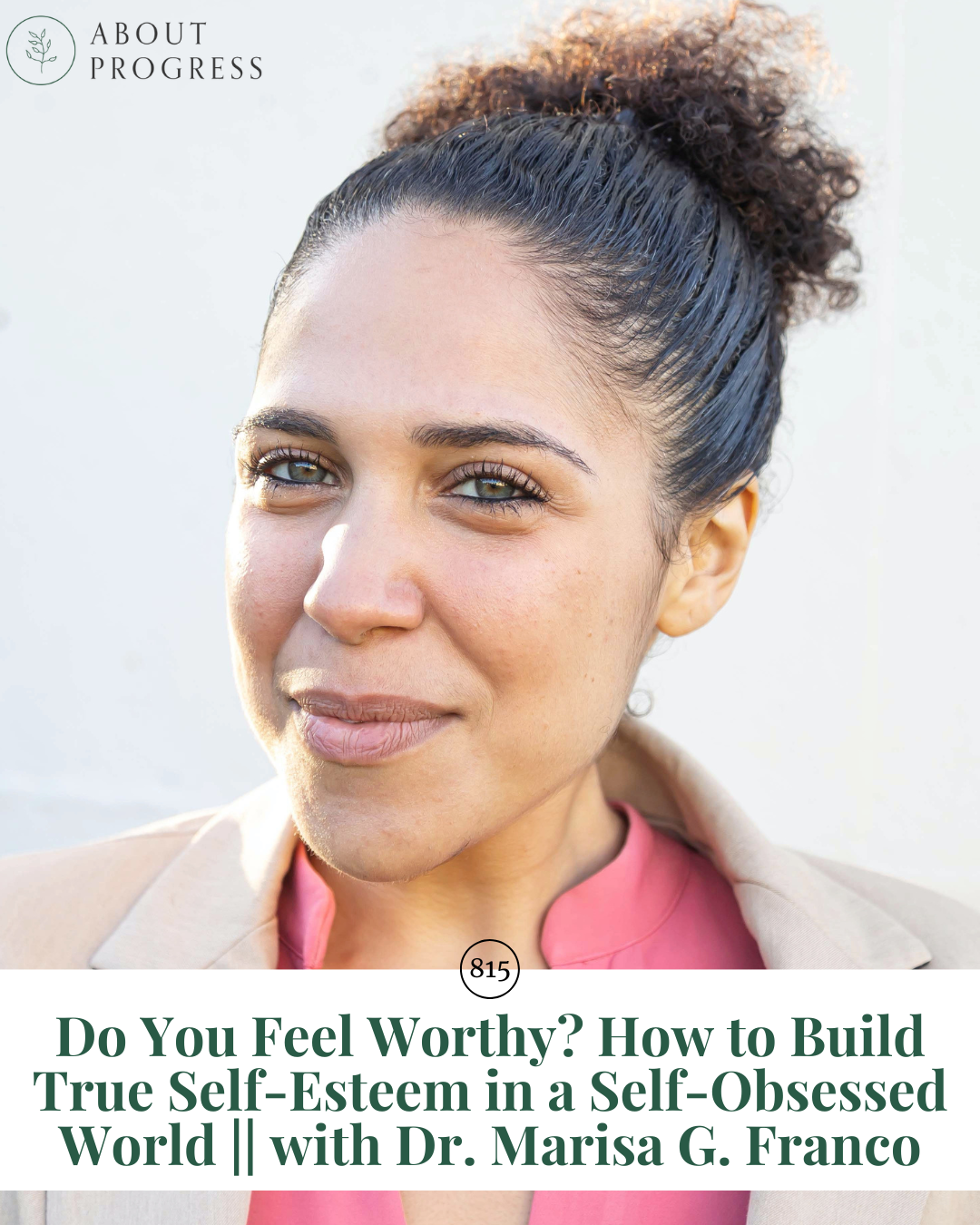
A year or two ago, I did a whole deep dive on positive thinking—and while we all know the importance of believing in ourselves, science actually shows that if you don't already have a strong sense of self-worth, positive thinking can backfire and hurt you more. That research uncovered by my friend Dr. Marisa G. Franco, was the result of years of study that completely changed how she thinks about self-esteem, self-love, and secure attachment.
In this episode, Marisa is back to reframe the way we think about self-worth. We talk about why some of our hardest patterns may be rooted in old memories, why shaming ourselves into change doesn't actually help us change, and what it looks like to become a safe place for every version of ourselves—including the messy, needy, angry, or insecure ones. If you've spent years trying to fix yourself into finally feeling worthy, this conversation is going to give you a very different way forward.
You can follow her on Instagram (@DrMarisaGFranco) or sign up for her free quiz (www.DrMarisaGFranco.com) to assess your friendship strengths.
Complementary episodes: Past episode with Dr. Franco on friendship
Sign up for the More for Moms Conference with $10 early bird pass: “LISTENER.”
Join the Supporters Club to keep About Progress around for good.
This episode brought to you by Quince. For free shipping on your order and 365-day returns at https://www.quince.com/monica. And by REBEL, your next favorite find is waiting at fromrebel.com.
About a few other things...
Sign up for the Go Getter Newsletter to get Progress Pointers in your inbox every Wednesday.
You can listen to the episode below, on Apple Podcasts, or on your favorite podcast app. If you like the show please share it, subscribe, and leave a review!
SHOW NOTES
Access exclusive supporter benefits
Leave a rating and review for the podcast!
Lend your voice and experience + be featured on the show HERE
Join Monica on Facebook and Instagram
Songs Credit: Pleasant Pictures Music Club
TRANSCRIPT
Marisa Franco: [00:00:00] I can make a mistake and I'm not a mistake as a person." And I think that's what the experience of worth is.
It's a practice of every time I have a negative emotion, I'm turning towards it and I'm offering myself care. I'm offering myself care. I'm offering myself care
Monica Packer: Hi, this is Monica Packer and you're listening to About Progress, where we are about progress made practical
A year or two ago, I did a whole deep dive on positive thinking. It is a world that really interests me, both, the research behind it, as well as the application of it. And one of my favorite kind of cultural ways we've seen that implemented is with Stuart Smalley from SNL, and how he would sit in front of a mirror and say all these positive affirmations to himself, ending with, "And doggone it, people like me."
While we all know the importance of believing in ourselves and [00:01:00] talking to ourselves kindly, there is something you may not know. Science actually shows that if you don't already have a strong sense of self-worth, in other words, self-esteem, positive thinking or self-talk and affirmations can actually backfire and hurt you more.
This research really puzzled my friend, Dr. Marisa G. Franco, And this confusion led to many years of study and even writing.
Good research comes from good questions. So Marisa's include: what if the goal isn't to finally become confident enough, secure enough, or healed enough that you stop feeling insecure?
Another question: what if real self-worth is learning how to stay on your own side when insecurity shows up? With those questions in mind, Dr. Marisa G. Franco is back on the podcast to completely reframe the way we think about self-esteem, self-love, and even secure attachment. We talk about why some of our hardest patterns may be rooted [00:02:00] in old memories, why shaming ourselves into change doesn't actually help us change, and what it looks like to become a safe place for every version of ourselves, including the messy, needy, angry, or insecure ones.
If you've spent years trying to fix yourself into finally feeling worthy, this conversation is going to give you a very different way forward. Dr. Marisa G. Franco is a professor, speaker, friendship expert, and author of The New York Times bestselling book, Platonic How the Science of Attachment Can Help You Make and Keep Friends which is a book that we talked about in a past episode.
And she has an upcoming book called Worth: The New Science of Self-Esteem and Secure Attachment. She writes about relationships for Psychology Today and has been a featured connection expert for major publications. She speaks at corporations, government agencies, nonprofits, universities across the country.
You can follow her on [00:03:00] Instagram at Dr. Marissa G. Franco or sign up for her free quiz at drmarissagfranco.com to assess your friendship strengths. While you're listening, I'm sure you're gonna have someone that comes to mind who may be struggling with their self-esteem, or maybe you've had this whole conversation of how to improve it, and I think you should send this episode to them.
So copy the URL while you're listening and text it to them. My conversation with Dr. Marissa G. Franco is coming up after a quick break for our sponsors
Monica Packer: My first book, Sticky Habits: A Woman's Guide to Reclaim Happiness, Ditch Perfectionism, and Create Habits that Last, is officially published and ready for you to buy anywhere books are sold or to request at your local library.
I was lucky leading up to the publication of the book to get great endorsements from some huge names but my favorite reviews have come from everyday women who this book was made for.
Like Jennifer who said, [00:04:00] quote, "I haven't enjoyed a book like this in a long time. It feels like someone finally saw me." Unquote. Or Aubrey, who wrote, quote, "This book shines in its tone, realism, and personality. The Sticky Habit method and the concepts behind it are special, unique, and an antidote to all the productivity experts out there."
Unquote. And finally, Ashley, who said, quote, "This book hit me right in the gut in the best way. I feel so much more hopeful now." Unquote. I've been hearing that Sticky Habits is one of those rare self-help books that won't make you feel bad about yourself, and that's the best stamp of approval I could ever seek to receive.
So get your copy now at stickyhabitsbook.com. And if you have and you've read it, let me know what you think. Especially if you leave a review on Amazon. I'm gonna give you a bonus star if you share the book Sticky Habits with a friend in real life. Again, if you haven't ordered the book yet, go to stickyhabitsbook.com, and I so appreciate your enthusiasm and support of this work
[00:05:00]
Monica Packer: Dr. Marissa G. Franco, welcome back to About Progress.
Marisa Franco: Thank you so much for having me again. I'm so happy to be back
Monica Packer: Your first interview was such a big hit, I've aired it multiple times, which is a rarity around here. It was platonic. It's about attachment through friendship, a secure attachment and how to do that. But you identified a hole, not in a relationship with others, but with yourself in a way that I think surprised even you initially before you really dove into the research on it.
I wanted to begin with your story on that. How did you see a hole in this self-relationship?
Marisa Franco: Yeah. People gave me great feedback on Platonic, but there was one person in particular who was like, "You know, you've taught me to say all of the secure things, but like, it's something else to actually feel secure internally." And I was like, "Oh, how tragic." Like, it's like you almost feel like doing these secure things feels inauthentic to you.
And like, [00:06:00] it challenged me to think about what does it mean for me to help people feel secure in their nervous system rather than it being something that they're saying, the secure thing t- that they should say. Um, so I was really challenged by that, and then simultaneously, I was reading about this theory called self-verification theory, which is fascinating, and it's basically that we look for people that verify our own sense of self.
So if I feel negatively about myself, I prefer to interact with people that don't see me too positively. Because when they do, I'm like, " I'm gonna let them down. They're gonna figure out who I really am." There's all this anxiety. And so there's fascinating research. People with low self-esteem, when they say, "I love you," affirmation, they actually feel worse 'cause it reminds them of just how bad they feel.
When they have a spouse that i... that loves them, they're less committed to that spouse. Um, when they, um, have positive events happen to them, they get sicker. And so there's all of these ways that, wow, if we struggle with self-worth, we [00:07:00] can find the love of our life, we can find that dream job, right? And it's just gonna fall right all off of us.
The beauties of life are going to slip away. And like, even if we find the safe, healthy relationships that I tried to push people towards in Platonic, they're not actually gonna feel safe for us. And so I realized to feel healthy in connection, we also need to go inward
Monica Packer: It's reminding me of the SNL clip that went on forever, Stuart Smalley. You know, like looking in the mirror and saying all these self-affirmations, like, and at the end like, "And doggone it, people like me." But your point here and with that theory is if we don't actually feel it ourselves or believe it about ourselves, we won't, experience that.
It won't... It's, it's actually damaging to do those kind of typical self-help tips that we are flooded with online.
Marisa Franco: Yeah.
Monica Packer: Can you tell us a little more about that?
Marisa Franco: Yeah. Can you talk a little more about that? Well, um, you can think about your sense of self-worth as a theory of self. If it's high, it's [00:08:00] that people are going to accept you and good things will happen. If it's low, it's that people are going to reject you and bad things will happen to you. Now, if you were convinced that that was true, that that theory was true, as people with low self-esteem are, or, you know, occasionally all of us, right?
'Cause there's parts of us that feel, that don't feel good. Then if someone was trying to hype you up, that would be very threatening ' cause it would only be more crushing now that you have farther to fall. So it is an adaptation to have a more insecure sense of self for that theory of self, for the reality in which your brain is living in.
And so that is why we reject all signs of success, all signs of positivity. It's like you're manipulating me to feel better when I know at the end of the day, the bad thing is going to happen
Monica Packer: So it's not just that we don't believe it and then we push it away, it's that it feels threatening to the way we see ourselves. Okay. Well, that feels both a lot different than the ways we've been taught, and [00:09:00] also kind of scary to change and hard to change. So is it possible then to shift the way we value ourselves?
Marisa Franco: Monica, I spent a year trying to figure out this question. Here's what I came across in the book. Um, why do we have this theory? Like, why would we have this theory that everybody's gonna harm us? And here's what I, what I read, that memories are the database of our self-esteem. We have experienced rejection, harm, bullying, neglect, abuse, shaming, whatever it is, and the thing about memories is that they don't just record the past, they predict the future.
So a part of us thinks we're literally reliving our memories all the time and our assumptions about what's gonna happen to us, how people will treat us, what people really mean. We are, we are sort of rummaging through our memories to figure out what reality is. Now, that is a tough pill to swallow 'cause it's like, well, the past, that already happened.
How do I change that? But [00:10:00] when I said memories are made to predict the future and not record the past, that's because memories can be updated each time we revisit them. Now, this is a theory called memory reconsolidation theory. And so what that means is that there's been powerful studies where people have gone into a negative memory, reactivated it, relived it, visualized themselves being back in that really hard place, and then visualized themselves intervening as a safe adult now and telling them exactly what they needed to hear in that moment for things to be less fearful, less scary, less threatening, f- less shameful.
And after they, after they do that, you know, it's kind of inner child work if people are familiar with the, the kind of therapy speak. They report higher self-esteem, better wellbeing, and even if you look in their brains at their hippocampus, which is a part of the brain that records the memory, you see changes at the neural level when they engage in this memory reconsolidation process
Monica Packer: We hear so much, you know, change [00:11:00] your thoughts. We never hear change your memories
Marisa Franco: Change your memories and your thoughts will change. Why are you having those thoughts? Get to the root of it. Yeah
Monica Packer: How, how would you recommend people pinpoint what those memories are? Because I think the beliefs, the thoughts are so front and center that we don't even recognize how far back they go, and that may be pretty challenging for people to recognize the memory behind the, the belief
Marisa Franco: Totally. Uh, well there's two directions I wanna go with this, Monica. One is to talk about implicit memories, which are things that happen to us that we don't remember that still affect us, and so we can go, um, in that direction. But I also wanna talk about the particular memories that still affect [00:12:00] our worth are what's called open memories.
So your memories could be closed or open. Closed memories are, yeah, maybe it was harmful, but it feels behind you, it feels resolved. When you revisit that memory, you don't feel anything.
Monica Packer: Mm-hmm
Marisa Franco: Um, it doesn't trigger you. You don't try to avoid it. It's just part of your story. Versus an open memory is one where you're still mad when you think about it.
You're still sad when you think about it. You're still activated. You try not to think about it. Um, you're, there's no resolution. Maybe it's something you ruminate on a lot, and it's the open memories that when people revisit those open memories, those are the ones that then they report lower self-esteem versus the closed memory.
So it's not that, you know, I, I can't objectively say, you know, you've been through this trauma and that's what you have to revisit. It's about what's your felt experience of that memory now? Is it threatening? Is it negative? Are you scared? Are you fearful? Is it still filled with emotion for you? Is it unresolved?
Those are the memories you need to go back to
Monica Packer: So is it as simple as thinking, [00:13:00] what does that belief come back to? Like, where did that start? And then to kind of analyze, is that something that still feels fresh for me? Like, do those emotions still come up?
Marisa Franco: it. Yes, exactly. So, then I need to reconsolidate. I need to revisit
Yes, I need to revisit the memory. I mean, for some of us it's our parents, right? Like, are you still triggered thinking about your parents? Are you still activated? Are you still angry at them? Are you still wanting to withdraw from them, right?
Like, the, those kind of things. Um, it's still fresh, right? It doesn't feel like it's quite in the past because it still triggers something when it comes up now
Monica Packer: So if they're able to pinpoint, let's say, an open memory that they can connect back to the way that they esteem themselves,
Marisa Franco: Yes then how do they reconsolidate? What do they do with that particular memory?
Yeah. So I, I can give us, like, some ... I'm gonna g- walk us through it to the best that I can with knowing that the, the in-depth version is in the book. Um, [00:14:00] so first you wanna activate the memory as viscerally as possible, which means using your five senses, even speaking about it in the present tense.
What am I seeing? What am I tasting? What am I smelling? What am I feeling? You know, you just wanna make it as, as vivid as you possibly can to reactivate the memory. Um, and so first you revisit memory, and you write about how does this affect how I see myself? How does this affect how I see the world? Then you go back to the memory and you ask yourself, "What did me at that time need?"
And you literally visualize just as vividly yourself going back to you at the time and saying, "Nothing is wrong with you. These people are reacting to you this way because of what they have going on. You have nothing to be ashamed of. You exactly how you are is perfect. You can cry. You can rage. I will still be here.
I will never leave you." Like, whatever it, it is that you need to hear in that moment, and you try to ... You visualize it, again, to make it ... 'Cause for us, remembering is reliving. Like, visualizing is almost a way of [00:15:00] forming a new memory in a way. Um, and then you write about, now that you've done that, you write about how do you, how do you see the world now, how do you see your sense of self now, and then you ask yourself, "Is there anything else me at that time really needs?"
And then give that, give that to yourself again, and then how do I see s- myself now? How do I see the world now?
Monica Packer: I would love to hear an example of a memory you did this with.
Marisa Franco: Oof,
Monica Packer: I'm so sorry to ask so personally, but it would be great to have that example, and then also how it practically changed in the present
Marisa Franco: Yes.
Monica Packer: back to for you
Marisa Franco: Yeah, so I did this activity with my friends, and, um, it's transformative. It really is. I'm just like, we're all crying. We're like, "We didn't even know we were so affected by this," or, like, all of the tho- all of the heaviness that was in there. So I went back to, at that time, my mom, she was a teacher, and then she would do home instruction.
She would work late, and I would go to soccer practice, and I was always the kid whose [00:16:00] mom did not come on time. And I had to wait with the coach, and the coach was like, you know, like, "Where's your mom?" And it happened, like, almost every day. And going back to that memory and me feeling like, wow, like, I don't matter.
I'm being abandoned. You know, I, I'm the one who, like, sticks out here as separate from everyone else or not cared for like everyone else. I was also, like, one of the only Black kids, and I think in a, in a, in a way, like, I could s- sort of sense that, too, that, like,
I'm sort of stigmatized. I'm sort of different than everybody else here.
Um, and feeling kind of, like, deficient and wrong and, like, unloved and uncared for. And, like, that's the thing about this, Monica. Like, kids have really big feelings, and so it's not about relating to this as you would as an adult, but, like, going back into what was that like for me as a child to experience that continuously.
Um, and then it was me as an adult going back in there and saying, you know, like, "Your mom is working. It has nothing to do with [00:17:00] you. Nothing is wrong with you. Like, your mom can not show up every, and that wouldn't mean anything about you. You've always deserved someone to show up for you. You've always deserved something to be here for you, and you're not lesser because your, your, you know, your mom is different than these kids around you reacting.
That doesn't mean anything is wrong. It doesn't mean that you're lesser. Like, you are so okay just as you are, and in fact, this isn't even something that you've chosen to. This is something happened to you, so it's not something to hold against yourself at all." And I'm tearing up, and I'm like, " I didn't know there was so much stuff in there."
And I'm writing about maybe people can show up for me, you know? Now with this new memory, maybe, maybe people will be there when I need them. Maybe, like, when people aren't there, I don't have to, like, relive, like, all of this, these feelings of shame and hurt, right? And maybe I can trust that I'm someone worth showing up for or, um, someone worth being there for.
And so, you know, it sound ... Again, as I revisit, I'm like, it sounds like a little memory, but I think, you know, for me, it affected me. And I think that [00:18:00] the, the secret to being worthy is being honest about what affects you rather than trying to put a bow on it and make it into something that it wasn't
Monica Packer: Thank you for sharing that really great example, and also showing that it doesn't have to be a hugely traumatic event, although it certainly can, and that I'm sure would, you know, require some real professional support to walk through. But I think a lot of us are similar in it being these smaller moments and maybe ones that were repeated, and not really recognizing, oh, that really did impact me.
Like, it's not something I could write a memoir about, like that one story, but it definitely impacted me
Marisa Franco: Right? Like, why am I so anxious about time now? Why am I so a- why am I getting so mad when people show up late? Why am I, like, going straight to, like, this is disrespectful, and, like, having such a strong reaction to it, you know?
Monica Packer: Got it. Okay. Okay, this whole process is really fascinating, but also very helpful. Like, I see how tactile it can be for [00:19:00] us as we're working through it, and it all goes back to this deeper foundation that you're trying to help us build, which is our own sense of worth, which I think you equate with self-esteem.
Marisa Franco: Mm-hmm
Monica Packer: What do you think we get wrong about self-esteem in our self obsessed- culture right now?
Marisa Franco: So Monica, as I am reading about self-esteem, I realize that there are two very different kinds of people who say they have high self-esteem, who say they feel good about themselves, who say they're a person of value. One- No, you can say the swear. Yes, One type is really mean to everybody around them. The other type is really kind and compassionate and loving towards everyone around them, right? And so as I'm reading this, I'm like, "What are the difference between these two people that both say they love themselves, both say they feel so good about themselves?"
The mean type, they compartmentalize anything negative about themselves. They try to push it away, not look at it. They feel good 'cause they're avoiding any negative emotions. And once you trigger that in them, once you [00:20:00] remind them of their own shame, they get feral. They get hostile. They get antagonistic.
They're the person that'll, gonna cut you, cut you off if they, if you cut them off, right? They're gonna escalate. They're gonna get defensive. If you give them constructive feedback, they're gonna tell, "No, let me tell you why this is actually your fault," right? They're always trying to act superior to other people.
And so I wanted a definition of worth that was about feeling everything, realizing that for some of us, our quest for self-esteem, that's contingent on us being this excellent person and threatened whenever we're not, and then we're getting mean whenever we're not, right? That that's ... I needed a more, a, a definition of worth that had more integrity, that was about fully acknowledging your internal world rather than trying to avoid it and perform high self-worth all the time.
And so my definition about self-worth is about acknowledging everything that you feel, having high regard for yourself, even if you feel vulnerable, even if you feel weak. Like, all of that is okay. That's part of my internal [00:21:00] experience. That's something that I welcome. And so one person I interviewed who was the sort of kind kind of self-esteem, they said they would, they would kind of, like, wave their hand over their day to see where their energy lied, their emotional energy lied.
They were intentional about trying to seek out their triggers and negative emotions because they wanted to show care for those parts of them. It's quite the opposite of trying to avoid anything negative about you. It's, "I can make a mistake and I'm not a mistake as a person." And I think that's what the experience of worth is.
It's a practice of every time I have a negative emotion, I'm turning towards it and I'm offering myself care. I'm offering myself care. I'm offering myself care
Monica Packer: I think we all know someone in our lives who is that mean version of someone with high self-esteem.
Marisa Franco: Yes, we do.
Monica Packer: I think it's a, it's much harder to think of people who are that, embody that kind self-esteem, and I think the factor to it is this ability to feel [00:22:00] secure about your insecurities.
Marisa Franco: yes
Monica Packer: Oh, I wanna, I wanna hear more about that, because I think this is gonna be something that really confuses people.
Like, how can I have high self-esteem while having integrity, like you said, and embodying, like, me as a whole person, my humanness, having compassion towards myself about it, but also as part of that feel secure about my insecurities? Like, what does that even mean?
Marisa Franco: know, it's complicated.
I have a question for you busy moms. When was the last time you got to spend a little time learning about you? Not how to be a better mom, not how to do more for your family, but how to feel better, live better, and feel a little more like yourself again. That is exactly why I created the More for Moms Conference, and it's back for its second year, and I want to personally invite you to attend.
The More for Moms Conference is a [00:23:00] free online event with 25-plus experts that will help you find more in five areas of your life: your happiness, habits, health, home, and hobbies. Our conference will start September 28th, and you can watch the speaker sessions or listen on the go completely for free for seven full days with the Basic Pass.
Or with the affordable All-Access Pass, you can get lifetime access to ad-free versions of all speaker sessions and in addition to that, get exclusive bonuses and even a copy of my book, Sticky Habits, sent to the US address of your choosing. For a limited time, you can use the code listener to get $10 off the All-Access Pass at aboutprogress.com/moreformoms.
This conference isn't about adding more to your already long to-do list. Instead, it's designed specifically for moms with very full lives who are ready to feel more like themselves again. Because being a good mom does [00:24:00] not require you becoming less of a person. You don't need to do more.
You need more of you. PS, your kids need that too. So put yourself back on the list and join the More for Moms Conference now. Sign up for free with the seven-day Basic Pass or get lifetime ad-free access with the All-Access Pass using the code listener to get $10 off for a limited time.
Head to aboutprogress.com/moreformoms to grab your spot. Again, that's aboutprogress.com/moreformoms. I can't wait for you to join us.
Monica Packer: Like, how can I have high self-esteem while having integrity, like you said, and embodying, like, me as a whole person, my humanness, having compassion towards myself about it, but also as part of that feel secure about my insecurities? Like, what does that even mean?
Marisa Franco: Know, it's complicated.
Well, um, it's about putting telling the truth about where you're at as [00:25:00] being more important than having to be in a particular place. And that's key because we cannot regulate what we don't acknowledge. We cannot care for parts of ourselves that we are pushing into the shadows.
And those parts of us that have low self-worth, right, they need something from us. They need our support. They need our care. And the more we push them away, the more they hijack us in ways like that mean high self-esteem person to say, "I'm feeling ashamed. Don't let me feel ashamed anymore. Put that other person down," right?
But when we turn towards it, now we're able to offer that support, and we're not as hijacked. So it is really about the most secure people are not never insecure. They are okay with being insecure. They can acknowledge that. They can say, "I was feeling really insecure in that moment." They can tell the truth of their insecurities and not think that that means something shameful about them.
So in my own therapy work, this was me bringing up a part of me that's, like, more anxiously attached and felt a lot of [00:26:00] shame and neediness, and, like, in my therapy, we use, like, divine force and, like, what would that divine force tell you? And I, I did that, and it was like, "That part of you is perfect, too.
Like, that part of you is perfect, too, that anxious part. It's perfect, and it's been carrying pain for the rest of you," and, like, how lovely. Like, how do I, how do I love that part of me that I have been pushing away for so long? Um, you know, I share this ... I can share a quick quote from the book.
Okay, so this is how I've started to relate. 'Cause I used to be a ... You know, I'm sure a lot of your audience relates if they're a perfectionist. My default was okay, and anything that challenged that default, I just tried to ignore. And it caught up with me, let me tell you. And so now I'm not trying to make my defaults okay.
I'm just trying to make my default what is true for me. And so going back to the parts of myself that I've struggled with, and I've, I'm saying, "I'm so sorry I've neglected you. I'm thankful for the ways you carried the pain I wasn't willing to see. I never want you to stop crying, raging, and screaming out about how [00:27:00] hurt you are.
I want to create an environment within myself where pain isn't something I ignore and shame myself for. Because without this pain, I may have never known these depths of love."
Monica Packer: Ooh. That's a whole different way of being, it feels like. I, I know one fear that comes up for people who are first trying to learn how to embrace their imperfections, and it's, like, okay that they have them to begin with, is this whole, again, fear that if I am kind to myself about my imperfections, then I'll never work on them or they'll never
Marisa Franco: real. Yeah, so relatable
Monica Packer: you've been kind of teaching the opposite here. Like, it's actually the neglect of them, not notice- like, refusing to see them and face them and accept them is what makes it so we are continuing those, in those patterns. But I think there's the, the other side of the spectrum too when if we are only paying attention to them and consumed by them, that's also [00:28:00] not good in self-esteem with, with high integrity.
So how can we work with that fear that ... And I, I, I always say, like, the, the fear is acceptance equates apathy.
Marisa Franco: Yes. Yes.
That's a good way of putting it
Monica Packer: with that fear while not becoming that mean self-esteem person and also the person who has, like, no self-esteem 'cause they're too hard on themselves?
Marisa Franco: Yeah, so I think I read this metaphor in the book, and I wish I remembered which so I could cite it. But, um, let's say you're playing basketball, and your coach is like, "You suck. Get better. You suck. You suck. You need to get better." Like, "You humiliate me." Or another coach is like, "All right, let's explore what you're struggling with here.
Um, it seems like you get- you kind of clam up when you, when you're dribbling for too long. You look up, and you get a little bit afraid. What would help in that situation? What's the support you need? Seems like when you shoot the ball, you're, you're holding your hands a little bit lower. Like, can we get a little higher with that?"
Right? Like, what's actually gonna make you better here? Like, this is how we're relating to ourselves internally often. You [00:29:00] suck, you suck, I'm gonna humiliate you, and now you're gonna get better, even though you don't even know what the problem is because you haven't actually explored that side of you.
You've only just shamed it, right? And so it's, it's not... I, I guess it's, like, a way of acceptance, but it's also, like, deep exploration and deep support and deep love for that part of yourself that you're struggling with because that part of you needs something. And you will only know what that part of you needs if you are able to turn towards it, allow it to be as it is, and explore what it needs from you.
And you know, if you're anxiously attached, you probably need someone to tell you that you're worthy of love and that you don't have to be ashamed of yourself and that you're not too much. And if you're avoidantly attached, you probably need someone to say, "Hey, your boundaries are okay. You know, it's okay if you need some space, and it's okay to feel, and it's okay to be vulnerable, and that doesn't mean anything less of you," right?
But you only know what you need if you explore it and if you take time to understand yourself. And that is why, and I think it's so foreign, it was foreign for me too, to know that change can [00:30:00] happen without shame, and it's, like, only something you'll actually believe once you actually embody it and do some of this work because for so many of us, it's our whole life.
Our change has happened from a place of shame and coercion. And the change is gonna feel fundamentally different. It's not gonna feel full of anxiety. It's not gonna feel urgent. It's not gonna feel like I have to change this or else. It's not gonna feel like if I'm not perfect about this, then everything's gonna come crashing down.
The change is gonna come from a place of peace , more tranquility, more in- in- internally driven desire that this is what I want for myself rather than something that I think everyone wants of me.
Monica Packer: And when I think of that person, I do see someone who knows they're worthy and has that, that self-esteem bounded in integrity, like founded in integrity there, of someone who knows like, "Yeah, I'm a human and I'm imperfect and I need some things to change, and here's how. And I, I'm not gonna do it by hating myself and I'm not gonna do it by ignoring it."
It feels different. I can almost see it. Um, [00:31:00] so I guess you're saying self-talk does still matter.
Marisa Franco: I am um, but I think it's, it's really about that self-talk changing something in your body and your felt sense. Um, like it's the ... If you're ... Uh, 'cause if you're saying, "I love you, I love you," like I said, and it's not actually sinking in and it actually is feeling threatening emotionally, it's not what works, which is why it's really about curating the self-talk to what actually feels like it's creating an emotional change in you.
Monica Packer: And it also seems that it's the truth too. Like, the self-talk is still true. It's not like the Stuart Smalley kind where you're just basically saying these platitudes to yourself, trying to force yourself to believe things you can't because of these memories that you're housing inside of you and these patterns of, of living and s- and thinking to yourself too.
Uh, it's, it's being honest with yourself, but in a different way
Marisa Franco: Yes, exactly. That's, that's what it is. Like, I just want us all to become real, like to stop feeling like we need to feel anything different than what we feel for our feelings to be acceptable. Because that's just... You know, and this is, you know, I [00:32:00] told my ex-girlfriend about this, some of this practice and, ' cause she was always like, "I'm so secure, I'm so secure, I'm so secure."
And I was like... And sh- her, you know, when her friend would leave late at night and she'd be all alone, she would have, like, these intense triggers, and she would kind of ignore them and numb out, um, because she saw herself as secure, and this didn't match her secure energies. But I was like, "It's not about being secure.
It's about being real." And so then she could start acknowledging, "I'm feeling so abandoned. All of this is coming up for me," and actually feel those feelings and say you're okay and you're still safe, and provide herself with the support that she needs. And that's, that's how I think the secure attachment movement, in becoming a status symbol, in making us all wanna w- say, " We're so secure.
We're so secure," similar to, like, the self-love movement, has actually estranged us from who we really are, and we need to start with who we really are and provide care. We need the, we need the medicine. We need the medicine to correspond to the actual issue that we're having
Monica Packer: That was the perfect [00:33:00] transition. That's what I wanted to ask you about next is this whole secure attachment piece and how it gets misapplied to self-esteem and, um, self-worth. Um, because you talked, you talked about this so beautifully and you, and you teach about it so beautifully in terms of friendships that it's, it's almost like mystifying that it gets misapplied towards ourselves.
So can you highlight a few ways that may be happening for people who, you know, have been learning a lot about secure attachment, maybe read your book Platonic, have worked on, on that within their relationships, and then how they may be misapplying it with themselves?
Marisa Franco: I can say this 'cause I'm the one who's been supplying it too,
Monica Packer: Which I love how honest you are about this in your book. Yeah
Marisa Franco: seriously, you know, we're all on a journey. Um, so there's certain, like, kind of like rules of being securely attached, let's say, if you're like really into the attachment literature. Like for example, when someone else is activated, I need to co-regulate them.
I need to provide them with the care and support they need to be [00:34:00] less activated. But the first step for true security to me now is checking in with yourself. Am I in a place to actually offer that? You know, how do I actually feel? Am I being activated too? Because I, I might not be able to do the secure thing right now.
Like, that might not resonate with what's actually emotionally happening for me. Or like with women I really see, they will use grace to destroy their sense of self. I've heard women, you know, this is speaking events that I do, women talking about, "I just had a miscarriage. My friend invited me to the baby shower.
You know, it's triggering for me, but should I be more giving? Should I be more generous? Should I have more grace?"
Monica Packer: Should I be more secure?
Marisa Franco: yeah, and it's the kind of question they're asking themselves?
and it's like you don't need to rewrite your emotional reaction, especially as women, we're so socialized. What was going on for them? What was happening for them?
And we're trying to squeeze our own emotion into a framework of what might be acceptable given this person's circumstance. Free yourself of that. [00:35:00] However you feel is okay. The first step is to align with yourself, to admit what you actually feel, to admit how this actually is affecting you, and that is okay.
And in fact, that's really helpful information as to what you need to move forward. For me as a friend, 'cause I really value friendships, often it's me trying to be the bigger person when I don't feel like I'm being treated right. I think it's the secure thing to be the bigger person. This person's going through a tough time and so, you know, I'm gonna try to get over it.
But the truth is, maybe I'm not over it, and me, me tuning to my own emotions is telling me that, and maybe I need to stay in a place of friction here to be in integrity with myself. And so sometimes this is gonna create more friction for you to be in alignment with yourself, but what it's gonna do is it's not gonna estrange you from yourself, and you're gonna find connection where you can be fully yourself within the context of that connection.
And that, I think, is what true connection actually is
[00:36:00]
Monica Packer: You said the word alignment. That seems like maybe one of the most important and determining factors to knowing how you esteem yourself, if you find yourself as worthy. What does that look and feel like for someone who's like, "Alignment?
Marisa Franco: Ha.
Monica Packer: What does that mean?"
Marisa Franco: does that mean? Yeah. You know, there's a couple of steps that I, I suggest for your work on worth, which is, like, when you're feeling any sort of triggered emotion, the first step is to just recognize it. Don't do anything with it, just recognize that it's there. I'm feeling hurt, I'm feeling angry, I'm feeling sad.
The next step is to regulate, which is to offer yourself what do you need? What do you need to hear? Put your hand on your chest. I'm safe. I'm safe. I'm safe. The third is to respond, which is now to use that information to do something in your connection. [00:37:00] This is-- You're not always gonna get to the state of response, but sometimes you will.
And so what that means is, like I said, when you're in, like, a conflict with a friend, how's this actually affecting me? Not, how should I be affected? Not, what's socially acceptable way to be affected? Not considering their context, what should I allow myself to feel? But how do I actually feel? And we-- So for some of us, that may be such a foreign question to us that we may have to ask ourselves, "If I felt fully safe, how would I feel?"
Because those feelings of, like, you know, I, I'm so used to someone trying to shame me for my emotion that I don't even know what it is anymore, right? If I felt fully safe, what would be the emotion that I'm experiencing right now? What would be the care that I need to offer, and what do I need to ask for?
And so it would- might be navigating that conflict with saying, "I know you're going through a really tough time, and this landed in a really hard way with me, and I need some repair and acknowledgement to be able to move forward. And if that doesn't happen, I'm not actually able to move forward while staying in alignment with myself."
Monica Packer: This is bringing it all back to a word that [00:38:00] really resonated with me when I was reading your book, and that was safe, safety. I mean, that I think is what someone who has a securely attached relationship with themself looks and feels like. They're safe to others, and they feel safe within themselves. And that doesn't mean they're transcendent of every imperfection, that they're so insecure they never experience a low moment or a moment of, of, of insecurity.
Um, but they are safe to work through it themselves, and they're safe for other people
Marisa Franco: Yes. It's like it's not I am safe so I never feel bad. It's I'm a safe container for everything that I feel. I'm a safe container for me feeling vulnerable, for me feeling weak, for me feeling ashamed. I am a safe container wherein I can look at that emotion and provide myself care and support
Monica Packer: You also talk about a transcendent kind of identity. Um, you, you don't know this about me, but I'm a habits and identity coach. I, I talk a [00:39:00] lot about identity. E- everything goes deeper. I loved how you talked about identity
Marisa Franco: Thank you
Monica Packer: in a, again, a self-obsessed world, I think we get stuck in that part of it.
And y- there's one part where you talk about how it's a good thing for us to get to a point where we're like, "I don't know who I am."
Marisa Franco: Yes.
Monica Packer: So for people who are moving through these stages that you've been illustrating for us today, why is that not the worst thing that could happen to them, to have that moment of being like, "Wait, so who am I now if I've, you know, reconfigured these memories, if I'm shaping the way I speak to myself, if I'm changed the safety in myself and with others?
Then if I feel a little lost, why is that not the worst thing?"
Marisa Franco: Yeah. Well, here's the thing. Our identities often estrange us from our felt experience. So I'm the strong one. Now when I'm weak, I'm just ignoring that, right? I'm the secure one. Now when I'm anxious, I'm just pushing that part of me away.
Monica Packer: Yourself for it?
Marisa Franco: Exactly. Or, like, for me, it's like I'm the friend [00:40:00] expert, so I always have to be the bigger person, right?
But what am I actually feeling? Or, like, you know, I, I remember getting like a, a flyer for Factor meals and I'm like, "I can't buy these single person meals. I'm the connector." But what do I... I don't like to cook.
Monica Packer: Yeah. Those are good
Marisa Franco: actual by the way. Those
Thank you. Ah, vote, yeah, vote of confidence. Um, so yes, our identities can really estrange us from our actual felt experience, and that's why I talk about the value of not knowing yourself, because it allows you to experience your emotional world more fully, right?
Like, all of these pressures I feel, like I know moms feel these pressures, too. I can't feel any resentment towards my kids. I can't feel any anger towards my kids, right? But it's like, what if I just allow myself to feel and then determine who I am from that rather than putting this top-down almost like, it's almost like a, I don't know, like a helmet or something that's, it constr- a trap onto like my, my own felt experience based on my identity.
So that's why I talk about the importance of not knowing who you [00:41:00] are. And at the end of this I... And, and if you think about being insecure, that's knowing who you are, right? That's despite my success, despite the love, despite anything positive coming towards me, I'm like, "No, I'm still unworthy," right? And there's this, um, psychologist, Robin Carhart-Harris, he talks about how when we go through something chaotic and unpredictable, one way we cope is we make ourselves predictable.
We make our own identities predictable. Now I am, you know, this person who has low self-worth, who knows what's gonna happen, who's always prepared for it. And so when we do this work of memory reconsolidation, all that's certain is possibility, and we are okay with that because we can have high regard for ourselves no matter what happens.
And so it's not about I always know myself. It's about I respect myself as not a human being, but a human unfolding. Like there's a, Alan Watts, he's a sort of Zen leader. He talks about like, "Look at a fist. It only exists in a certain stance. Change my hand and the fist disappears." Like we [00:42:00] exist within a certain context.
We're in a different context and our emotional world is completely different, and that's something that we can welcome so that we can truly know who we are
Monica Packer: I think in many ways, like having a strong sense of self, a strong sense of worth really, is transcendent of those periods of e- evolution as we're reacquainting ourselves with who w- we are, we're becoming new people. And I kinda had that moment too this past fall. I went on my first solo trip ever, uh, and abroad.
I went on a Pride and Prejudice pilgrimage, Marissa. It was so
Marisa Franco: cool, Monica.
Monica Packer: It was amazing.
Marisa Franco: that for you
Monica Packer: But it was, it was really... I, I've, I've talked about this a little bit online, so I don't mean to be repetitive here, but the trip was equal parts filled with joy and grief because I experienced myself in a way that I hadn't in a long time, and in a way that I found confusing as someone who's an identity coach, you know?
And it [00:43:00] was a really important moment though for me to recognize who I am is allowed to continue to evolve. There's stages to this. It's transcendent of just this like, I decided these are my values, and so this is it. This is who I am. It's allowed to shape, um, in a different way and at different times. So that's been an important instruction for me personally
Marisa Franco: I feel like I just exhaled hearing that story, and, like, it's just so important because, like, for example, like, I've had a sprained ankle for eight months. I'm a very active person. I love running. I was getting into surfing. I was hiking. I was dancing. But honestly, writing this book helped me so much because it was like, I don't have to be who I've been.
Like, this is part of life. Change is something that I welcome, and, like, what can I do now? I can still do my weightlifting. I still do my yoga, and, like, it's okay. It's okay that I'm not who I've been or who I predicted myself to be, and I can bear this version of reality
Monica Packer: And that to me really does again exemplify the safety piece [00:44:00] of being someone who knows that they are worthy.
Marisa Franco: Thank you. Thank you, Monica
Monica Packer: Oh gosh, so Marisa, I could talk to you for hours, but I do wanna direct them to your book Worth. I'm so excited for it. Is there anything in particular you want them to know about this book beyond what we've already talked about
Marisa Franco: Oh.
Oh, well, there is a story that I wanna share that I think brings to life some of the concepts we're sharing. So I was hanging out with a friend, and I... He's a professor, too, and I was telling him about this book, and he was like, "I am worthy. Like, that almost sounds like you're still evaluating yourself.
What you're saying seems like you're going beyond self-evaluation." And I was like, "You're so right. It's not about I am worthy. It's just about I am. I am. I am
Monica Packer: Mm-hmm. That's it. I can't wait for people to read it. Is there any other place they should go if they want to connect more with you and learn from you online?
Marisa Franco: Yeah, absolutely. So the book is called Worth: The New Science of Self-Esteem and Secure Attachment. I have tons of exercises there to improve your sense of worth that's based on the science. Um, if you wanna find tips from me [00:45:00] from Relating to Self and Others, you can find me on Instagram at DrMarisaGFranco.
That's D-R-M-A-R-I-S-A-G-F-R-A-N-C-O. Or you can reach out on my website, DrMarisaGFranco, for any speaking engagements related to self-worth, resilience in times of change at work or outside of work
Monica Packer: Marissa, we always end with one question, and it's what is one small way listeners can take action on what they learned today?
Marisa Franco: Next time that you're triggered, turn towards yourself and tell yourself you're safe, you're okay, and you're loved
Monica Packer: Beautiful. I've enjoyed every moment of this conversation.
Marisa Franco: a great conversation really so good, but that's all you. Thank you very much for being willing to return to us and to speak with us today. It was, it was everything
Ugh, I really was, Monica. I just feel like we're so kindred on these topics. Like, you made my eyes light up. You made all my excitement gush out of me.
Monica Packer: Good. That's what I love to hear. [00:46:00] We did it. Okay, let me... I, this, sorry, it's a new platform for me
I hope this episode gave you the hug and kick in the pants you need to grow. I'll now share the progress pointers. These are the notes I take so you don't have to, and those on my newsletter get them in a graphic form each week. You can sign up at aboutprogress.com/newsletter. And what I share in the graphic each week will be an expanded version of what you hear on the podcast.
Pointers to help you improve your self-worth. Number one, Notice what you feel before deciding what you should feel. Number two, treat your triggers as information, not evidence that something is wrong with you. Number three, you can accept yourself and still want to change.
Number four, practice becoming a safe place for yourself. And number five, let your identity evolve. Again, the expanded version will be available in a graphic form by [00:47:00] signing up at aboutprogress.com/newsletter. If you sign up and it's already been sent out, just reply to an email you get from us and ask for this graphic.
This podcast is listener supported. Members of the Supporters Club make my work with About Progress free and available to all without having to put About Progress behind a paywall or dramatically increase the number of our ads. In return, supporters get access to three levels of exclusive benefits for more time to more content with me, including my private premium ad-free podcast, More Personal, that's separate from About Progress and is so much fun to produce.
You can sign up at aboutprogress.com/support. You can always support the show for free. The best way to do that is to share this episode with someone who came to mind as you were listening. And the second and also free way that you can support the show is by leaving a rating and review on Apple Podcasts, and doing so right now will automatically submit you to my annual Favorite Things giveaway that I do each year around the anniversary [00:48:00] of the podcast, and that's coming up in November.
So leave your review now, and you are way more likely to win a prize. You can do that on the Apple Podcast app. Thank you so much for listening. Now, go and do something with what you learned today
Marisa Franco: I realize that there are two very different kinds of people who say they have high self-esteem, who say they feel good about themselves, who say they're a person of value. One type is a total asshole to everybody. And the other type ... Oh, sorry. You're gonna have to edit
Monica Packer: It's okay. Maybe you could say just jerk or something.
Marisa Franco: One- No, you can say the swear. Yes, one type