
How To Dress Yourself and Rediscover Your Style as Your Body Changes || with Angela Foster
May 18, 2026
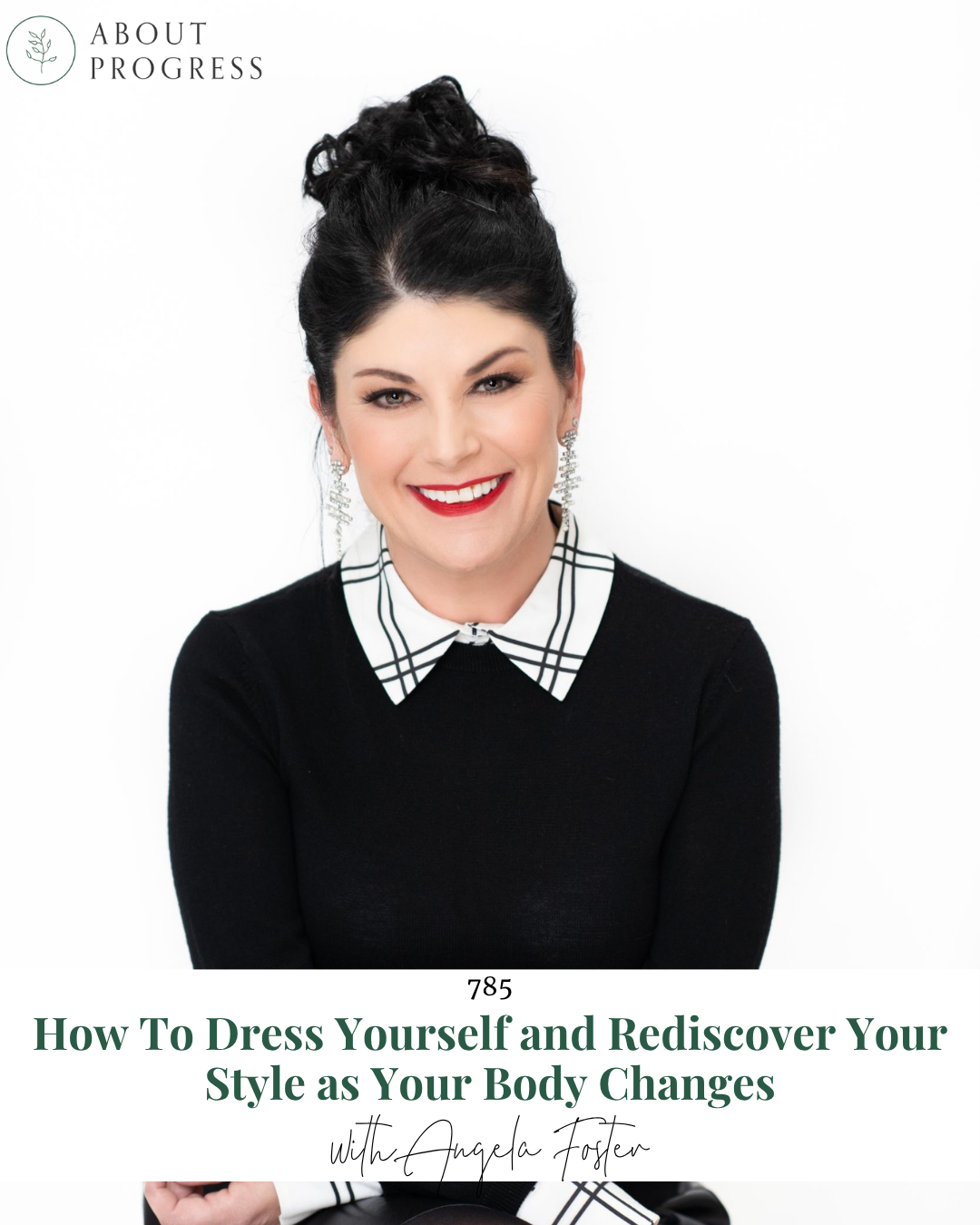
Feeling like you have nothing to wear often stems from a disconnect with your evolving body and lifestyle. My chat with Angela Foster illuminated how personal style is more about authenticity than trends. We discussed the importance of understanding your body shape and dressing for your current life phase, rather than an idealized image. Angela's approach is about crafting a wardrobe reflecting your true self and simplifying your daily routine. By focusing less on fleeting trends and more on what resonates personally, you transform your closet into a space that supports who you are, enhancing both confidence and ease.
Angela’s website, LinkedIn, Body shape quiz: angelafoster.co/monica
Get the Best Summer Ever Workshop at half-off old pricing!
Preorder Sticky Habits book today!
Join the Book Launch Committee for behind-the-scenes and first peeks at all things book.
Join the Supporters Club to keep About Progress around for good.
Complementary episodes: 5 Steps to Reconnect with Your Style (episode on closet curation, referenced)
About a few other things...
Sign up for the Go Getter Newsletter to get Progress Pointers in your inbox every Wednesday.
You can listen to the episode below, on Apple Podcasts, or on your favorite podcast app. If you like the show please share it, subscribe, and leave a review!
SHOW NOTES
Access exclusive supporter benefits
Sign up for the next Sticky Habit Intensive
Book Launch Committee
Leave a rating and review for the podcast!
Lend your voice and experience + be featured on the show HERE
Join Monica on Facebook and Instagram
Songs Credit: Pleasant Pictures Music Club
Sponsors links + codes: Get your AquaTru water purifier with the discount code “MONICA.” Get your teen Knix with code “PROGRESS.” Go to Quince for free shipping on your order and 365-day returns.
TRANSCRIPT
Angela Foster: It's not about being dressed up, it's about being dressed in clothes that feel like you and you're comfortable and confident in.
Monica Packer: Hi, this is Monica Packer, and you're listening to About Progress, where we are about progress made practical. We have all had that experience of standing in our closet and surveying our wardrobe and feeling like we have nothing to wear But the truth often is it's not the clothes, it's how we feel in them.
Bodies change. This is something I wish that I had learned from a really young age. I wish somebody had sat me down and told me, "Monica, your body is going to change not just every day of your life, but every week, month, and year. It will never be the same every single day."
I think if I had known that, then I wouldn't have struggled as much when my wardrobe no longer fit my body, but even more so how my body no longer felt like it fit my life. When our closets no longer match our bodies or our lifestyles, even our values and how we see ourselves, that's why it can feel like we have nothing to wear. Today's guest wants to help change that daily conundrum for you so you can rediscover your style and know how to dress yourself as your body changes, because your body will change.
I speak with Angela Foster, a stylist who will help unpack the emotional and practical layers underneath women's relationships with style. We talk about perfectionism, body changes, trends, confidence, motherhood, and why so many women feel disconnected from getting dressed. What I loved about this conversation is that it's really not about the fashion, although there's a lot of great fashion tips here.
It's really about identity. It's about learning to trust yourself again. It's about dressing for your real life instead of who you think you are supposed to be. Talking with Angela reframed some issues I've had with my own closet, but more importantly, my new phase of life. I know it will do the same for you.
After 20 years as an executive in the fashion and beauty space, Angela Foster became a petite style coach in 2018, creating the Spark Petite Style Method, a proven framework for women to build wardrobes that actually work. Through her coaching services and weekly podcast, Inside Petite Style, Angela eliminates the frustration and decision fatigue professional women experience getting dressed in the morning.
Her clients never again stand in their closet thinking, "I have nothing to wear." Maybe you heard a friend say that about her own closet. As you listen, copy the URL of this episode and text it to her. My conversation with Angela is coming up after a quick break for our sponsors.
Monica Packer: I am never two feet away from my water bottle, and that's because I'm always parched. And what helps me maintain my habit of drinking water is not only does it taste good, but I know it is clean too. Did you know that three out of four US homes have toxic chemicals in their tap water?
Even though contaminated water looks clear, it could put you at risk for health concerns from fatigue, hormone disruption to cognitive decline. Surprisingly, standard fridge and pitcher filters do little to remove most contaminants, and bottled water contains microplastics.
So what's the solution? Get AquaTru like my family. It's a countertop water purifier, tested and certified to remove eighty-four contaminants, including chlorine, lead, forever chemicals, and microplastics. Its patentint four-stage reverse osmosis system goes way beyond ordinary filters. For pure, healthy water you can trust, no plumbing, no installation. We have had ours for a long while, and when we first got it, my kids were enthralled with it, mostly because of the taste.
I replaced the filters many times, and it's so easy to do. It also looks pretty good on the counter. Join ninety-eight percent of customers who say their drinking water is cleaner, safer, and healthier.
Go to aquatru.com now for twenty percent off your purifier using promo code Monica. AquaTru even comes with a thirty-day best-tasting water guarantee. That's A-Q-U-A-T-R-U y- A-Q-U-A-T-R-U.com, promo code M-O-N-I-C-A, aquatru.com.
Monica Packer: Summer is fast approaching. If you are a mom who has had summers only about survival, it's time to instead create a summer for the scrapbooks. To help you do that, sign up for my $17. On-demand workshop the best summer ever. Workshop in 60 minutes with me. You'll get clarity on what you want the summer to look and feel like.
Create a personalized plan for realistic routines, rhythms, and household rules to make your summer sing and establish a path to still prioritize self-care. All with the printable workbook. To boot. Go to about progress.com/workshops to get the best summer ever. Workshop today and then watch it when you're ready.
And while you're there, check out my other available on-demand workshops, how to dream again and new rebuilding a relationship with me. All workshops are currently priced at over half off my typical workshop pricing because times are tough, but you still deserve support. Again, get a workshop or two tailored designed for you, especially the best summer ever.
Workshop now at about progress.com/workshops.
Monica Packer: Angela Foster a warm welcome to about progress.
Angela Foster: Oh my gosh. Thank you so much. And I have to tell you, I have been so looking forward to this conversation. I personally am a fan of yours and your podcast. And then just also to be able to like, share some like easy takeaways for your audience has been, it's been very exciting, so thank you.
Monica Packer: This interview has been much requested by our community
Angela Foster: Oh, good.
Monica Packer: it's a lot about just women feeling like they don't know what to wear or they have nothing to wear. That kind of really is what, how they state the que the or, that's how they state. I have nothing to wear,
but I wanted to start with that actually.
Angela Foster: Yes.
Monica Packer: that seems to be actually masking a lot of other things, lots of other layers there.
Angela Foster: Yep.
Monica Packer: to know from your personal experience, how you think that belief, that anxiety is possibly tied more to perfectionistic thinking or prescriptions, like those style rules that we have floating around at all times.
Angela Foster: You kicked it off with the juicy one. So I have,
Monica Packer: Yeah.
Angela Foster: I have a, a cup, A couple of thoughts on this. So the first thing is my, my clients have all started off when we start working together with the, I have nothing to wear, comment, and never ever have I walked, like, seen their closet or walked into their closet and then literally have no clothes.
So. It's more of a feeling, and to your point, a mindset. So typically what it means is I don't have anything to wear that flatters my body. I don't have anything to wear that flatters my new body shape or nothing that I love to wear. Or it can even be, I don't have any complete outfits. So
Monica Packer: Okay.
Angela Foster: manifests itself in lots of different ways, but.
A couple of things. The first one is, you know, your mom will sit you down when you are at a specific age and say, you know what, honey? I'm gonna teach you how to do this, or I'm gonna teach you how to shave your legs, or I'm gonna teach you how to do, you know, all of these things that our moms are amazing at teaching us.
And never once, at least the women that I hang out with. And of course they're all, you know, like they're coaching clients. So, um, has a mom sat down and said, Monica. Let's talk. You're gonna start shopping for, you know, by yourself moving forward. And these are the things that you need to know about your body shape, about how to find clothes that match your lifestyle and all of that.
Not because they don't want to, but because nobody ever sat them down and shared those things. So any skill. I don't, I mean, I don't know why. We just assume that we know how to dress for ourselves and our lifestyle and our bodies when nobody taught us. No. I mean, like, I haven't learned any skill, just, you know, O through osmosis or whatever.
So I think that's really where it stems from, right? I don't know what to wear. I don't know how to shop and all of that. And then instead of saying, well, of course I don't, because nobody ever told me. They're like, oh, it's my body, it's my weight, it's my stomach, it's my, you know, then it becomes a thing of.
It's my fault. Which doesn't make any sense. I mean, we know that realistically, right? Like if I never taught you how to play the, the piano, you wouldn't know. So, so anyways, and then yes, it becomes a thing of I didn't do it right, I'm bad at it, so I'm gonna ignore it, or all of that.
Monica Packer: So it's kind of like they're lacking the know-how alongside that, the skillset. And it turns into this cycle of just mindset and belief about themselves
and the fear of doing it.
Angela Foster: Yes.
Monica Packer: you know, you brought up the body changes and I think that's also one we don't get directly told, Hey, your body's gonna change. it will change the rest of your life. It will always change.
Angela Foster: Yes.
Monica Packer: When we're in the closet and trying to put on our clothes that we bought 20 years ago, or
even three years ago,
or six months
ago, and we've are experiencing changes, that's a huge factor in why women get into that cycle and stay
Angela Foster: Yep. Yep. S so many good things there. Yes. When we walk into our closet, a hundred percent, when we walk into a store, into a dressing room and bring, you know, 50 pairs of pants and none of them look good, fit well and all of that, it is. And, and again, it just is such a. I gained weight or I didn't get, you know, like, or I didn't lose all the weight or you know, whatever.
I'm going through menopause and I haven't gained any weight, but everything's moving around into different places and all of that stuff, and it never is a thing of, you know what, we're women, our bodies will change if they haven't already and they'll keep changing for numerous reasons. And knowing how to deal with that, knowing how to, when my body changes, knowing how to address that.
And you know what? Skinny jeans might not be awesome on me anymore. That's cool. I know what to do instead. But that power of knowing what to do instead. Changes can change everything, right? Because we squeeze into clothes that don't fit well, or we squeeze into something that doesn't look as good as it used to on us, and that sets the tone for the entire day.
It's really hard to be the best for your kids, for your family, for yourself, for you know, everybody else in your life. When in the back of your mind it's, uh. This doesn't, it's not comfortable. It doesn't look good. It doesn't make sense for what I'm doing, all of that. It's just so the number one step for your listeners and for every woman, no matter what is to understand what works on your body shape, nothing else matters.
It doesn't matter what color it is. It doesn't matter what brand it is, it doesn't matter. You know, if you don't understand how to dress for your body shape, then like that's, that's the place to start. So.
Monica Packer: Okay. I actually want to lean more into that,
Angela Foster: Yes.
Monica Packer: just because I think, again, that that alone is what is so loaded for so many women and. We don't have to put you into the, uh, psychiatrist's position or therapist position here to, to, to try to deal with that, but at the same time, I'm sure you deal with it every day as a stylist. So what do you say to the women who you can see is hesitant even about that step because of how much it brings up to them? What do you say to them?
Angela Foster: Well, the first thing is, is that, and you and I have both said it, and I think it's interesting that we're in such different, you know, niches, but yet it's a topic all the time. Our bodies are gonna change it. I mean, it's just the, it's just the way of life and that's okay. What we can do is we can.
Ignore it and be uncomfortable or embrace it and say, oh my gosh, I brought this beautiful life into the world and my body changed and that's the way, or, I'm going into a different part of my life and my body changed. And, but it's that deal of not knowing what to do. Not saying, okay, I understand my body's changed.
I probably need to buy different shaped clothes. The styles and the silhouettes that used to look good on me don't anymore. But not knowing what to do. Instead, once you know what to do instead, that changes everything. The other thing is, is that, and not to get off to your, because to your point, I am not, um, I'm not qualified to be a psychiatrist.
But the other thing is, and this is part of the way I teach Body Shape, is. When I first started teaching it, there was a lot of, oh, I'm an apple. There was a lot of fruit analogies back then. I'm not sure that there still are because I don't pay attention to that garbage, but it's an, I'm an apple and my boobs are too big and my shoulders are too wide.
It was always a, this is what I am and this is why it's bad. Well, so I was like, this is depressing and awful and I don't like, we need to change this. So what we do first is we pick your favorite feature. What is it that you love most about your body? And that can change too, just as your body shape changes that you know, what you love about most about your body.
It can change too. Like maybe I didn't have any boobs and then I had a baby and now I have great boobs and I'm so excited and you know, and all of that. So what we do is we look at what's your favorite feature, and it can be anything, um, and how to accentuate that first.
Monica Packer: Hmm.
Angela Foster: Then after we decide what your favorite feature is, we talk about things, ways of accentuating it, that have nothing to do with, um, being like, flashing a bunch of skin or anything like that.
We wanna make sure that the way that you accentuate your. Body shape makes sense for your lifestyle. And if you're crawling around on the floor with your kids, you know, hoochie mama. Skirts are not practical, nor would I, you know, nor would I suggest those. But, so we do that first. And then the only thing that we have left to do is just to create the illusion of balance.
So, for example, and my mom, I like, I laugh about it, but my mom's always like, we have those like strong German childbearing hips. I'm like, thank you, mom. Yes, I'm aware. And, but it's true. We also have like a smaller bust, so we wanna just create the illusion of balance so that everything looks in proportion and that translates differently to everyone.
But I was helping, and I'll never forget, you know, there those, those clients that it was like traumatic for you and for them to go through the process. I'll never forget it, she's burned into my brain forever, but it was about five years ago and she said, and she has three daughters and one son. And she said to me, I have never once walked past a mirror and thought I love that about myself.
Which I thought was, I mean, that's why, because it was so heartbreaking. I was like, ever and. Some clients, we worked together for about six months, and some clients you can say like, wouldn't it be a great just to be able to throw on something, run to the grocery store on a Saturday morning and not be concerned that you were gonna run into somebody that you knew, like you had to like dodge behind the toilet paper.
Wouldn't that be amazing for her? That had zero impact? She's like, no, I don't care. Like, okay. But we, what we finally got to was the thing that you have three daughters that you are setting the example for. You deserve to feel good and they need to know that they deserve to feel good when they're your age, my age, whatever.
Monica Packer: Mm-hmm.
Angela Foster: So, and the only way they're gonna learn that is if you really, truly feel good about yourself. So if. Right now, you're not doing it for yourself. Think about the example that you're setting for your daughters. And of course, at this point now, I would say like your son too, because it's important for him to be able to reinforce his future, you know, wife's confidence and, and all of that.
So, so yes, it's powerful,.
Monica Packer: You bring up something that I think is easily neglected in this whole conversation, that it's not just about appearance, it's about so much more.
Angela Foster: Yes.
Monica Packer: you flesh it out a little bit more for us? Why does this matter?
Angela Foster: Absolutely. So, I mean, we talked about my client with the daughters and the example that she's setting for them, but there's also, I mean, 'cause it's, it's happened to all of us and I, I know I used the grocery store example just because probably it happened to me so many times that it traumatized me. But you know, those times when you just wanna be able to like, run someplace real quick and you don't have to worry about like running people, running into people that go to church with you or you know, your daughter's best friend's mom and, and all of that thing.
It's just how you think about walking into the grocery store knowing that you are, you look casual and cute. And how you feel about yourself and how you interact with people and what that experience is like. Granted, it's a boring errand that we all have to do, but do you know what I'm saying? Like you think about how you approach that situation versus when you have holes in your t-shirt and your bra is nine months too old and it's stretched out and you have, you know, like slides on.
Like the way that you approach everybody that you come into contact with is complete. Two separate, like 180 degrees away from each other. It's not about being dressed up, it's about being dressed in clothes that feel like you and you're comfortable and confident in. Because a woman can be just as confident in a pair of jeans and a tee as, uh, you know, a designer dress.
Right. It's all about the am Is this appropriate for what I'm doing and what my lifestyle requires? Do am. Am I dressed like me? Does it feel good?
Monica Packer: Mm-hmm.
Angela Foster: should be. I mean, let's think about it. I mean, Monica, we get dressed literally every day. I mean, we don't have a choice. I mean, if we wanna like go, I mean, I guess like leave our bedroom.
Monica Packer: a member of society, yeah.
Angela Foster: Right. We have to get dressed every day. So if we have to do it, it might as well be fun. And on the flip side, it should be easy. And I think that, and it kind of goes back to, sorry, 20 minutes later. It kind of goes back to your, your perfectionist piece, right? It doesn't have to be perfect to be great, right?
There's, because I honestly, I don't think there is a perfect, I don't think it, I don't think there is such a thing, so.
Monica Packer: Well, my community is well familiar with something I've had on my do Something list for years and it's have fun with fashion
Angela Foster: Yes.
Monica Packer: this was in a weird me way, meek trying to reacquaint myself with. Myself, it wasn't just about what I was wearing, it was way more about trying to explore who I was, like what I liked, what I gravitated to, what
reflected me, what colors I loved. Uh, I, I think that's another layer to this that is worthy of exploring.
.
Monica Packer: So to your point, I think it's really wise for women to, to recognize this isn't a superficial thing.
Angela Foster: No.
Monica Packer: This is about so much more and, and, and, and to also like. as evidence for that. We know how it feels when we aren't prioritizing this part of our lives.
Like it doesn't feel as good. Like there is something there and it's not even about appearance and what
Angela Foster: Yeah.
Monica Packer: think.
Angela Foster: no, absolutely. And I think that that becomes. Easier to understand or to accept as we get a smidge older, right? Like what I talk about with my clients now when they say, you know, oh, I got compliments on it and all of that, I'm like, that's amazing. I'm so glad. Because, you know, that's the, the whole cycle, like we get compliments, it reinforces our behavior, you
Monica Packer: Sure.
Angela Foster: lovely. Right. More importantly though, is how did you feel. I mean, I think it's great that they all loved your outfit. How did you feel? Was it, did it, did it make sense for you? So? Mm-hmm.
Monica Packer: That's wise that you do that. I, I wanna talk about one more thing with the understand your body shape before
Angela Foster: Yes.
Monica Packer: tips that you
Angela Foster: Of,
Monica Packer: us.
Angela Foster: Course. Of course.
Monica Packer: You know, you, you're right, we all think of body shapes with fruit. Shapes because that's how we were maybe on e the EAN is how I feel like I, I learned that when my family finally got cable, like my last year in high school. But, um, there's one part of that has always bothered me and I see you're teaching it differently. So I just wanted to hear your perspective on this with a, with those fruits as body shapes
so there, it seems like the pursuit was always about being smaller, like that smaller is better, but the way you talked about it was balance. How
is that different?
Angela Foster: Okay. Yes. And obviously I have all sorts of clients and body shapes and all of that, so. Yes, you have to understand how to dress for your body shape. That's the very first thing.
So I made the joke about, you know, like having strong German childbearing, hips, right? And then a small bust. So most women feel the most comfortable when they look in the mirror from head to toe, and there's. Balance there, right? Like my bust looks about as wide as my hips do. When that happens, that creates that balance.
So then that means then in this particular scenario that you know, like I can wear bulkier sweaters, I can wear blouses with more detail. I could do poof sleeves or a more exaggerated collar. Or, you know, maybe a looser, more oversized top. So I'm adding volume to the top while keeping the volume to a minimum on the bottom right.
So like skinny jeans on this particular body shape look fabulous. Straight leg jeans, flare jeans are brilliant on this body shape, right? Because it accentuates your bottom. And then when paired with something that adds a little bit of volume on top, you have created the illusion of balance. I always think about it like when, you know, when like contouring first started and there was three bajillion videos on YouTube about how to contour your cheekbones, right?
And we were all like, okay, we're gonna contour until the cows come home. Great. You're creating the illusion that you have cheekbones and I don't have any, so like, I'm like, I'm on it. The same thing with your clothes. You're just creating the illusion that your, you know, your body shape is balanced by just clever, the clever use of silhouettes and styles and all of that.
So did, did that answer your question? Did that make sense? Okay.
Monica Packer: And I think that will help again, for the women who are like, I don't wanna identify my body shape because I can't make the, you know, things, look, I can't be this size, I can't be that kind of shape ever. So,
Angela Foster: no, it's not about size. And to be quite honest, and I don't know if this is gonna help your listeners or not, but sizing at this point is nonsense. It's complete total nonsense between vanity sizing and different countries that the, you know, that the garments are constructed in and different fit models just every, like, the number means nothing.
And if, if I could really get one thing across to, to your listeners is that. The number doesn't mean anything. If you don't like the number, cut the tag out. Who cares? Like, do you know what I mean? It's if it looks great on you, you love how it looks on you, and you can create a great outfit out of it.
Who cares Like
Monica Packer: Brilliant.
Earlier on in our conversation you talked about how there are things we need to do instead. So we first talked about understanding your body shape. What are other things women can do instead so that they can reacquaint themselves with their style?
Angela Foster: Right. So yes, because just like. Your lifestyle changes as you know, your, your career changes or your home demands change and all of that, your style is gonna change too. And I think sometimes we get stuck in a style that doesn't make sense for our lifestyle at this point. Right.
Monica Packer: Hmm.
Angela Foster: The other thing is, is that, you know, I can say to you, I think this silhouette would look beautiful on you.
It doesn't really matter what I think though, because you're the one that gets to wear it and create a closet around that. So one of the exercises that I like to do with clients. Is, and it depends on where they're at in the whole journey, is to go onto Pinterest and choose some things, especially when they're going through like a, they're going like transitioning back to work or away from work and all of that.
Because both things cause a total kerfuffle in the closet. Like all of a sudden you have clothes for nothing. You're like, okay, great. This is awesome. So to create. Some sort of a vision board and I hesitate to use that 'cause I think that sounds so Wawa, but, um, a vision board for what you would like your style to be like.
So for example, and I just did an episode on Reese Witherspoon, so she's like top of mind to my head right now.
, You know, she's short,
Monica Packer: Yeah.
Angela Foster: This girl, she does so many things. Well, not to get off on a total tangent, but she knows how to dress her body shape. She knows how to make the most of her very limited height, and she makes it look so easy. Right Now, the stilettos, I don't know how easy those look, but who, um, but if you have somebody in mind.
Style inspiration person who you're like, you know what, I love that. Then go on to Pinterest and start pinning some different things. Like if you're saying, you know what? I'm a stay at home mom and I wanna level up my style. My kids are getting to the point where they're a little bit more self-sufficient and I can spend a little bit more time on me.
Phenomenal. Terrific. Like, let's, we're on it. But pick some outfit ensembles that makes sense with where you wanna be. It doesn't have to be everything. It could be like, oh, I like the way she paired that sweater with those pants. Or, I like the shoes that she wore. It doesn't matter, whatever it is, and start pinning some different things.
The thing, and I do this with all of my VIP retainer clients and it. Unbelievable. It's magical, honestly. They will pin between 10 and 15 pins and then of course you know how Pinterest is, 'cause the algorithm is so smart. They start bombarding you with ones that are just like it. And even better, once the client has pinned between 25 and 30, sometimes they go crazy And I'm like, oh my gosh, this is a novel.
It's gonna take me a second to get through this. Which I love that you know that they're so open to all of those things. They will see a very distinctive style. Very distinctive. You'll all of a sudden be like, okay, well there is literally a pair of barrel leg jeans in every single one of these pictures.
Clearly that is something that makes sense for you. Or there is a cross body handbag in 50% of the pictures that you pinned. So clearly we need to make sure that you have, you know, a few cross body handbags. Ev like they all say like, I don't have a style. I don't know what it is.
They do. They may not be able to articulate it, and they may not be able to just take random pictures and pair things together, but they have a style and they know it. They just haven't been able to like formulate it yet, and that's where the pictures come in so incredibly handy.
Monica Packer: Okay. So I love so much about that, Angela, is it wasn't about what's in style. You like, although what you end up pinning could be in style or not. It was more, it's more about like from in inward, you know, in out what inspires me, what feels more like me?
Angela Foster: Yes,
Monica Packer: spot those, those, uh, trends, I guess
internally instead of like making them driven externally.
You are not bad at habits. You've just been using the wrong method. My first book will be published this fall. It's called Sticky Habits, A Woman's Guide to Reclaim Happiness Ditch Perfectionism, and Create Habits That Last. It's set to release September 8th, but you can pre-order the book right now for three special bonuses.
This book is not about. Doing more. It's about building habits that survive real life, creating routines that flex instead of break. Letting go of perfectionism that keeps you quitting and learning how to keep promises to yourself. Again, even on hard days. In a world of self-help. That too easily ignores the invisible labor women carry. That changes everything because women must do habits differently. Sticky habits will teach you how to do so. Please pre-order the book now and check out the special pre-order bonuses by going to sticky habits book.com that's linked for you in the show notes.
I'm so thrilled for this book to be out in the world. It is several years in the making and I know it will change so much for you. Again, go to sticky habits book.com to pre-order the book now.
Angela Foster: yes. So can we touch on trends for just a second?
Monica Packer: I will love that. That was
Angela Foster: Oh,
Monica Packer: trends question mark.
Angela Foster: oh, was it really?
Monica Packer: Yes,
Angela Foster: Oh my gosh. That's right. Okay. So, and again, I think it gets to the point where, um, you just get to a certain point in life and you're like, I think that's amazing that bell bottoms look great on her, and I'm not a hundred pounds or six feet tall. Right? Like, it's just, that's not. So it's, as you get older, it does get easier just to ignore trends that you know are not gonna work on you.
Also though, once you know the styles that do work on you, it's so much easier to walk away from the latest trend because you're like, oh, you know what? I think that's amazing that, you know, like sheath dresses are in, or whatever. But you know what? That doesn't look great on me. I've tried it. I've tried it, tried it, tried it.
Never works. Never works. I'm gonna just bypass it. I'm gonna save my money for something. That is great. The other thing is, is that it used to be, and I'm really dating myself now, so apologies, but when I was growing up, there was, uh, in the town I grew up in, we had a Marshall Fields and a Gimbals, and I think that might've been like the two.
There might, I'm sure there was other stores, but those were the two, like that mom my, that my mom and I went to shop at. And so we all had access to the exact same brands. Everything that Tommy Hilfiger was launching that season, we all had it because that was the, you know, like that was the only thing new going on.
Right now we have access to the entire world. It doesn't matter if everybody's saying like, skinny jeans are out, you need to move on or whatever, because you know what? They look great on me. They're easy. I don't have to have 'em hemmed. I have the perfect shoes to go with them, blah, blah, blah. I know if I go online, I'm gonna find a place with skinny jeans.
Right, so it's just so easy and it makes it less like the transition for having access to all of these different styles and things like that just makes life so much easier because then you're not subjected to what Tommy thought was great this season. And if it wasn't great on you, then you were like, okay, well I guess I have no new clothes,
Monica Packer: Yeah. You know, and the thing I think about trends is, you know, for a few years. was this like Chelsea boot that so many style influencers were sharing. Like this is a classic, it's not going anywhere. And the last few months there's been all these videos of this out of your wardrobe and it's that. boot that they all said would never go out of style. That was a classic. And so I like your approach because it, it's, you know, from, from the, and you get to create your own trends. What you know works for you, what you like, what you gravitate to. And if that Chelsea boot is indeed something you love a lot and love to wear and reflects your style, you don't have to throw them out the first time. The same style influencer tells you that those need to be put out of your closet Now.
Angela Foster: I know. Can I say one more thing?
Monica Packer: Of course.
Angela Foster: you see a list that says the 10 things that every woman must have or the 10 things every, you know, whatever. Fill in the blank. You know, adjective must have Just ignore it. Ignore it. Yeah. Look at it. I mean, 'cause I do. 'cause I'm curious. I'm like, okay. What does she think is so important to have?
And then say, okay, that's terrific. And I would never in a thousand years wear a pair of overalls, or I would never in a thousand years wear a pair of wide like jeans or fill in the blank again, like, whatever. Do you know what I mean? It's okay. That's what one person thinks, believe it or not, no matter how popular the influencer is, they're really, you know, like there are are other opinions.
So just ignore it.
Monica Packer: And are you speaking more to like the specific wrecks? Like, you'll like this boot, you need, you must have this boot, these pair pants. But what about in general, like everyone could benefit from a cardigan or a blazer
or some slacks or a white button down. Is that true or is that not even true either,
Angela Foster: It's not really even true either now. Okay, so again, it goes back to your lifestyle, right? Like if there, like if you have zero places to wear a blazer and I love a good blazer trust, like I love a good,
Monica Packer: Yeah.
Angela Foster: my clients are like, doesn't make sense, there's nowhere that I would then don't. No, you don't need a blazer.
What is it gonna do? Just hang in your closet. Hey, closet, real estate is precious. Which that I did love Your closet organizer. I can't remember what her name was that she had on, but I was like, yes, yes. Tell 'em again. Don't keep things that you don't need, love, want, whatever. But closet real estate is precious.
If your lifestyle doesn't make sense with a blazer, don't have a blazer. You know what I mean?
Monica Packer: Yeah.
Angela Foster: I cannot stand a cotton button down Now. I have lots of clients who need them, want them love 'em, whatever. That's great. I can shop for white button downs all day long, doesn't mean I'm gonna have one.
Right? So it just, yeah, it really has to start with you. And the only way it can start with you and, and this is body shape, styles, whatever, is if you really know yourself and that takes some time. One thing I would say about this in regards to your listeners is we are really fast to shop. Right. Like we are quick to on the draw, like we're sitting there on the couch at night with the family and you know, whatever ad comes up and we're quick to add things to our closet.
I really try to encourage my clients, especially when we first start working together, to not shop for the first four to six weeks.
Monica Packer: Wow.
Angela Foster: have to know more before we're just adding random pieces into our closet that aren't gonna make our lives easier. .
Monica Packer: Okay. I mean, this shouldn't be brain science, but it is. To hear a professional, like in this world, talk about style is about you. know, I hear that. I'm like, of course, of course it's about you. But in the, in our lived experience, it doesn't feel that way. And, is how we can take that back, you know?
So I love these steps starting with. What, what do I like about my body?
Angela Foster: Mm-hmm.
Monica Packer: What do I wanna accentuate what am I drawn to when I look at other people's clothing and, and their styles and what reflects me? Um, what else can they do? Then, you know, what would be the next step,
maybe as part of this self knowledge that they're building and as part of that, bettering their wardrobe.
Angela Foster: Right. So just like they're quick to shop, which girl I love to shop. I mean, like, I can shop, well, I do shop all day every day, so I mean, but. But slow down on the shopping. Also, please slow down on the purging, especially perfectionists and I have a lot of them as clients. They love a clean, beautiful, organized closet.
Now it if you know, it may or may not make sense and we're quick to like throw things away either because somebody told us to skinny jeans again, go back to the skinny jeans aren't ending. Um. They're quick to get rid of things when if we knew just a little bit more, we could have paired it with something else.
Or these pants they don't like, they hit me at a word spot or whatever. Okay, well, are they comfortable? Do you like them? Do they speak to your style? Great. We can make them work like we, there's a way so slow to add. Slow to get rid of things would be my, would be my thought.
Monica Packer: With all those recommendations in mind, what
would be next for them? Or even what do you want them to know about this whole process of, of relearning what their style is?
Angela Foster: Right. So, wow. Okay. So there's a lot. Um, the first thing that I would say is don't get overwhelmed, right? 'cause we have talked about, there's a lot of, probably I shared more than I should have, but there's a lot of takeaways. So I think going back to the part of our moms don't teach us. Not because it's their fault, they just don't know.
, We also don't necessarily know what order to go in, right? Like I said, body shape is the first one and it is the most important. But let's try not to get distracted by, oh, I had my colors done and they said pink looks great on me, so I'm going to add a bunch of pink stuff, or whatever. Do you know what I mean?
Or they said that kitten heels are the heel to have, you know what I mean? Like, okay, but let's, let's go in order. And I think that stops the overwhelm, right? Because I know that we're gonna have listeners, they're like, okay, I'm gonna go into my closet and I'm gonna fig, you know, figure this out and all that.
Let's just take it in order. 'cause if you don't go in order, then it's like, and I hate to use this awful analogy, in fact, I need to come up with another one. But it's like, you know, building the roof before you build the foundation of your house. You're, you're still gonna, and, and then what's so frustrating, and I hear this from clients all the time, especially ones who like tried to do it on their own or tried to use like a personal shopper at a store or something like that, is then they're like, I spent all this money, I went to all this work.
I thought I had it figured out and I still have a mess in my closet and my life, it's still not any easier and I still can't get dressed. Do you know what I mean? So that's why the steps are what they are. Does that make sense?
Monica Packer: Okay.
Angela Foster: Good.
Monica Packer: can you review the order of the steps then for
everybody?
Angela Foster: yeah, absolutely. So, and I can take zero credit for this because my clients are the ones that actually put my framework in place by the questions that they ask, the next challenge they ran into and things like that.
But I call it Spark, and you start with your body shape. Obviously. The next thing is pants, because. Pants are such a conundrum, right? For every woman, it doesn't matter. And I know that there's gonna be curvy women out there. There's gonna be really skinny women out there that'll be like, oh yeah, but she has it so much easier than I have.
Let me just tell you, no woman finds pants, finds finding pants easy. It's just not, it's not a thing. So it's not you. Its pants can be a problem. So let's figure out your perfect pan formula, which it's not hard. We can do this. Um, and then after that, because a lot of women wanna look pulled together, no matter their dressy, casual, whatever, they wanna feel like they're pulled together and polished and all of that.
So then we talk about accessories. What makes sense for your lifestyle? What's going to help support your favorite feature and accentuating it best? And again, looks different for everybody. After that, that's when we talk about color and we talk about really how to turn these styles and silhouettes into your own personal style.
Because once you can articulate what your personal style is, if it's, fun, athletic mom or whatever, like however you would explain that. Um, or articulate that it makes it, you know, where to shop. You know, the styles that fun, athletic mom would never, ever wear, like, doesn't make sense. You know, she's not gonna wear Hello Reese, you know, four inch stilettos.
That's not gonna be fun, athletic mom. So it really helps. Point you in the right direction and say, here's where I shop. Here are the styles that work for me the best, so that all, with the goal of 80% of my closet works together. There's always gonna be that random thing. Like, we went on a beach vacation and now I have a sarong.
Or,
Monica Packer: Sure.
Angela Foster: what I mean? Like they, there's like the random one-offs. That's completely fine. That's what the 20% of your closet's for the 80% of your closet though should be staples that you can, that it's easy. That you can throw on before you go to the grocery store at seven o'clock in the morning.
You're like, I'm good. I've got this right.
Monica Packer: So under, under a, it's, is it accentuate like with colors and accessories
Angela Foster: Well, A is for accessories, and then for the R it's when we really start refining your style, and that's where we talk about the colors that work best on you.
Monica Packer: Okay.
Angela Foster: just do they work, they work best on you, but they make, they make sense, right? You can get your colors done. Not to go off on a tangent, but you can get your colors done and purple, turquoise, and hunter green all look great on you.
But if you build your closet around that, you're gonna be like, girl, I've got like, literally, I have nothing to wear because I have.
Monica Packer: way, Uhhuh.
Angela Foster: Do you know what I mean? So we have to take the colors that look best on you and then really create it. But like what are our neutrals? What are our summer accent colors?
What are our winter accent colors? That makes sense so that you really have ease of shopping. Yes. So colors. And being able to articulate your style all fall under that refined thing. But you could, I mean, you can see, right, like going back to the whole awful house analogy, like if you start there before you go through the other steps is not gonna, you know, like who cares if you know your colors and who knows if, like, who cares?
Not helpful. So,
Monica Packer: Okay.
Angela Foster: yes.
Monica Packer: K?
Angela Foster: Oh, I'm so glad that you asked. So that is all about laying out your closet so it makes sense for you. Get how to purge things without fear. That fear of what if I wanna wear it tomorrow? Right?
Monica Packer: Mm-hmm.
Angela Foster: making sure that it's laid out so that when you do walk in the, you know, that 10 outfits that you wear the most are together.
Handy, easy to find and all of that. And then also we can have, sometimes we have gaps that we have to fill in, right? Most women. And then that's when we discover that is when we really get, you know, deep and dirty into the closet and say, okay, where are we at? What are we missing that would make my life easier?
And honestly, for most women, it's a lack of staples. Right. Like we don't have enough basics that can go and, you know, be mixed and matched. So we'll have a sweater, but then our pants aren't really awesome with it. Do you know what I mean? So we have some gaps to fill in. So it's just the whole closet piece of it.
Monica Packer: Okay. I feel like we need to have you back for the whole closet layout. I,
Angela Foster: Oh.
Monica Packer: that will be something that all my listeners would love to know more about.
So let's, let's put a pin in that one. I do want to quickly, and I know this could be another whole interview too, you talked about a pants formula,
Angela Foster: Yes.
Monica Packer: imagine listeners
Angela Foster: I know,
Monica Packer: up and being like, Pant Formula, wait, tell me, what is that? What do I need to know?
Angela Foster: right? I know that was a little bit of a teaser and I'm not a good teaser 'cause I just like throw out everything I know all at once. So the, the perfect pant formula, there's three measurements. Yeah, there's three measurements we need to know, and I have to say, we have made so much progress. Literally, I was at, was it Bloomingdale's or nor?
It doesn't matter, last weekend, and they had their pants laid out by the rise.
Monica Packer: Okay.
Angela Foster: like, finally, thank you, thank you. Because so many women don't understand what makes pants comfortable. What makes your butt look good? What makes them fit well? So there's three measurements. The first one is the rise, and that is the measurement from your crotch to the top of your waistband.
Monica Packer: Okay.
Angela Foster: And it varies wildly. Wildly, but once you know what yours is, it again, it goes back to making shopping easier, right? You can eliminate the ones that aren't gonna look good and you know the ones that will look good. The second measurement that you need to know is the inseam.
Monica Packer: Okay.
Angela Foster: And most women will have two ins seam numbers, one for like ankle length pants, and then ones that they can wear with maybe a small heel or a large heel depending upon, you know, what the woman.
You know what, what she likes. Um, but there will be two. So, and those are incredibly important to know, especially because women will be like, oh, they're too long, but I'll have 'em hemmed. Yes you can. And sometimes we absolutely have to. Unfortunately, when we have too much cut off, it can throw off the shape, it can make 'em hang wonky, and what you loved about them often disappears.
So we try to avoid hemming as much as possible. An inch or two at the most is fine when you start getting into the four inches. Please don't do it. Like you're wasting your money. You're gonna end up with a product that you don't like and all of that. And then the third piece of the perfect pant formula is the leg shape.
And this is so crucial where the other two, where the rise especially has to do with comfort and obviously the length has to do with making sure that you don't have to hem everything that you purchased. The leg shape really has to do with supporting the body shape piece because it helps create that balance.
Even. Even more, and it's the, for example, like when wide leg pants came out and everybody wanted to wear wide leg pants, and I had clients who were like, they look awful on me. I'm like, okay, well let's talk about it. They don't look awful on you. We can make them work if you want to. There are leg shapes though that are gonna be easier to work with than others.
You have to have a pair of wide leg pants. That's cool. We'll come up with a outfit that looks great. But again, it goes back to how much do you wanna work? Some. Some of my clients, they're willing to work for it if they can have the wide leg pants. Terrific. Some women are like, yeah, no it's not. It's not worth it.
I'm gonna stick with my straight leg or my flares or whatever. Do you know what I mean? But the leg shape really is crucial.
Monica Packer: Okay.
Angela Foster: Did that help?
Monica Packer: Willing to share that.
Angela Foster: Of course.
Monica Packer: Pam formula. Brilliant. Okay, Angela, I have a billion more questions, but I think I'm going to stop myself with just these final few and, and the first one is a little to a lot more personal. I'd just love to know why this matters to you.
Like
Angela Foster: Oh my gosh.
Monica Packer: passionate about style personally?
Angela Foster: So a co, a couple pieces, and I'll try to keep it short just by my previous behavior. The first one is, is that, you know, we talk about confidence a lot and how critical it is for a woman's wellbeing and happiness and all of that. And there is something about. Walking through with a client and taking her from a spot of I have nothing to wear and nothing look good, looks good, and I'm not, you know, and all of that.
And bringing her to a point where she's snapping mirror selfies and sending them to me on Sunday morning before church or before her and her family go on vacation. It is such, I get goosebumps when I think about it. It is the most rewarding thing I can imagine doing in my life is helping a woman. She ha she was con, I mean, she was confident she had the seed in her, but having somebody else like, you know, get her to the end part is the most magical thing ever.
Ever.
Monica Packer: And
Angela Foster: thank you.
Monica Packer: that you get to do that
Angela Foster: I know
Monica Packer: and
Angela Foster: it's a blessing.
Monica Packer: From you. Yes. Uh, our final question, I'm sure everyone listening is gonna want to
Angela Foster: Oh.
Monica Packer: more from you, so where
Angela Foster: I hope so. Okay, so I actually have a special gift for your listeners because I felt like body shape was probably gonna be a big topic of conversation. So if they go to Angela foster.co/monica, there will be the body shape quiz.
Monica Packer: Awesome.
Angela Foster: Yes. And then once they take the quiz, they'll get their results and then there'll be a quick, personalized video that will share some of the styles that look best on their particular body shape.
So yes.
Monica Packer: go take that. Well,
Angela Foster: Okay.
Monica Packer: we link to that in the show notes. So that was Angela foster.co/monica.
Angela Foster: If they're a podcast girl, then they should definitely hop on over and listen to Inside Petite Style. Yes. So, because tips every week, all sorts of stuff.
Monica Packer: We will
Angela Foster: Yes.
Monica Packer: We'll link to that as well.
Angela Foster: I.
Monica Packer: is one small way listeners can take action on what they learned today?
Angela Foster: Oh gosh. Take the body shape quiz. Definitely. And then the second piece is to not take action and not buy anything for a little bit, not purge anything for a little bit. Like maybe start a Pinterest board and you can always keep it private. You could also invite Monica and I to join you and we can celebrate your like fun new style that you're discovering.
I would love that. I volunteered you. Sorry, but
Monica Packer: I,
Angela Foster: I.
Monica Packer: I'm, uh, more than eager to volunteer for that. That's great.
Angela Foster: Right. I'm, I'm telling you, as a woman's discovering her style and seeing what she's pinning and seeing what she's, and all of that, it's fun to like
Monica Packer: Yeah.
Angela Foster: watch the, process with her. So, so yeah, that would be my first thing. Take action. Take the quiz and then hold off on a while, like before you do anything else.
Monica Packer: Okay. Well, Angela, you are so good at what you
Angela Foster: Oh,
Monica Packer: and
Angela Foster: thank you.
Monica Packer: perspective too.
Such a unique way of, of looking at
this, um, in a way that I think is going to really lift women up to feel more
Angela Foster: I hope.
Monica Packer: moving through this process.
Angela Foster: I hope so.
Monica Packer: for your time.
Angela Foster: Oh my gosh. It was an absolute pleasure.
Monica Packer: Well done. I took you so much longer.
I hope this episode gave you the hug and kick in the pants you need to grow. I'll now share my progress pointers. These are the notes I take so you don't have to. And those on my newsletter get them in a graphic form each week, and the graphic has an expanded version of what you will hear today. Number one, feeling like you have nothing to wear is rarely about not owning clothes.
It's usually about the disconnection between your body, your lifestyle, and your wardrobe. Number two, most women were never actually taught how to dress for their body shape or lifestyle, yet they blame themselves for struggling with style. Number three, instead of chasing trends, start by identifying what you genuinely love about your body and style, then build from there.
Number four, your wardrobe should support your real life, not an imaginary version of yourself. And number five, before buying more clothes or purging your closet, slow down long enough to understand your personal style and what actually works for you. This episode reminded me of one that I aired years ago, Five Steps to Reconnect With Your Style.
I did this with a lovely woman who owns her own style company, um, and, and I actually met with a stylist then who helped me go through my actual closet, and that's what Angela referenced in this episode. Um, so I've linked to that in the show notes for you if you want to listen to that one as well. This podcast is listener supported.
Members of the Supporters Club make my work at About Progress free and available to all without adding in tons of ads or a paywall. Supporters get access to three levels of exclusive benefits from more time to more content with me. I would love for you to consider being one of them to make sure this work can move forward past our ten-year anniversary this fall.
You can go to aboutprogress.com/support to check out everything Supporters Club. You can always support the show for free. The best way you can do that right now is by sharing this episode with anyone who came to mind as you were listening to it.
Copy the URL that you see in your app and text it to them right now. Thank you so much for listening. Now, go and do something with what you learned today.
Monica Packer: Um, once I get, when, like week six of lingering cough from the flu. I almost threw up with a client yesterday was coughing so hard all of a sudden, like it came out of nowhere. So I'm just trying to take a second before that happens again.
Angela Foster: Oh yes, of course.
Monica Packer: Okay. I think I'm not gonna have that experience again.