
How to Handle Your Emotions So Your Kids Don’t Have To || with Eli Harwood, the Attachment Nerd
Apr 13, 2026
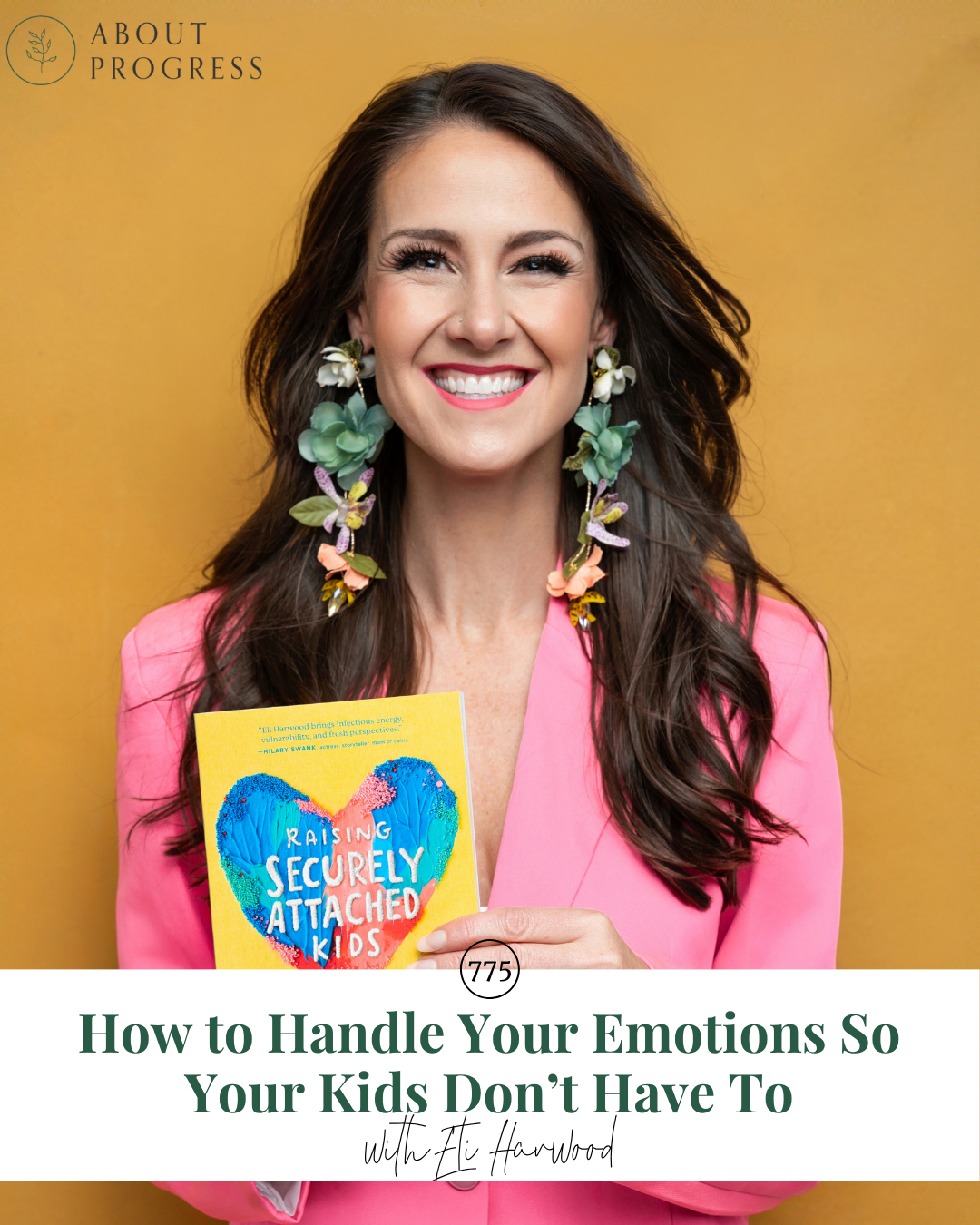
I had the opportunity to chat with therapist and author Eli Harwood about the messy, beautiful journey of parenting. Eli emphasizes the importance of focusing on our side of the parent-child relationship. It's not about blaming ourselves for our children's struggles, but rather about leveraging our emotions and experiences to enhance our connection with them. Parenting, Eli articulates, raises parents as much as it does children, and it's vital to approach our personal growth with compassion. Eli shared the five gifts from a secure parent—offering a glimpse into what important standards we can aim for as parents. We discussed how our emotional baggage can sometimes interfere with these gifts, but by understanding our patterns, like people-pleasing or perfectionism, we can grow and better support our kids.
Preorder Sticky Habits book today!
Join the Book Launch Committee for behind-the-scenes and first peeks at all things book.
Join the Supporters Club to keep About Progress around for good.
About a few other things...
Sign up for the Go Getter Newsletter to get Progress Pointers in your inbox every Wednesday.
You can listen to the episode below, on Apple Podcasts, or on your favorite podcast app. If you like the show please share it, subscribe, and leave a review!
SHOW NOTES
Eli's Website, books, Instagram
Access exclusive supporter benefits
Sign up for the next Sticky Habit Intensive
Book Launch Committee
Leave a rating and review for the podcast!
Lend your voice and experience + be featured on the show HERE
Join Monica on Facebook and Instagram
Songs Credit: Pleasant Pictures Music Club
Get your AirDoctorPro air purifier with the discount code “MONICA.” Transform your space now. Go to https://www.quince.com/monica for free shipping on your order and 365-day returns; Get organized, refreshed, and back on track this new year for WAY less. Head to Wayfair.com right now to shop all things home; Join Masterclass for 15% off at masterclass.com/progress
TRANSCRIPT
Eli Harwood: the key here isn't, hey, it's your fault.
Your kid is struggling. The key is there are things you can do within your own nervous system. Heart, body and mind. That will really help your child utilize their relationship with you.
Hi, this is Monica Packer and you're listening to about progress where we are about progress made practical.
Have you ever had a moment as a parent where you think. Where did that come from? Like anger, overwhelm, or a reaction that is bigger than the moment? And I'm not talking about your kid, I'm talking about you. Today's conversation is going to help you make sense of those kinds of reactions. And this is a conversation I wish I had 11 years ago.
About progress is a self-help podcast and community one that began over 11 years ago as I personally learned how to change myself outside of the perfectionistic model. I knew so well you likely know that, but what you may not know is that this desire to work on myself was instigated thanks to how poorly I saw I was showing up for my kids.
I was having the, where did that come from? Moment. Over and over and over again, I knew that in order to truly help my kids, I first needed to help myself. So much of parenting out there is about fixing the kid, but what if we need to work on the parent too? In today's interview, I am talking with therapist and author Eli Harwood about what it really means to be a secure parent and how our own emotional baggage patterns and even the ways we learn to cope as kids can either block or build connection with our children.
We talk about why parenting brings up so much anger, overwhelm, and even old wounds and what to do with that when it happens because it will. Eli is going to show us how the most effective way to help our kids is actually by learning how to handle our own emotions, reactions, and patterns.
This episode is honest. It's incredibly validating and also very practical. You will walk away understanding your triggers in a new way, and with a clearer picture on what actually helps your kids thrive. Being a good enough parent who is taking care of themselves too. Eli Harwood is a licensed therapist, author, creator of the social media platform, attachment nerd and mom of three on a mission to help make the world a more secure place, one parent child relationship at a time.
As you're listening, if you think of someone who you would like to share this episode with, do it in real time. That interview is coming up after a quick break for our sponsors.
One of the things I did not have on my almost 40 bingo card is more allergies. Since I already have some kids who tend to struggle with allergies in general, I am now joining them in noticing the great difference between having good versus poor air quality.
This is why we love Air Doctor in our home. It's the only air purifier we use , and we are in good company. Air Doctor won Newsweek's Readers Choice Award for best air purifier with Air Doctor, we notice reduced allergy symptoms as an entire family, fewer odors around the home,
the cleaner air for my kids brings me a lot of peace of mind, as does the extra protection during wildfire season, air doctors, powerful three stage filtration captures particles about 100 times smaller than what typical air purifiers can remove.
Air doctor captures airborne contaminants that you do not want to be breathing in. Dust, pollen, mold spores, pet dander, wildfire, smoke, bacteria, viruses, odors and more, it has a whisper, quiet operation.
It's not loud like others on the market. And the auto mode feature is a big favorite of mine because it automatically kicks into different modes as needed, as well as an easy change filter reminder. So I don't have to guess when it's time to change my filter.
We are part of the 98% of Happy Air Doctor customers who say their home's, air feels cleaner, safer, and healthier. Head to air doctor pro.com and use promo code Monica to get up to $300 off today Air Doctor comes with a 30 day money back guarantee.
Plus a three year warranty. An $84 value free get this exclusive podcast only offered [email protected]. A-I-R-D-O-C-T-O-R-P-R o.com using promo code Monica.
Monica Packer: Eli Harwood, welcome to about Progress.
Eli Harwood: Thank you so much, Monica. It's so good to be here.
Monica Packer: I have been looking forward to this so, so much in large part because I'm one of your dedicated community members who learns so much from your generous ways of teaching every single day and helping us feel seen and also to become better parents. So thank you for your work.
Eli Harwood: Oh, I'm so glad.
Monica Packer: by acknowledging something I've noticed in the parenting world, and I'm sure you definitely have parenting advice is so often about fixing your kid,
Eli Harwood: Yes,
Monica Packer: you
Eli Harwood: yes.
Monica Packer: which is
Eli Harwood: Yes.
Monica Packer: However, you have a different perspective that you're trying to offer in your work in
Eli Harwood: Mm-hmm.
Monica Packer: specifically with your new book, how to Deal, which is so, so good, uh, you want us to actually work on fixing the parents? Why does it matter?
Eli Harwood: So when we think about how kids develop, kids develop in relationship to their grownups. So when a kid is struggling, the most effective tool we have to help a kid is the relationship between them and their caregivers. And you know, we all are wired like that, even in adulthood, but it is more profound in childhood.
So this is a thing anyone who's listening, who's a therapist will be like, Hmm, that's right. But you know, you have a family come in and, and almost always the identified patient as the child, like the child is not doing well at school or acting out or not following rules. You know, there's this sense of.
What's going on here? And, and the family's mindset is like, how do we help the child? Right? And the therapist knows from years and years of working with families that at the end of the day, it's about helping the system
Monica Packer: Hm.
Eli Harwood: more than it is about helping the child. It's what are the unmet needs of the child?
What are the environmental factors happening, and, and that might mean. You know, diagnosing a child with a particular, um, disorder or brain type, whatever. But it also means adapting the family system to meet the needs of that specific child. And so every therapist who's ever worked with families is always maneuvering kind of this, okay, you're coming in telling me that this kid is the problem, and I'm gonna know that there's a deficit, probably like this child needs attunement from you and you don't know how to give that attunement because no one gave it to you.
Monica Packer: Mm-hmm.
Eli Harwood: Or this child is acting out. Meanwhile, in the background, we have a high conflict marriage going on where there is lots of anxiety and fighting and tension, and that child is kind of the canary in the mine right? Like, Hey, something's wrong here. And so. It's far more effective for us as grownups to learn how to cope with our emotions and to kind of come from a place of dealing with our stuff first, uh, than it is to try and get kids to become something without having dealt with our stuff.
So the legacy of leadership as a parent and honestly as a person in the world is most effective when we look at ourselves first and we say, what is it I need to deal with? And we all have different things we need to deal with in order to be the deeply, emotionally available, secure people our kids can rely on.
Monica Packer: Okay. And you know, when I hear the answer, I feel like I'm realizing these moments in my parenting history. I, I have five kids, but uh, four of 'em have special needs, you
Eli Harwood: Mm-hmm.
Monica Packer: sometimes you get these answers always online because that's where the non nuances, right? Like that you made your kid have a DHD,
Eli Harwood: Oh.
Monica Packer: you know, or like. Uh, the reason why your kid is misbehaving is, is a you problem. So we're not saying that
Eli Harwood: Nope.
Monica Packer: when,
Eli Harwood: Nope,
Monica Packer: it.
Eli Harwood: nope. Definitely not. That's, I love that you brought that up. 'cause that one in particular has, has been said by some people I really respect and, and I'm like, oh, whoa. We don't have any data that says that. And I don't think that's true or helpful. Um. The, the key here isn't, hey, it's your fault.
Your kid is struggling. The key is there are things you can do within your own nervous system. Heart, body and mind. That will really help your child utilize their relationship with you.
Monica Packer: Yes. Okay.
Eli Harwood: So that you know, so for instance, I have a child who is diagnosed A DHD, um, and on the autism spectrum, and my job is to figure out.
What she needs and how I need to adapt. What is it in the way of me giving her what she needs? And one of the things she needs is for me to care more about her identity development than I do about other people's discomfort with her behavior. And that's hard. Um, one of the chapters in the book is how to deal with feeling judged,
Monica Packer: Mm-hmm.
Eli Harwood: because that's something we have to figure out how to deal with in the world in order to, to be who our kids need us to be.
My daughter is incredible and she's gonna grow up to be a world changer. I have no doubt. Um, and she is not able to manage her impulses in the same way that some of the kids her age are able to. It's not the way her brain is developing, but ask her to tell you a tall tale. Oh my gosh, it's incredible.
Monica Packer: Yeah.
Eli Harwood: What her brain can do, and so we have to deal with these. Emotionally vulnerable spaces inside of ourselves so that they don't get in the way of our kids getting what they need from us. So I have to go, why am I so afraid of, you know, Sharon at the grocery store thinking that I'm failing at parenting instead of.
What I know is true, which is my daughter's doing the best she can. The grocery store is a very hard place for a kid with a DHD. I chose to take her here, right? Like the compassionate view on my child can get lost if I haven't dealt with this insecurity that other people might look down on me. And so when we learn to deal with some of these emotional places from a mature, secure place.
It's okay that Sharon thinks I'm failing as a parent and that I'm a Snowflake parent and she doesn't know me and I don't ever need to see her or talk to her again. And so, and honestly she's made me not even judging me. You
Monica Packer: Yeah,
Eli Harwood: know,
Monica Packer: there's that too.
Eli Harwood: Like, but that I think is the key piece is when we. Deal with our emotional vulnerabilities and areas of growth.
Then we create scenarios for our kids where they can more effectively get what they need from us. It's not our fault they're struggling, but it is our empowerment to show up for them in a way that helps them when they're struggling.
Monica Packer: Thank you for differentiating that. And, and I always say that just, you know, for the people it is, it's, it's a sensitive place to be in when your child is struggling to no fault of your
Eli Harwood: Mm-hmm.
Monica Packer: and still to. Notice that things do come up, even in trying to help them better show up to what they're facing. And at the same time, we are all humans.
Eli Harwood: Yes.
Monica Packer: we, we will to some degree,
Eli Harwood: Mm-hmm.
Monica Packer: influence our kids in ways that we didn't intend or
Eli Harwood: Yes.
Monica Packer: to our own baggage.
Eli Harwood: Yes.
Monica Packer: so there's that too. We are human.
Eli Harwood: You know, the title of my book is so long. It's How to Deal with Your Blank so Your Kids Don't Have To. And then there's an asterisk at the bottom and that is as much,
Monica Packer: Yeah.
Eli Harwood: and it's on the back of the book. But the, the as much is key here. No one is gonna do personal work and become like some evolved, you know, guru whose children are like.
I can't think of a single thing that my mother or father did that wasn't secure. Like that's not real. Um, our goal is to become good enough and deal with our stuff enough that our kids are able to experience the gift of a secure relationship with us.
Monica Packer: So what you're painting for me is the standard we should be aiming for. So it's not perfection, it's not for never causing harm, you know, to our children or sharing and our emotional baggage. It's. It's more about that security. Can you paint the picture a little bit more? You, you do
Eli Harwood: Mm-hmm.
Monica Packer: of your, your latest book, how to
Eli Harwood: Mm-hmm.
Monica Packer: these gifts that we give to our kids.
Like that's
Eli Harwood: Mm-hmm.
Monica Packer: for. So can you flesh out what you think is the standard we should have
Eli Harwood: Mm-hmm.
Monica Packer: our horizons that we're aiming?
Eli Harwood: Yes. , So I say these are the five gifts of a secure parent.
The first gift is the gift of feeling that we as the parent, can handle their emotions. So our children would be able to say, my parent cares about what I feel and knows how to support me. That is not 24 7 all the time. In every scenario or immediately.
Monica Packer: Okay.
Eli Harwood: Um, you know, I have a son who's in that pre, he's an adolescent, I guess he's that pre-adolescent Tweenies sta stage.
He's 11. The process of figuring out how to respond to his emotions at this stage of life is much trickier and more complex than it was when he was, you know, four,
Monica Packer: Mm.
Eli Harwood: because he is developing a complex sense of self in the world, and so. If my child feels that I can handle their feelings, it doesn't mean that he has a meltdown and an attitude, and I always automatically know exactly what to say.
It means sometimes I over respond or I under respond, but that I stay in the game. That I figure out how to, how to get to the point with him where he does feel seen, he does feel supported. You know, we, we are back in sync together again. Even if something that takes a couple days, you know, it's not always as simple as I need to say this thing and my kid's like, oh, I feel seen and supported by you.
Like, it takes work and labor. But that's the first gift. The second gift is the gift of feeling that we understand their perspectives. So my parent listens to me and works to truly understand me. You know that, you know this in your own life, when people care about the way you see the world, it is magic.
It's such a gift to know that your perspective matters. And that's true. When I, our kids are two and they're like, you know, pointing at the light on the wall like, mama, mama, and you're like, ah. I see what you're seeing. I see what you want me to understand. And when they're teenagers and they're like, I think it's really a problem that we eat meat in this family and we need to really consider our ethics, and you're like, okay, okay.
Let me help me understand how we go there with this thing that you're trying to teach me. It doesn't mean we always agree, it means we listen.
Monica Packer: Okay.
Eli Harwood: third gift is the gift of feeling that we want them close to us. So my parent lights up when I enter the room and they love being around me. I.
Monica Packer: Wow.
Eli Harwood: This is in some ways one of the simplest gifts to give our kids, but I think it often gets forgotten in the rush of modern life, and it's so important to just come back to it of no matter how old your child is, like they need to know that you notice when they're there, that you are happy that they are there, not that you are like wounded when they're gone.
Right. It's not like, I can't believe that you were with your friends and not me, that that's not secure,
Monica Packer: Yeah.
Eli Harwood: but that it's like, ugh. I love when you're here. It's so good to have you here, and I, I just, you matter to me and that sense of I want you near is such a gift of, of life because lots of other people aren't gonna want them near in the world.
And so there's a protection around their hearts knowing that we do's.
Monica Packer: a huge one right there.
Eli Harwood: The fourth is the gift of feeling that we show up for them in the important moments. So my parents shows up for me when I'm struggling and when I'm celebrating. And this doesn't mean 24 7 y'all like, you know, and, and this is not, you know.
Every single meltdown, you're cooking dinner and your kids actually just need food and they're all just feral and you know, you're not gonna stop and attend to every single second. You know, at that point you're gonna just stir the past and try to get through it and get food on the table.
Monica Packer: Yeah.
Eli Harwood: But, you know, those big moments, they get their heartbroken or you know, they're really struggling with feeling like they don't fit with a group of people that you are.
You are responsive when they let you in, when they open up those tender doors to their hearts, that you respond to that, and then when they're proud of themselves or they're working on something and they're interested in something, you know that you are giving them that sense of, I'm with you. You know, you're cheering them on and.
For working parents. This doesn't mean you have to go to every single game. You have to be at every single recital. You can't, but that your kids can sense that you are with them in spirit, even when you can't be there in person. You know, you're behind the scenes being like, that was epic. You know? Uh, meanwhile you're like repairing your eardrum from their violin recital, but that they, they know you're with them for those tender moments and triumphant moments.
And then the last one is the gift of feeling. We accept them for their full, authentic selves.
Monica Packer: Hmm.
Eli Harwood: My parent is proud of every part of me, and this is about, you know, loving our kids, not just for how they perform or how they behave or what they do, but are really showing our kids that we love you and all the messy tentacles of who you are.
And there might be parts of who you are that I don't get, that I don't understand yet, but I know those parts are beautiful and lovely and meant to be here. And we're gonna figure out what they are and what they lead us to together.
Monica Packer: In so many ways, these gifts are our touchstones, right? As
Eli Harwood: Mm-hmm. Mm-hmm.
Monica Packer: maybe I didn't handle that moment right, but when I know that the ultimate goal, like let's say, is to help them know that I may not understand fully.
Eli Harwood: Mm-hmm.
Monica Packer: that this is the way they see the world or
Eli Harwood: Yes.
Monica Packer: brain works. Then that goes so far to helping us make up
Eli Harwood: Mm-hmm.
Monica Packer: these gaps that we have as parents, which we'll always have
Eli Harwood: Yes.
Monica Packer: and you so kindly let us have too. One of the things I like to lean into that is so prominent in your book is dealing with our emotional baggage. I'm actually not a big feeler, and, and you talk about how you, you are, that's something that comes so naturally to you. I got so much on this because I was able to better pinpoint what I was feeling
Eli Harwood: mm.
Monica Packer: carrying that around. But I wanted to speak to the emotions in general about how in not processing ours, both, you know, from our present and our past. Uh, it can interfere with these, with these gifts
Eli Harwood: Mm-hmm.
Monica Packer: give to our kids. So I wanted to ask you about that in particular. How does our emotional baggage interfere with these gifts in ways that people may wanna be aware of?
Eli Harwood: Hmm. Well, the primary way that attachment functions between kids and parents is an instinct for our children to seek our presence, to seek closeness and proximity to us when they are dysregulated or overwhelmed or in distress. And so. That instinct can get muddled up and thwarted in our kids. And some of you know this in your own life, like if I said, Hey, I'm, I'm gonna have you open up the most tender emotion you can think of, and then we're gonna bring one of your parents in the room and you're gonna be like.
No, you're not. I don't want them anywhere near me when I'm feeling this. Because what you learned was my parents are uncomfortable with emotions, um, obtuse with emotions. They don't notice them, they don't understand them. They can't recognize they're in the room. Um, over responsive to emotions.
Monica Packer: Hmm.
Eli Harwood: they break down when emotions come into the room, but.
Ineffectual at helping me feel better. So we want to deal with our emotional baggage to the degree that when our kids are in these tender emotional states, our presence is regulating for them so they feel better after being in the room with us. You know, and again, think through people in your life, it's like, who do you wanna cry with?
What do you need to do to be that person for your kids, you know? And who do you wanna be celebrated by? I mean, there's sometimes the, the hangup isn't responding to tenderness. Sometimes it's like, I know how to do that. But then when a kid is feeling really proud of themselves, that triggers some. Some wound in you because your parents were like, who do you think you are?
And so you don't know how to celebrate without fearing that you're creating arrogance in your child. Um, you know, so there's, there's a lot of complexity and messiness and personal story involved in this, but you're thinking, what do I need to deal with emotionally? Maybe I need to learn to feel my feelings more.
Maybe I need to learn to tolerate my feelings more.
Monica Packer: Hmm.
Eli Harwood: Maybe I need to learn to focus less on that. And there's, there's a few guidelines in the beginning of the book going through like, if feelings feel uncomfortable for you, here's the work you need to do. If feelings feel like you're swimming in them all the time, here's the work you need to do.
So it gets different based on what attachment, adapt, adaptation you are more inclined towards.
You are not bad at habits. You've just been using the wrong method. My first book will be published this fall. It's called Sticky Habits, A Woman's Guide to Reclaim Happiness Ditch Perfectionism, and Create Habits That Last. It's set to release September 8th, but you can pre-order the book right now for three special bonuses.
This book is not about. Doing more. It's about building habits that survive real life, creating routines that flex instead of break. Letting go of perfectionism that keeps you quitting and learning how to keep promises to yourself. Again, even on hard days. In a world of self-help. That too easily ignores the invisible labor women carry. That changes everything because women must do habits differently. Sticky habits will teach you how to do so. Please pre-order the book now and check out the special pre-order bonuses by going to sticky habits book.com that's linked for you in the show notes.
I'm so thrilled for this book to be out in the world. It is several years in the making and I know it will change so much for you. Again, go to sticky habits book.com to pre-order the book now.
Monica Packer: And, and that's something that your work has always been long centered in is that is attachment and having secure attachment. You share this about how you didn't really have that necessarily from your
Eli Harwood: Mm-hmm. Mm-hmm.
Monica Packer: How she worked to heal
Eli Harwood: Mm-hmm.
Monica Packer: Can you share a little bit more about that as it relates to what we were just talking about of dealing with our own
Eli Harwood: Mm-hmm. Mm-hmm.
Monica Packer: as, as parents.
Eli Harwood: So both of my parents came from a lot of generational trauma that was unresolved, buried, not dealt with, and playing out in addiction and abuse and, you know, rage. So there was a lot of yuck that both my parents grew up in and then they got together as people do
Monica Packer: Hm.
Eli Harwood: and they had us. And so when I was little.
My mom was drowning in trauma and my dad was escaping his hard stuff through addiction, so there was no one in the house that was stable and sturdy enough and attuned enough to be that place for me. And for a lot of us, especially, I'm thinking of your audience, you know, we were very gifted at taking care of other people as a way to get our needs met and that.
That was my adaptation as a kid. But my mom, this is where my story is so unique. When I was nine years old, she was in a really dark place and she was thinking either the world will be better off without me or I could do something about this. And she checked herself into a psychiatric hospital, and this is like the eighties.
She literally like opened the yellow pages and was like. Psychiatric. Like, where, where do I find this? Um, and she went into this treatment for about a week and she said she was there and people were taking care of her. And she thought, oh my gosh, I feel so different. I feel so different when, when I have this support, I think I might be able to handle some of this.
And she left that stay and she just kept going. She just kept going to therapy. She got on medications she took responsibility for her emotional welfare in order to be able to model that for us and start to give us something different. And there were a lot of years of, of healing and work, and she does still struggle from time to time with some, depressive episodes.
But she set this path forward in our family where it was like, no, we're gonna talk about the hard things. We're gonna work through this stuff, we're gonna figure it out. And. I made her move close to me when my son was about two years old, so this, by eight years ago, she lived across the country and I was like, you need to live here.
I need you to be close. Because I wanted her around and I wanted her around because of the years and years of work that she did to be able to see me at the same time that she was working through her stuff. Right. And that's, that's the gift. You exist. I'm aware of you child as I am in inhabiting the world as opposed to you exist for me, make me feel good, which I think is what a lot of people end up doing on accident.
I don't think they do it on purpose.
Monica Packer: You know, I think that story alone just can give so much hope because what you do, I mean. You teach people this, you, you're a therapist who, who helps people heal and, and you didn't have a perfect
Eli Harwood: Mm. Mm-hmm.
Monica Packer: lot of healing and shared a lot of emotional baggage and, and a big credit to her too.
Of course. I, I, I think one of all the gifts you shared, if there's a thread between them, I can see this gift of trying.
Eli Harwood: Oh, I love that. Yes,
Monica Packer: like, she,
Eli Harwood: she, she
Monica Packer: did
Eli Harwood: so.
Monica Packer: and then she did something else and
Eli Harwood: Yes.
Monica Packer: kept trying.
Eli Harwood: Yep. And the tr and the trying isn't, I'm trying to make you see me a certain way or I'm trying to make you fe do X, y, or Z. It was, she was trying to deal with her stuff.
Monica Packer: Yeah.
Eli Harwood: That's the key. And that's what creates trust too. You know, there's a lot of trust in somebody who can say, I think I'm not giving you what you need.
There's a lot of trust that happens there, and I'm going to, and I'm going to work on it.
Monica Packer: Yes. Yeah. So we just keep coming back to, you know, you don't have to be perfect. You
Eli Harwood: No.
Monica Packer: trying and, and something that um, I've been saying more often in our community is in the trying, is the doing. Like
Eli Harwood: Mm.
Monica Packer: do
Eli Harwood: Mm-hmm. Mm-hmm.
Monica Packer: um, which we forget.
Eli Harwood: Mm-hmm.
Monica Packer: Uh, one of the thing I was thinking about with the emotions is. There may be emotional baggage from our past that we don't even know is there until we are in the middle of parenting.
Eli Harwood: Yes.
Monica Packer: Right. Like for me, I never would've said I was an angry person until that was the primary emotion I felt as a really young mom
Eli Harwood: Mm,
Monica Packer: very
Eli Harwood: so many children. So many children.
Monica Packer: And um, so I wanted to walk through some that you have found comes up.
Eli Harwood: Mm-hmm.
Monica Packer: I'm sure they all come up, but maybe the ones that have come up most often that people are like parenting,
Eli Harwood: Mm-hmm.
Monica Packer: through parenting brought this one up for me and I
Eli Harwood: Yes.
Monica Packer: how to work through that specific emotion
Eli Harwood: Yes. Well, I wanna say this really clearly. I think that. Parenting raises parents as much as it raises kids. So the act of getting to know our children, learning them, supporting them, that is a developmental process for us. And the expectation that like, well, you're the grownup, you're the adult, therefore you have it all together and you is is not real.
And every stage that our children go through, we go through a new stage in ourselves. So seeing that as like, I'm, I'm more responsible for my developmental process as a parent than I am for my child's developmental process, and that if I take that perspective, I'm gonna be much more helpful and accessible to my child because I'm working on how I respond, how I see things,
Monica Packer: Yes.
Eli Harwood: the most common things that come up.
That are surprising, I think for people are the, are the emotions. You know, if you went through hard stuff as a kid, you figured out some way to cope and then you had patterns of coping that probably relied on people pleasing or you know, a control habit. And there's chapters on all of this in the book, you found ways not to feel powerless.
And what happens when you have kids is those coping mechanisms are, are shaky. They aren't. Dirty the way they were when it was just you or just you and a partner. And so you know, that all gets blown up. And that's actually not a bad thing because those are habits you had to adapt in an environment where there was no other option.
And so as those kind of. I call those bad habits. As those bad habits get broken open, you're gonna feel raw, you're gonna feel powerless, you're gonna feel overwhelmed, but you're also gonna have an opportunity to learn how to become emotionally mature in your body. When you learn how to do that, then you get to help your kids do that.
You know? So you go, oh, this, for an example. You maybe have always done the people pleasing thing where you keep everybody happy and then you have a child who has neurodivergence and you can no longer keep everybody happy because the amount of effort it takes to help your child navigate impulse control in the world means that a lot of people aren't pleased with you.
Right? So at first, that's gonna feel like. You're failing like something's wrong. It's gonna feel super new and uncomfortable, but you are becoming, because now instead of simply looking at the world and going, how do I make sure no one's mad at me? You get to evolve into like a deeper sense of yourself and be like, wait a minute, is that my primary goal?
Monica Packer: Hmm.
Eli Harwood: Is it really a, is that what I want people to say at my funeral? No one was ever mad at her. Probably not. I probably wanted something deeper and richer and more meaningful. Like she really showed up and she really cared. And when you really show up and you really care, you are not going to be able to please everybody.
So you, you learn how to tolerate those emotions and therefore be an auth more authentic version of yourself.
Monica Packer: I love the connection you make between like these emotions that we carry on as part of our emotional baggage and how they turn into patterns of behavior that become, you know,
Eli Harwood: Mm-hmm. Mm-hmm.
Monica Packer: Um, only does that make so much sense to me, but it also helps someone like me who I'm like, know what I'm feeling,
Eli Harwood: Mm-hmm.
Monica Packer: I can see.
Eli Harwood: Mm-hmm. Mm-hmm.
Monica Packer: see a pattern
Eli Harwood: Mm-hmm.
Monica Packer: I show up to something
Eli Harwood: Mm-hmm.
Monica Packer: me see there is something to work through emotionally as part of that. So I can almost reverse engineer
Eli Harwood: Mm-hmm.
Monica Packer: Um, other people may be more the reverse, like they feel more of a general feeling and then have to then work on the bad habit.
Eli Harwood: Yep.
Monica Packer: right?
Eli Harwood: Absolutely. Totally.
Monica Packer: Okay. So for those who are new to this, can you make one of those connections for
Eli Harwood: Mm-hmm.
Monica Packer: how can one emotion of show up as a behavior or a behavior Also be showing us the
Eli Harwood: Mm-hmm.
Monica Packer: and more of in a specific example or two from your, from your book.
Eli Harwood: Well, let's talk about anger because I think so many parents feel scared by their own anger and scared by the anger their children feel. So if you grew up in a home where anger was on one end of the spectrum or the other, so anger might have been everywhere all the time, out of control. And that was a very dysregulating experience, or anger might have been never allowed, viewed as violence.
I think a lot of people conflate anger and violence, so like anger equals danger. So you come into parenthood and all of a sudden you are feeling angry all the time and you. You don't want to feel angry all the time. You're afraid that makes you like your parents were, or you're afraid that that means that you, you know, are a terrible, horrible, bad person because your parents never showed you how to feel ma anger in a mature way.
Um, now you're experiencing it and it's an invitation for you to figure it out. So I talk about how anger is like a lighthouse. It tells us we're about to crash on the shore. It's, it's a helper. And when anger is. Understood as an an emotion that is trying to meet a need, um, it gets far less out of control.
So the, the process of dealing with feeling angry, um, the emotional baggage piece of that is, okay, so you grew up in a home where anger was out of control and so therefore you learned how to stuff your anger and deny your anger. And what happens is. Now you have no skills or tools when you and or your kids are feeling a very normal human emotion, and so you might use habits.
Some, these are some of the bad habits in the book that you relied on. You might go into a blaming habit. You know, what's wrong with you, you're out of control. Not in my house. You know, you're, you're blaming your child for their anger instead of helping them regulate their anger. Um, you might go into a numbing habit.
You know, you might have developed kind of like a tuning out of things of like, well, I don't, I don't wanna do this. So you just leave the room and you, you know, are gonna go have a drink. Or, you know, tune out in some way. Watch some, you know, scroll some videos. , The bad habits that are arising are arising because no one in your world knew how to deal with anger.
And so you are gonna recognize, oh. Here's the anger. I don't know what to do with it. And now here are these habits that I used to cope because I was a kid in a situation and now my job is to deal with both the habit and the anger. And so, you know, you would read the chapter on how to deal with anger to kind of help you understand what it looks like to have a healthier relationship with anger.
And then you might deal to, you know, read through the chapter on people pleasing or whatever the bad habit is that you developed around anger, so that that's not in the way of you being able. To sit with your kid in a moment where there is emotion in the room and find your way to each other's hearts.
Monica Packer: I read that chapter on anger at the most perfect time, and I'm gonna tell you it's. It helped me work through and better understand it because like I said, I never would've described myself as an angry person and I still wouldn't. But that was, uh, a primary emotion, I think, with those young kids. And it came up for me again because of the Christmas season.
Like we just finished Christmas and crashed and burned. In a way that I hadn't in years and I had tried my best to be realistic, to do things ahead to, you know,
Eli Harwood: Mm-hmm.
Monica Packer: better. And still by the end of the Christmas break and my kids being home for two weeks and
Eli Harwood: Mm-hmm. Mm-hmm.
Monica Packer: In charge, you know, 'cause my husband had to work the whole Christmas break, which
Eli Harwood: Mm.
Monica Packer: for him either. I realized, oh, the primary emotion I'm feeling right now is anger.
Eli Harwood: Mm-hmm.
Monica Packer: But it's masking something. So what is, what am I not masking? But it's, it's
Eli Harwood: Yeah.
Monica Packer: to me
Eli Harwood: Yes.
Monica Packer: deeper
Eli Harwood: Yep.
Monica Packer: and, and part of that, you know, could be like blaming other people for not like, you know, reading my
Eli Harwood: Mm-hmm.
Monica Packer: things.
So I realized anger for me always signaling that I have a lot of unmet needs.
Eli Harwood: Yes. That's what I was just thinking. I was thinking it's telling you, so I say in the book that anger tells us when we feel violated or desperate,
Monica Packer: Yes.
Eli Harwood: and.
Monica Packer: like a woo light bulb for
Eli Harwood: Yep. So, you know, anger is gonna come up when we're experiencing abuse as a community, as an individual, you know, harm from someone. But it's also gonna come up when there is a core need that is going unmet at a level that is desperate for us.
Monica Packer: Mm-hmm.
Eli Harwood: Um, and so being able to go, oh, okay, this, is this an, this is what anger's telling me now how do I meet it? Because what gets what I think work gets tricky with anger is a lot of times once it comes up. We sort of fixate on putting it out at someone else, but we have to do that dig first, which is like, I feel angry.
What is the anger about? What is it pointing me towards? And then we could bring, you know, there is still some anger in that, but we can bring that to somebody and say, Hey, here's what's happening for me and here's what I need. And then we can, or we can meet our own needs. You know, sometimes that's just being like.
I don't know. I have this belief that we have not evolved enough for the single family home structure of humanity. That seems to be happening more and more and more cultures. Um, I think that we are wired for community in the same way that we're wired for attachment. And being at home by yourself with all of your children was never supposed to be a thing.
You were supposed to be in the village. And there's other parents and we're all co-regulating each other and there's structure and there's time, and we have work to do together. That. This kind of thing of like, we have school now. We don't have school. Here you go. You're all in your house by yourself. I don't know.
It's insanity inducing. I know. I know very few people who, who feel like, yeah, it's so great. So.
Monica Packer: easy.
Eli Harwood: Yeah,
Monica Packer: yeah,
Eli Harwood: My kids and I just do calm crafts all day and everything's fine. Um, it's really is a complex experience to be a, a parent by yourself regulating multiple kids at the same time with d different developmental needs.
So I think, you know, once that anger comes in being like, oh, this isn't working for me to do this by myself. I need to call a friend and have them bring their kids over here.
Monica Packer: Yeah,
Eli Harwood: need to have a structure each day for how community will play out so that I'm not just Lord of the Flies by myself with my kids.
'cause it's, that's just not gonna work very well for us.
Monica Packer: and you know, it took me about three weeks to like process that, but once I finally did, I was able to like have that conversation with my husband and just be like, we don't, actually, don't know what the answers are yet,
Eli Harwood: Yeah.
Monica Packer: we, we can think through. break situation better in advance for next time.
Eli Harwood: Yeah. Yeah.
Monica Packer: maybe also we just go to Disneyland instead of
Eli Harwood: Well,
Monica Packer: else,
Eli Harwood: oh my gosh. And of course, I was gonna say, and of course what's, what's tricky is like what are your family resources and how can you do that? You know? So you have to get creative. If, if going to Disneyland is an option, great. If it's not, you know, then thinking through who, who in our community is in a similar position that we could team up together and help meet each other's needs together at the same time.
Monica Packer: Yeah,
Eli Harwood: Um.
Monica Packer: is needed
Eli Harwood: Yeah, and, and sometimes you're just angry for a couple of weeks because you can't fix a situation and like, it's okay. Your kids aren't gonna be like, now I never trust her again. You know, the, the beauty of the attachment dynamic between us and our kids is that it is flexible and it is. Absolutely healable.
You know, if, if your parents came to you right now and said, I'm really sorry that I was not more soft, or I was not more sturdy when you needed me to be, and I'm working on that and I can see how that affected you. Like, that'd be powerful, right? Like, that's powerful stuff. So I don't want anyone to get into like a, I can't mess this up.
I can't mess this up. There's, there's actually a chapter on perfectionism because that is an anxiety. Experience and that will not help anybody feel secure. Your job is to remember you are the parent your kids need, you are. And so, you know, just get to work and piece by piece and with compassion. Uh, the other thing is every single chapter, there's self-compassion scripts because I know how easy it is to slip into that like kind of self beratement.
Instead of going like, Hey, you're a human. It's okay. You're feeling angry, you ma, your anger spilled over. It happens to all of us. How can you clean it up?
Monica Packer: Another gift we can give our kids, right?
Eli Harwood: Mm-hmm.
Monica Packer: like we said, the trying I, I was just hold. Um, pulling up your table of contents, because like you said, perfectionism is one of the habits. But I think even if they were just to go and look at the, these, the contents here and see like, oh, regretful, like, I never know, I'd feel regret as a parent
Eli Harwood: Yes.
Monica Packer: that I feel jealous
Eli Harwood: Mm-hmm.
Monica Packer: that I would get in a denial habit because it's so hard and painful to take ownership of my
Eli Harwood: Mm.
Monica Packer: or that I'd be very permissive as a habit of
Eli Harwood: Mm-hmm.
Monica Packer: So there are so many here that are. think obviously specific enough that we can be like, oh
Eli Harwood: Mm-hmm.
Monica Packer: surprising.
Eli Harwood: Mm-hmm.
Monica Packer: like that's what parenting is. I feel like it's full of surprises. So I want to lead them to go and check out how to deal, um, and, and, and to start working through this in a way that it's, it's a, it's a manual too.
And
Eli Harwood: Mm-hmm.
Monica Packer: the book too, like you don't have to read it, cover
Eli Harwood: No.
Monica Packer: Although I did because it was so like helpful and
Eli Harwood: Aw.
Monica Packer: But more is that what am I struggling with now and how can I work through that
Eli Harwood: Yeah,
Monica Packer: there anything else you want them to know about your book specifically?
Eli Harwood: I just hope, I hope it feels like a little paper parent on the shelf. You know, like a place that you can, a refuge you can go to when you're like, I don't know what I'm doing. This is overwhelming. I'm feeling these really confusing feelings, and you could pull it off the shelf and just get some comfort and guidance and know that you're not alone.
This is hard and you're not alone.
Monica Packer: Before we ask our final question, Eli, where should they go in addition to the book to learn more from you?
Eli Harwood: Ah, well, a couple of things I offer. One is I have a podcast now. It's called the How to Deal Podcast. You can listen there for free. I also have a parent program. I call it the Secure Parent Program. So if you're like, I don't have people, I don't want people who think like this, I need some supporter on this.
I have made it a pay what you can option, because I just don't want money to be the thing that keeps people from getting support. Um, so they're like.
Monica Packer: brilliant.
Eli Harwood: Modules and there are support groups, and I do live q and as. So you can join the Secure Parent Program. You can find all of my stuff, my books, my podcast, all [email protected].
And then I run my mouth for free on the internet under that same name.
Monica Packer: And you're so good at that. And
Eli Harwood: Aw.
Monica Packer: that in like the best way, the turn of the phrase like, you know how they,
Eli Harwood: Mm-hmm.
Monica Packer: usually becomes as a criticism of running your mouth and you do it in the best way possible.
Eli Harwood: Thank you.
Monica Packer: Eli, our final question is always the same, and it's just a way to distill so much of what we learned in our time together. What is one small way, and actually you know what, it goes with the whole thing we're saying, you know, doing
Eli Harwood: Mm-hmm. Mm-hmm.
Monica Packer: So what is that One small way that listeners can do something with what they learned today?
Eli Harwood: Well, I think the most powerful gift that you can start with is to begin to talk to yourself with tenderness. When you mess up with your kids, I want you to develop a little voice in your head. You can imagine it being like a little old lady or like an animal that feels comforting to you. I want there to be a little voice that says, I see how hard you're trying.
This is hard, but you can do it. What do you need to go forward? You know, start with self-compassion, believing you are doing the best you can with what you have so that you can keep going. Like, this is a marathon. And, and if the voice is like. Don't be anxious, don't do this, don't do that. The the, you're gonna burn out and you're gonna get into a martyr place.
I think we all know that martyr place. Well, why am I even trying, why am I even doing this? You know?
Monica Packer: Yeah.
Eli Harwood: So really work on honing in the skill of self-compassion, because you need that. That is your water, that is your power bar for getting through this marathon. I don't know why. That's my metaphor. I don't run marathons.
But, and also I'm dating myself by using the term power bar.
Monica Packer: I was
Eli Harwood: Who,
Monica Packer: power
Eli Harwood: eats power bars. They don't even exist anymore. Oh my gosh. I could like taste that in my mouth. Um,
Monica Packer: I could, yeah. But, but that, but that's very, not only as specific, but like the best note to end on possible.
Eli Harwood: I'm so glad.
Monica Packer: Thank you, Eli. This has been a gift to spend time with you, and I'm so hopeful people will check out your book, how to Deal, and as well as your new podcast and the other resources you mentioned. Thank you so much for spending the time with us today.
Eli Harwood: I loved being with you. Thank you for having me.
Monica Packer: That was incredible.
Eli Harwood: Oh,
Monica Packer: you a lot longer.
Eli Harwood: no, you're fine.
I hope this episode gave you the hug and kick in the pants you need to grow. I'll now share the progress pointers. These are the notes I take so you don't have to, and those on my newsletter, get them in. an expanded graphic version each week, you can sign up at about progress.com/newsletter. Number one, focus on your side of the relationship, not just fixing your kid.
Number two, you don't have to be perfect. You just have to stay in it. Number three, your emotional triggers are cues, not failures. Number four, your coping habits may no longer be serving you. And number five, start with self-compassion. It fuels everything else. Again, the expanded version is in the newsletter.
You can get that at about progress.com/newsletter. I wanna share a do something challenge. I have forgotten to do that for a while, and I wanna bring it back. This is one way you can do something to take action on what you learned. I'd encourage you to pick one recurring emotional reaction, like anger or overwhelm, and trace it back to what triggered it, what may be underneath that reaction, and what would support look like instead.
I always like to hear about how these challenges go. You can email me at hello to about progress.com or message me on Instagram At About Progress. This podcast is listener supported. Members of the Supporters Club. Make my work here free and available to all. No additional paywall, no extreme number of ads.
Being part of the Supporters Club isn't a charity. In return, you get access to three levels of exclusive benefit, starting at $2 a month and capping at $7 a month. My favorite benefit is more personal, my private premium ad free podcast for two levels of the Supporters Club. You can check it all out and sign up at about progress.com/support.
You can always support the show for free. The best way to do that right now is to share this episode with a friend. I know you thought of someone, so who can you send this to?
Copy the URL and text them right now. Thank you so much for listening. Now go and do something with what you learned today.
Monica Packer: So can you flesh out what you think is the standard we should have
Eli Harwood: Mm-hmm.
Monica Packer: our horizons that we're aiming?
Eli Harwood: Yes. So I'm gonna, I'm, I'm gonna pull out the list. 'cause whenever I try to think of a list in my head, I'm like, oh, I'm, which one did I,
Monica Packer: not
Eli Harwood: did I, which one did I forget?
Monica Packer: have I taught for years, but I can't remember the
Eli Harwood: Mm-hmm. Mm-hmm. By the end of this book tour, I will have of these solidly memorized, but right now,
Monica Packer: Yeah.
Eli Harwood: okay,