
How to Stop Letting Other People’s Opinions Hold You Back, While Still Caring About Them || with Sharon McMahon
Sep 21, 2026
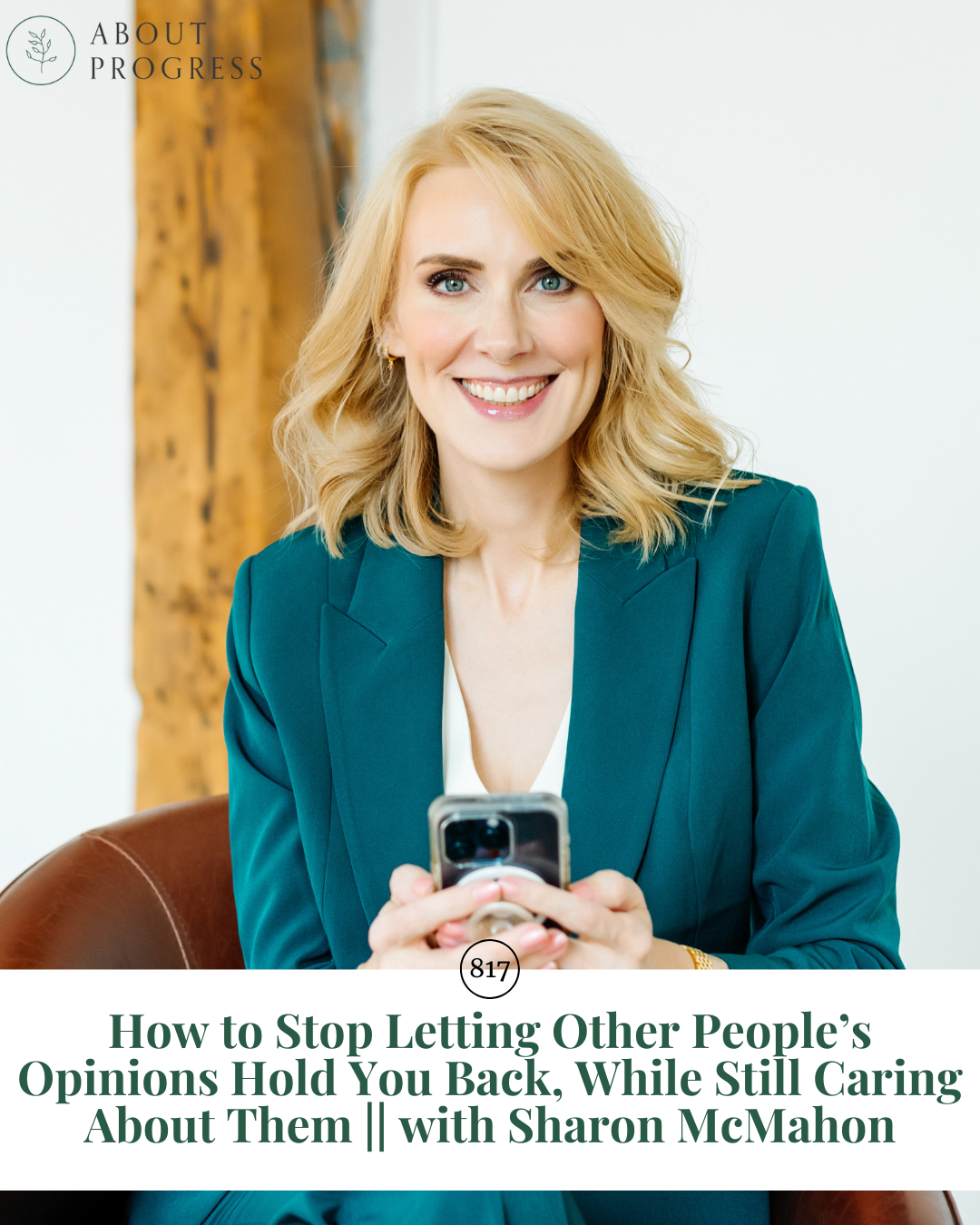
Have you ever been made to feel like you're too much and not enough at the same time? Sharon McMahon is back to talk about the women throughout history who refused to shrink themselves — women like María de López, Ida B. Wells, and Claudette Colvin — even when their own communities told them to sit down and shut up.
We explore what we can learn from these women right now: that courage isn't about not caring what people think. It's about caring — and deciding not to let it stop you. No work for liberty can be lost. You just have to decide what you want to stand for and take the next needed step.
Sharon's website, newsletter, Instagram, books
Complementary episodes: Past episode with Sharon McMahon on how it’s never too late and never too small
Watch this episode on Youtube
Leave a review of the book
Sign up for the More for Moms Conference with $10 early bird pass: “LISTENER.”
Join the Supporters Club to keep About Progress around for good.
This episode brought to you by Quince for free shipping on your order and 365-day returns; and from REBEL, your next favorite find is waiting at fromrebel.com.
About a few other things...
Sign up for the Go Getter Newsletter to get Progress Pointers in your inbox every Wednesday.
You can listen to the episode below, on Apple Podcasts, or on your favorite podcast app. If you like the show please share it, subscribe, and leave a review!
SHOW NOTES
Access exclusive supporter benefits
Leave a rating and review for the podcast!
Lend your voice and experience + be featured on the show HERE
Join Monica on Facebook and Instagram
Songs Credit: Pleasant Pictures Music Club
TRANSCRIPT
Sharon McMahon: [00:00:00] if we can remember to view our place in a, in a vast and ever-expanding universe as part of the fabric as opposed to the weight of all that is wrong rests on my shoulders, we can decide what that fabric to look like. We can de- decide that we, we don't know how the story ends, but we are not going to give up our ability to impact what gets written
Monica Packer: Hi, this is Monica Packer, and you're listening to About Progress, where we are about progress made practical
Have you ever been made to feel like you're too much, too opinionated, too ambitious, too loud, too sensitive, and somehow still like you're not enough at the very same [00:01:00] time? I know I have. I have noticed this both personally but also objectively over the years how women can get treated by others when they are trying to lead change, whether it's shifting their local school boundaries to changing the laws in their country.
They are criticized. They are ridiculed. They are dismissed. They're often told, "You are too much, and you are not enough," and sometimes in the very same moment
And yet I firmly believe that we need women who are willing to have the courage to be misunderstood, to care about people enough that they are willing to do the hard things that others in their lives simply don't understand. Today, Sharon McMahon is back on About Progress to talk about the women throughout history who refused to shrink themselves even when the people around them told them to sit down, be quiet, or give up.
This conversation isn't [00:02:00] just about history, though. It's about what we can learn right now from these women from the past when we are criticized or misunderstood, or when we're wondering if what we are doing actually matters
We will learn from Sharon that maybe courage isn't not caring about what people think. Maybe it is caring, but deciding not to let it stop you. Sharon McMahon is a number one New York Times bestselling author, longtime government and law educator, and one of the most widely read independent voices in American politics and culture.
Known as America's government teacher, Sharon helps millions of people better understand history, government, and current events through her online community, newsletter, The Preamble, and award-winning work. Her best-selling books include The Small and the Mighty, and her new children's book, We Are Mighty.
At the heart of Sharon's work is a simple belief: powerful change is built by ordinary [00:03:00] people doing the next needed thing. As you're listening to this episode, if you think of someone in your life who is being criticized or feeling shut down or wondering if what they do matters, make sure you share this episode with them.
Just copy the URL and text it to them. , My conversation with Sharon is coming up after a quick break for our sponsors
Monica Packer: My first book, Sticky Habits: A Woman's Guide to Reclaim Happiness, Ditch Perfectionism, and Create Habits that Last, is officially published and ready for you to buy anywhere books are sold or to request at your local library.
I was lucky leading up to the publication of the book to get great endorsements from some huge names but my favorite reviews have come from everyday women who this book was made for.
Like Jennifer who said, quote, "I haven't enjoyed a book like this in a long time. It feels like someone finally saw me." Unquote. [00:04:00] Or Aubrey, who wrote, quote, "This book shines in its tone, realism, and personality. The Sticky Habit method and the concepts behind it are special, unique, and an antidote to all the productivity experts out there."
Unquote. And finally, Ashley, who said, quote, "This book hit me right in the gut in the best way. I feel so much more hopeful now." Unquote. I've been hearing that Sticky Habits is one of those rare self-help books that won't make you feel bad about yourself, and that's the best stamp of approval I could ever seek to receive.
So get your copy now at stickyhabitsbook.com. And if you have and you've read it, let me know what you think. Especially if you leave a review on Amazon. I'm gonna give you a bonus star if you share the book Sticky Habits with a friend in real life. Again, if you haven't ordered the book yet, go to stickyhabitsbook.com, and I so appreciate your enthusiasm and support of this work
Monica Packer: Sharon McMahon, welcome back to About Progress.
Sharon McMahon: I'm so [00:05:00] excited to be here. Thanks for having me
Monica Packer: It was an honor the first time. It's a double honor a second time. I know what it means to have your time. Uh, our last interview was really impactful for a lot of women, especially because we were talking to the women who are convinced it's too late, and that the things they do are too small to matter.
And as important as that was, I wanted to talk today to the women who have been labeled too much,
you know, by society, by their family, by their friends, , by everyone, or maybe one person, and it really impacted them. Um, to begin though, I, I thought h- you know, as I was thinking about this, I thought these two groups have a lot in common,
Sharon McMahon: Mm-hmm.
Monica Packer: and it's that either way, society seems to dismiss them, and they often do so by either saying, "You're too small," or, "You're too mighty," and it's often at the same time.
Sharon McMahon: Mm-hmm.
Monica Packer: I wanted to begin with your thoughts on why this dismissal is a tactic that society uses, and what people are really afraid of
Sharon McMahon: I think [00:06:00] you're right that, uh, so often people, women feel, at least at some point in their life, both of those things.
Monica Packer: Mm-hmm
Sharon McMahon: Uh, they often feel like personally they are too much. They're too loud, they're too bossy, they have too many opinions. They have, you know, whatever they're bringing to the table. It, it often starts in school, uh,
where if we, you know, even going back to educational research, we see that if we separate out children at young grades, that girls tend to do better in single-gender classrooms.
Boys tend to do better in single-gender classrooms, and I know that that is, uh, not a, a, a thing that we can bring to bear in every school. But the reason for that is because, , so often that is where these ideas begin to become internalized, that you're too much. It's not cool to be smart.
It's not like, what-- Stop answering all the questions.
Stop asking all the questions.
I [00:07:00] was definitely the fifth grader, I look back at fifth grade Sharon, who had too many questions and was viewed as like, "Can you just like shut up so we can go do the coloring?" Or, "Can you shut up so that we can," know, like, "You're asking dumb questions." Uh, so I do think that often women who are labeled too much in a personal capacity also feel, uh, too small in a professional one, they feel too small in a, in a larger societal one. They feel as though, um, they are excluded from the decision-making tables while also being told that who they are, , is simultaneously too much and not enough. So I, I relate to that. I think it's, it's a very, it's a very common way to feel.
it's especially, , prevalent because women tend to go into, [00:08:00] uh, caretaking professions more often, than men do.
Women t- of course, tend to be nurses and teachers and social workers and, uh, these types of professions that are incredibly important in every single way. Nobody would say teachers are import- aren't important. No one would say nurses don't matter. We all agree that these are very important jobs, um, and yet they are treated as, you know, low on the hierarchy of respect. they are not, uh, valued, uh, uh, appropriately in my opinion, , based on how much impact they have on society writ large. So when you then have, um, women who go- tend to go into these kinds of careers or perhaps they stay home with their children for a period of time, in which case they al- also tend to feel like, life is small.
I'm here like negotiating about sippy cups. I'm, like, it... You [00:09:00] can have the blue ones in the dishwasher. -- Stop hitting." You know, like your life can feel very, very small when you have young children. and that's also, of course, Very normal way to feel. But all of these factors conspire, uh, I think to sort of, uh, bring these feelings
specifically to women in every aspect of their life
Monica Packer: And I see because those, you know, those voices like you said, they can, they can be instigated externally, and then we internalize them. And then we're always living in that paradox of feeling like we're not enough and then we're too much at the same time. And that's really hard, um, to navigate life when you are stuck in the middle of that contradiction at all times
Sharon McMahon: Mm. I think women who are, who, uh, feel like they're too much,
Monica Packer: Mm-hmm
Sharon McMahon: um, often are [00:10:00] ambitious and they want more. And so when they feel like they're not taken seriously, even though they have a master's degree in education or they're a nurse practitioner or, you know, whatever it is, they're not taken seriously, , it can contribute to the feelings of their life feeling small
Monica Packer: A- and with that, you know, we're gonna be talking about some amazing figures from history that you featured in your books, especially the newest one, We Are Mighty, but I wanted to talk about one other way I think we often get dismissed. Like, either you're not enough, like you're too little, you're too small, you're too quiet, like go over there, go in your corner, or like you're too much, like stop.
Um, I watched this interview with, the podcast Wild Card, and it was with the author Terry Tempest Williams. Um, really an amazing woman, but the question she was asked is... What is something that you still feel like you need to prove to people you meet?" And she responded that, "I'm not crazy."
Sharon McMahon: Mm-hmm.
Monica Packer: [00:11:00] we get dismissed, is just told we are crazy.
Sharon McMahon: Mm-hmm. Mm-hmm
Monica Packer: did that happen to any of the figures that you featured in your latest book?
Sharon McMahon: mm. First of all, yes. Ask any man, he will tell you the woman he broke up with is crazy.
Monica Packer: Crazy
Sharon McMahon: It's always, "His ex-girlfriend is crazy." the amount... Like, and, and also women tend to say this about other women too. Like,
Monica Packer: Yes.
Sharon McMahon: is crazy."
We all know. I mean, there's a reason Miranda Lambert has an album called Crazy Ex-Girlfriend. Like, that is a very prevalent way to refer to a woman is, "She's crazy." that has meant different things at different times in history. Uh, in the past, somebody who was crazy, it literally meant that they, um, were suffering from severe mental illness and potentially needed to be institutionalized. That used to be sort of a, a defini- a, a definition of madness, for
example.
Monica Packer: [00:12:00] Mm-hmm.
Sharon McMahon: but what could What could qualify for madness was simply having strong opinions.
Monica Packer: Hmm
Sharon McMahon: it could be in pos-possession of a uterus that would make you hysterical if you, if you, uh, had too many emotions about, about something. You're, you're hysterical. That was a way of dismissing people. You even see that to this day,
Monica Packer: Mm-hmm
Sharon McMahon: and it-- this is also reflected in a number of people in my book, where, um, you see people still espousing the belief that women are not qualified to lead because they're too emotional. We see that fr-frequently today. Uh, and that's an idea that is perpetuated by both men and women, women are too emotional to lead. Which by the way, I'm pretty sure nearly every single war in history has been started by a man. And,
Monica Packer: Yeah.
Sharon McMahon: and anger is an emotion.
Monica Packer: Mm-hmm
Sharon McMahon: Anger is an emotion. Uh, we'll-- That's a story [00:13:00] for another day.
Who's really too emotional to lead?
Monica Packer: Mm-hmm.
Sharon McMahon: a sto- topic for another day. But when I think about people like María de López, who I have written about in both of my books, , she was somebody who, uh, by all external measures, was not conforming to any of society's predetermined standards for what a woman should be. She was not, , married with children. She did marry later in life, but she was not like a twenty-two-year-old married mom. Uh, she was not married with children. She pursued higher education. was, uh, one of the first, uh, Latina professors in the University of California system. She was the first known woman to campaign for women's suffrage in Spanish in the United States. , She wrote op-eds for newspapers talking about, , why would we deny the vote to women when, uh, democracy depends on, um, individual [00:14:00] participation? Are women not people? just couldn't believe that women were consistently treated as lesser than men, uh, when they were consistently, , just as capable in a variety of ways. So, uh, María does something that is really, , remarkable. She does a, a couple of things. One of the things she does, and I talk about this in my children's book, is that she never stops asking why And she never stops being, , problematic to the powers that be by continuing to ask why
Monica Packer: हम्म।
Sharon McMahon: was not available to her. She decides that she wants to help in the war effort in World War I, and she wants to, uh, fly a plane. wants to be an ambulance driver. She, she's like, "I, I can do those things. You know, like, I speak a bunch of languages. I'm actually a really smart person. I'm capable of doing these things." And she's consistently told no over and over and over, and she keeps [00:15:00] asking, "But why?" nobody could really give her a good reason. Uh, and it wasn't until the war had gone on long enough, um, that the Red Cross develops a partnership with the United States government and opens becoming an ambulance driver, not to, um, not to women joining the military. That's a bridge too far. But women could become part of the Red Cross, and then women could join-- could, uh, drive an ambulance via the Red Cross. Uh, she did travel to New York and began taking flying lessons to learn how to fly a plane before she was, , assigned to serve in France, and she s- gets a medal of commendation for her service in France as an ambulance driver. You know, she's, she's famous in Southern California during her lifetime for a variety of reasons that we don't even have time to get into. But she, , never stopped being too much. She was always, the person who's like, "Well, I'm traveling to South America by myself. I'm taking a train [00:16:00] trip through the Andes all alone." She, you know, continued to defy cultural expectations of her, and, um, at a s- at a time when it-- there was a, especially a high amount of pressure to conform. And we look back on her now, and we're like, "Heck yeah! Heck yeah, you should learn to fly a plane. know, heck yeah, you should campaign in Español," Like, it seems it, it's a sign of progress that we would say today, like, "Heck yeah, women should be able to fly planes if that's what they wanna do.
Of course, you should drive an ambulance." Um, but the principle remains that so often, , people, women in particular, are just told, "You can't do that." And the, the, women who continue to press back and say, "Why not?" And to somebody to give you an honest [00:17:00] answer, of which they almost never have one, are the women who -- history looks back on with fondness.
Monica Packer: I'm always grateful for that 20/20 lens. And we, you know, in, in the beginning of this conversation we talked about what it feels like to be in the moment, of being in that contradictory position, that feeling like, well, you know, I'm supposed to be quiet, but I'm too much. Like, I've been told, like, what I do doesn't matter, and yet I've also been told, like, I need to stop or I'm crazy.
And I, I just think of the, these women that you've highlighted in your work in, in both of your books and, and how they still had something else you talked to us about last time, the audacity to try anyway, the audacity to not give up. Um, and I, I'm thinking of several others too, and I would love to hear of another woman that you think we should know [00:18:00] about from your children's book, We Are Mighty, that similarly was in that - contradictory place and persisted
Sharon McMahon: Oh my goodness. I have, uh, there's so, there's so many that I, uh, would love to spend three hours talking about.
Monica Packer: Yeah.
Sharon McMahon: o- one woman that I, that just sort of comes to mind for me is I- Ida B. Wells,
who is probably a name that a lot of people recognize.
Monica Packer: Mm-hmm
Sharon McMahon: You know? Like she's, she's somebody that like, "Oh yeah, I've heard that name before," that a lot of us would recognize as a, as a figure from American history. , But most of us would probably not be able to say with any kind of specificity what exactly she did. We might know, you know, like general timeframe that she existed. Uh, and what Ida B. Wells continued, uh, you know, she had a long career What she did throughout her career is, uh, in- still incredibly impactful and fascinating. , But when I [00:19:00] say that she, , was up against incredible opposition to her work, that's not an understatement. I'm talking about, like, her offices, um, being firebombed, for example. , Being run out of town in some occasions where people, uh, didn't want somebody like the l- the, you know, air quotes, "likes of her", to be...
have, have ridden in on a train and to be speaking to these big audiences of predominantly women, uh, who were gonna get some kinda crazy ideas that woman there. Uh, she refused to give up her investigative reporting, particularly into lynchings that were occurring throughout America, thousands of lynchings. Um, she is one of the primary investigative reporters, um, who covered this topic. Uh, and one of the reasons we know about the, uh, know as much as we do about lynchings in the United States is in part because of her work. I think one of the things that I keep coming back to when I [00:20:00] study people like her, or people who did similar work, is that easy for us to now be like-- And now they have high schools named after her.
In fact, I, I
Monica Packer: Yeah.
Sharon McMahon: recently in San Francisco
and happened to run across Ida B. Wells High School, and my family was like, "It's a Ida B. Wells High School. Let's take a picture in front of it." You know? Like, I... That warms my heart that they recognized her name, number one, knew she was important, number three, felt, you know, felt like sh- her- seeing her name on a building was worth commemorating and that we should take a picture in front of it. Um, I- it's a proud, a proud mom moment, uh, that we, that, that we just happened upon that. So now we look back and we're like, "What an incredible woman. What an incredible..." You know, she also was a big, um, advocate for suffrage, in particular suffrage for Black women. She refuses to take her place at the back of the line and is like, "Actually, I'm gonna be right at the front where I belong." Um, there, the [00:21:00] list of things that, uh, that she's engaged in throughout her long career is really noteworthy. And it's easy, I think, for us to look back on her life as a list of accomplishments, because I could continue to talk about her accomplishments for another 20 minutes and would not have reached the end, right? but i- this-- brought this up a moment ago, But in the moment, doesn't feel like accomplishment. the moment, it doesn't feel like, "I am really killing it out here. Look at me racking up the wins," right? Like, that's not how it feels in the moment. it feels like it requires daily courage. It feels like it requires more than you have to give sometimes. It feels like withstanding, , an extraordinary amount of pressure to work for a higher purpose. It feels like continuing to put one foot in front of the other, [00:22:00] even when you can't see the path in front of you. It does not feel like we're-- we might be on day 365, but the win's coming at 366. It doesn't feel that way. You can't see the win. And I think today, perhaps we, we might feel, in part because of how visible the wins are on things like social media, we might feel like if we can't see the win up on down the road, like all we gotta do is collect 100,000 signatures and, like, then we'll, we'll be golden. Uh, if, if we don't see the immediate goal of like, as soon as we cross the finish line, we'll have everything we wanted, it feels like, um, it's easy to fall into despair as though nothing we do matters, as though nothing can change, as though we will never be able to dismantle the problematic systems that, uh, govern some aspects of, of our American [00:23:00] life. , And I'm here to tell you that the-- again, the people you admire from history could almost never see the wins. They could not see the wins up ahead, and they kept acting as though what they would do would matter. , And ultimately, we can look back on them now and see that it did. Of what they did mattered. But in the moment, that is not often how it felt. And so I, I find that actually to be an encouragement rather
than a discouragement. It doesn't mean that I'm doing it wrong if I don't see the, the finish line of collect the signatures, win the game. Um-
Monica Packer: Have a school named after me right now.
Sharon McMahon: S-
Monica Packer: Yeah
Sharon McMahon: Collect the signatures, do the march, get the high school. You know? Like,
Monica Packer: In that order
Sharon McMahon: right, not how she, her life unfolded. And, and she was a working mom, by the [00:24:00] way.
Monica Packer: Yeah.
Sharon McMahon: Wells was a
working mom
Monica Packer: I was just gonna bring that up because the thing that really struck me when I was reading this book to my kids is how her own friends told her, "You can't do what you're doing and be married and have kids." Her own friends, and that's a lot of how, a- again, if we're in, back in that contradictory place, we are there because the people we love are telling us, "Shh.
Nope," like, or, "You can't," or, "You shouldn't." And, and, and she did anyway without knowing that a school would be named after her, and I'm sure several one day, and to be memorialized in history this way. I, I wanna come back to the people who are unconvinced and feeling the despair, but first, I think we need to go back to why then, because the women you've talked about so far and, and, and the others featured in your, in your books, like, I think what they have in common is that criticism.
It's familial, familial, it's societal, and I wanna know what are those people afraid of? Like, what is [00:25:00] the family afraid of? What are the friends afraid of? What are the people in the neighborhood, the town, even broader society, like what are they actually afraid of when women are too much?
Sharon McMahon: Hmm. They're afraid probably of a few things. One is change, change is scary, right? They're afraid of what will happen if change occurs. They'll-- They're afraid of what will happen to them if change occurs. If change happens, will it destabilize my place in the known order? if you, if you have too many wins, will it make my life look even smaller and less significant? Uh, if you are able to achieve the following things, um, what will it mean for me? Often, people who are acting from a place of fear are acting from a place of protective self-interest. I'm afraid of what, y-you know, what will happen if you achieve this thing and it, uh, creates change that is a change that I'm not [00:26:00] ready for. Often, , those, those kinds of changes that people are afraid of are tied to identity markers that they have for themselves. And so if, if this group over here is successful in creating change, it destabilizes my own sense of identity, that is a tremendously, um, a tremendously scary thing for many people.
We see this even in, in many ways today. People's, um, identities have become intertwined with their political beliefs, and when you attack their political beliefs, it feels like you are attacking them personally.
Monica Packer: you're
Sharon McMahon: attacking their very formed identity, and your brain very much does not want-- does not like that.
Doesn't want that. It doesn't want to be, be forced to reckon with that. Uh, your brain wants to keep you safe, and it wants to keep you alive, and it prefers the status quo. If, if [00:27:00] change was comfortable for most people's brains, we would all be like super fit, and we would all eat, you know, twelve servings of vegetables, and we would all be like journaling and reading five hundred books a year and like all of the
Monica Packer: Yeah
Sharon McMahon: that we, you know, uh, imagine that we'll be making at the next New Year's Eve. Here Here are my resolutions.
Monica Packer: Mm-hmm.
Sharon McMahon: change was actually that easy, We would all just be the people we'd wanna be every day, right? Uh, but change, in fact, is very difficult. And, for some people, when what a figure wants to change impacts their identity, , it becomes something that they are willing to fight tooth and nail to avoid. , That's not a new human phenomenon. It's still, it's still going on today.
Monica Packer: Hmm
Sharon McMahon: and it's one reason people advocate for change that is, - Change that is, uh, deliberate. Change that is slower. Change that is easier for people to integrate. If we take [00:28:00] step one and then we live with step one for a while, then we can take step two. , That feels like an easier, an easier way to move forward to many people than making big changes. What do
You think they're afraid of? I wanna hear what you think they're afraid of,
Monica
I have a question for you busy moms. When was the last time you got to spend a little time learning about you? Not how to be a better mom, not how to do more for your family, but how to feel better, live better, and feel a little more like yourself again. That is exactly why I created the More for Moms Conference, and it's back for its second year, and I want to personally invite you to attend.
The More for Moms Conference is a free online event with 25-plus experts that will help you find more in five areas of your life: your happiness, habits, health, [00:29:00] home, and hobbies. Our conference will start September 28th, and you can watch the speaker sessions or listen on the go completely for free for seven full days with the Basic Pass.
Or with the affordable All-Access Pass, you can get lifetime access to ad-free versions of all speaker sessions and in addition to that, get exclusive bonuses and even a copy of my book, Sticky Habits, sent to the US address of your choosing. For a limited time, you can use the code listener to get $10 off the All-Access Pass at aboutprogress.com/moreformoms.
This conference isn't about adding more to your already long to-do list. Instead, it's designed specifically for moms with very full lives who are ready to feel more like themselves again. Because being a good mom does not require you becoming less of a person. You don't need to do more.
You need more of you. PS, your kids need that too. So put yourself back on the list and [00:30:00] join the More for Moms Conference now. Sign up for free with the seven-day Basic Pass or get lifetime ad-free access with the All-Access Pass using the code listener to get $10 off for a limited time.
Head to aboutprogress.com/moreformoms to grab your spot. Again, that's aboutprogress.com/moreformoms. I can't wait for you to join us.
Sharon McMahon: I wanna hear what you think they're afraid of,
Monica
Monica Packer: mean, my answer too was change,
Sharon McMahon: Mm-hmm.
Monica Packer: because change is uncomfortable. But so, so that kind of shows like if I were able to answer what Sharon McMahon answered, it's not because it's like rocket science.
Sharon McMahon: Great
Monica Packer: think we forget because in the moment, the reason they're afraid is personal,
Sharon McMahon: Mm-hmm.
Monica Packer: and the way they attack is personal.
So I wanted to talk about that more for the people who are in the position of feeling like maybe I need to tap down, [00:31:00] or maybe I do need to be quiet, or maybe I should stop because it's this reminder of this is a, just a human reacting in a very human way. Not a good way or worthy way or a way that's okay, but it's just another human
Sharon McMahon: Mm-hmm. It's a, it is a normal human response, and actually we've all done it. We've all
Monica Packer: that too. Yeah
Sharon McMahon: Uh, there are ways that, you know, like imagine if your spouse or significant other came home with a giant, new, ugly recliner that was going to take up 50% of your living room and
had like, you know, a motor in it and like a bunch of bells and whistles and like was the completely the wrong color, and it was like bl- black camouflage or whatever.
This horrible thing that you are like, "Excuse me?" He's like, "I just think we should change the living room. I mean, I need a more
Monica Packer: Yeah.
Sharon McMahon: place to sit." Um, that... You would not be like, "Sounds good." [00:32:00] Pr- most likely you would be like, "Huh?
one, you spent a lot of money without asking me. No. Number two, I like the living room the way it is. I, I'm going to resist the change, uh, that I don't, that I'm afraid of."
Monica Packer: Yeah
Sharon McMahon: the, the chair is much lower stakes
than some of these other s- broader societal changes. Women had been relegated to a certain place in society for thousands of years,
Monica Packer: Yes.
Sharon McMahon: to upend that
is, is a much bigger deal, uh, than changing one's living room furniture.
But if you can imagine how much resistance you would have to somebody insisting that this horrible, ugly chair go in your living room, you can imagine the amount of resistance, visceral resistance, that occurs in some people, um, when asked to change everything they've ever known about how society is meant to work. It is l- legitimately a visceral, physical felt experience to them. It's not [00:33:00] always coming from a place of... I mean, sometimes it is, but it's not always coming from a place of, "I hate you, and you're stupid, and I don't wanna do any of your dumb ideas." I think that's how we perceive it. Of like, "I just hate Sharon, and Sharon's ideas are dumb, and I, I won't vote for anything she says." some people, yeah, are like that, but most people are just afraid.
Monica Packer: Yeah. Yeah
Sharon McMahon: are just afraid for themselves
Monica Packer: Mm-hmm. And yet that minority can be very loud too. And I think, you know, for their human reaction turns into dehumanizing us, you know, by removing us from, excuse me, by removing us from the norm of what's typical or good and right. You know, that's why women are called crazy or too much. And, and I wanted to go back to another figure, if you have time, to talk about, you know, was there one of these women that you feature, and there are some men too, I love their stories as well, but was there a woman who did, in the moment, maybe succumb to the despair a bit?
Or [00:34:00] internalize the criticism in a way that did make her stop? Or question herself at least, and what she did with that?
Sharon McMahon: Mm-hmm. I think you just brought up a really good point that when we're reading, you know, biographies or stories of women from the past, we rarely read about when they question themselves.
Monica Packer: Mm-hmm
Sharon McMahon: We only read what they accomplished,
Monica Packer: That's right
Sharon McMahon: We don't, we don't-- because that's not what you're sharing with the newspaper interviewer when your school opens.
Monica Packer: Mm-hmm
Sharon McMahon: what you are telling your friends about that they write in a letter that becomes part of the historic record. , We only see the wins, and we don't see what it took to get there. So I, I, I think it's an important point that if you, if you feel like quitting, if you feel like, , "I don't know if I can do this," it
Monica Packer: they're right
Sharon McMahon: [00:35:00] yeah, feels like, yeah, you know what?
It actually would just be easier to maintain the
status quo. It
would just be easier to, to sort of, you know, go along with their ideas. you know, one of the women that I have written about in, in both of my books
is, um, a woman named Claudette Colvin
Monica Packer: Yeah
Sharon McMahon: is, for a period of time, um, she finds herself silenced.
And, uh, she's, uh, the 1950s, she's a 15-year-old girl who, , is told that she needs to get off the, uh, get off of the segregated seat, uh, on a bus in Montgomery, Alabama, and this is, this is actually nine months before Rosa Parks does the same thing.
Monica Packer: Mm-hmm.
Sharon McMahon: why do we know about Rosa Parks but we don't know about Claudette Colvin? Uh, she's, she's gained more prominence in the last handful of years. Actually, Claudette Colvin literally just died,
Monica Packer: Yes
Sharon McMahon: just died a few months ago from the
Monica Packer: Mhm.
Sharon McMahon: recorded.
Monica Packer: Mhm.
Sharon McMahon: not that long [00:36:00] ago, right? She,
Monica Packer: Ja
Sharon McMahon: until, uh, very recently. But why do we know Rosa Parks but we don't know Claudette Colvin? Um, it's because she was told she was not right for the job. She was not right for the job of being the face of the civil rights movement. She was not right for the job of being the face of a federal lawsuit to integrate public transportation in Montgomery, Alabama. , she was not right for the job because she was too young, uh, and that was, that was wrong. She was not right for the job because, uh, she becomes pregnant when she's 16, that made her an outcast. She was not right for the job because when she refuses to give up her seat on the bus, she's dragged off the bus by white police officers and later charged with a number of crimes, uh, that she didn't commit, by the way, and, uh, is convicted of one of the crimes. And so, uh, her, her record was actually expunged very late in her life [00:37:00] when she petitions to have, you know, her, her conviction, um, dismissed, and it is successful gospel at it. but because she's now a convicted criminal, and she's pregnant, and she's young, she's consistently told over and over, "I'm not right for the job." And that was u- ultimately something that she felt, , a great deal of, um, angst about. She, she hated being dismissed. She hated being dismissed by her own people on her own side. Again, as you mentioned, her own friends and family, her own social circle. Other people in the civil rights movement dismissed her as being both too much and not enough at exactly the same time. She's too many of these bad things and not enough of these good things. Um, at the sort of the- towards the end of her life, she gives this really poignant interview, um, that I love. I've, I've read a [00:38:00] number of times, and she says to the interviewer, um, that she wanted her grandchildren to know that stood for something, and that, know, she did not just sit down and shut up when told to do so, that Grandma stood for something. that becomes a legacy-defining moment for her, when she decides that she wants her grandchildren to know that she stood for something. And, and honestly, I feel like those of us who have children We would someday want them to remember that about us. We would someday want our own grandchildren to think, "Grandma stood for something." Uh, that's something that I think most of us would say, "Yeah, I would want that. I would want my legacy to my grandchildren or my children or my great-grandchildren to be that I stood for something." ultimately, she-- people are [00:39:00] successful in silencing her for a period of time. In fact, they were successful at silencing her for decades, many decades. She moves away from Alabama. She moves to New York City. She works, um, a-y- as like a housekeeper. She does not become, you know, i-immortalized the textbooks the way Rosa Parks does. Rosa Parks does basically the exact same thing nine months later. But she does it as a woman in her does it with, you know, a quiet, gentle demeanor, and she does it with good hair, and she does it with...
I mean, you'd be surprised at how much every single aspect of Rosa Parks was considered before she was chosen as, as the face of this movement, and yes, that included her hair. ,
Monica Packer: Wow
Sharon McMahon: something most women or most men don't have
to think about. Most people are not like, "Mm, if his hair was better, [00:40:00] maybe he could be an impactful leader."
You know, like half these men don't even have hair. Give me a break. You know what I mean? Like, um, the idea that the-- a woman needs to have the, the right hair in order to be, to be a change maker. That was actually part of the decision calculus in the 1950s. but ultimately, she decides after many decades that, , she is going to be remembered for having done something, and I appreciate that about her.
I appreciate, , that she doesn't let the fact that she, , once gave in to the silencing. She doesn't let that impact who she becomes later
Monica Packer: Mm-hmm, mm-hmm. [00:41:00] So you chose the three women I had as my top three, too.
Sharon McMahon: Really? Is
Monica Packer: Yeah.
Sharon McMahon: tell me who they were
Monica Packer: And and in that order, which is so fascinating to me. I wanna end with this being just a bit more personal, and not too personal because obviously you deal with a lot of crap. There's no nice way to say that. But when I think of a woman who's been directly told to sit down and shut up, I think of you.
Sharon McMahon: Mm.
Monica Packer: And, you know, y- I read a few comments on one post, and you were literally told that
Sharon McMahon: Mm-hmm.
Monica Packer: so many words, sometimes quite literally.
Sharon McMahon: Mm-hmm
Monica Packer: So again, you don't have to go into, like, you know, "Here's my best friend who now isn't talking to me" or anything like that. But I, I know you've dealt with this to a degree that many of us would never in our right minds want to have on a day-to-day basis.
So
Sharon McMahon: Mm-hmm.
Monica Packer: from the past few years especially, Sharon, how have you learned to deal with [00:42:00] people's disappointment in you, criticism of you, rejection of you? And this is probably the biggest one that I think that is hardest for us on, you know, the person who's dealing with it, misunderstanding of you
Sharon McMahon: I know people really hate to be misunderstood, don't they? I do too.
Monica Packer: I do. Yeah
Sharon McMahon: I also really hate being accused of doing something I didn't do.
Monica Packer: Yes.
Sharon McMahon: that just like chaps my hide.
Monica Packer: Mm-hmm
Sharon McMahon: so yes, I have, I have dealt with this, um, very, you know, in very, in many private moments. Um, and I've dealt with it in, in some very significant public moments as well, where g- government officials, were in- involved in, you know, trying to get me to shut up. , And I can tell you that it-- there's never a point where you're like... Or at least for me, I, [00:43:00] I have not reached a point where I'm like, "It doesn't matter. I simply don't care." I actually think it's normal to care. The amount that you care or the amount that you let the care ruin your life is what you have a choice over. But I think it's very normal to care about what other people say about you, what they think about you, because that is how humans have evolved.
Monica Packer: Yeah
Sharon McMahon: Human society has evolved, , based on community groups, your safety was, was dependent on your acceptance by a community group. And so this human society is, it, you know, like we have evolved to care about what other people think. And I actually think in many ways that is, can be beneficial in that we actually want care about what others think to help control people's behavior. That's
what keeps us from just taking everybody else', like, "This is my car [00:44:00] now.
Finders
Monica Packer: ways it's the rule of law, like why that works.
Sharon McMahon: Right.
Monica Packer: we care.
Sharon McMahon: right, we care about what other people think. So anybody who tells you, "I never care at all about what anybody thinks," um, that's actually a really abnormal way to exist.
Monica Packer: Yeah. I've never related to that. Yeah
Sharon McMahon: no, no. Uh, often those people are lying or they're psychopaths. You know? Like, that's not-- both of those are not good. So I'm not gonna pretend that I'm like, "I just don't care."
Monica Packer: Yeah
Sharon McMahon: what I will say is that teaching in a classroom helped me grow a thicker skin.
Monica Packer: Yeah
Sharon McMahon: teenage girls are mean as heck. There is no meaner audience than 15-year-old girls, let me
tell
Monica Packer: Mmhmm
Sharon McMahon: They will just look at you when you walk into a room and be like, "Ew." They will just straight up say, "Ew," to your face, okay? So there's nobody meaner. Um, when I look back at, like, baby teacher Sharon, uh, on my
Monica Packer: Yes
Sharon McMahon: day versus veteran teacher Sharon, [00:45:00] I did learn to internalize that feedback much less than when I first began. It's not that I never cared about what my students thought. It's that I could better control how much of it I chose to internalize. Uh, and so that's a skill that I developed over time, and I, um, I won't say that I've developed it perfectly or that I only internalize the feedback that I think is valuable.
You know? Like my husband will tell you that's not true either, that I let comments bother me more than I should sometimes. but here's what I will say, is rather than claiming that something does not bother me, I simply choose to not let it stop me, and that is a, I think, a useful, usable distinction. can let this bother me and continue to do my important [00:46:00] work. It can bother me that Senator blah blah blah said X, Y, and Z. It can bother me that that is happening, and I can refuse to stop. It does not-- it's not one or the other. Uh, and that d- it to me has been a very helpful reframe of not liking what you're saying does not mean I quit talking. Both of these things can be happening at the same time, actually. You're entitled to your opinion, and you're not gonna stop me
Monica Packer: I mean, I, I'm sure everyone wanted to do, like, a big slow clap there. Like, I felt like standing up and doing that for you. But that's what I love so much about you, Sharon, is you do ca- I mean, this is why you're here, because you do care. You care,
Sharon McMahon: I
Monica Packer: and you don't... Yes,
Sharon McMahon: Yeah
Monica Packer: and thank goodness for that because otherwise they'd be robbing you of your humanity and,
and, and, and what you do so well thanks to the caring.
Um, I just [00:47:00] wanna add one more thing on that that I see in you, and this is something my friend said. Her name is Amber Brezicky, and I just wanna say her name because, I mean, I'm sure she's been told she's too much a time or two, but she told me one thing that's helped her is to have the courage to be misunderstood.
Sharon McMahon: I, I know.
Monica Packer: That's what I see in you.
Sharon McMahon: Mm-hmm.
Monica Packer: It's, the courage to not stop because you have the courage to be misunderstood. So I just wanted to thank you for that.
Sharon McMahon: Thank you
Monica Packer: So Sharon, we always end with a final question, and I wanna do a little twist on it. The, the usual question is what is one small way listeners can take action on what they learned today?
Instead, I wanna phrase this to, like, if you could go back in time and tell these women who we've talked about and others that you reference in both of your books, but especially... I'm gonna hold it up 'cause we have it, too. We Are Mighty. I just love the illustrations of this. It's are so good, by the way.
By Susanna Chapman. It's so incredible. Anyway, but if you could go back and talk to those , women, , and also speak to the women who are listening, who may be in that place of being told they're too much, and they're internalizing it to some degree and wondering if [00:48:00] they should just stop, what would you tell them?
Sharon McMahon: Mm. Oh my gosh. have so many things that I've-- So many conversations I've rehearsed, things that I would like to say. Um, but I, you know, I, I'm reminded of a phrase that I talked about in my first book, which is, uh, we're- after- at somebody's funeral in the first book, somebody gets up to talk about her, and one of the phrases that she says is that, "No work for liberty can be lost." And I would want women in this book to know that, uh, because they most certainly went through dark times where they were like, of this matters. What am I changing? I'm writing the articles and nothing happens." would want them to know that no work for liberty can be lost, that who... what... who [00:49:00] they are and what they are doing become part of the fabric of, of the nation, part of the fabric of their communities, the fabric of the world. And that is true of people - listening today, that no work for liberty can be lost, and it becomes part of who we are. And if we can remember to view our place in a, in a vast and ever-expanding universe as part of the fabric as opposed to the weight of all that is wrong rests on my shoulders, we can decide what that fabric to look like. We can de- decide that we, we don't know how the story ends, but we are not going to give up our ability to impact what gets written
Monica Packer: Another slow clap right there. So I'm gonna encourage everyone to, uh, go get We Are Mighty, [00:50:00] and The Small and the Mighty as well, which was one of my favorite reads of that year. Just such a special, special book, and, and this one is no different. Where else should they go if they wanna connect with you and learn more from you?
Sharon McMahon: Mm-hmm. They can visit me on social media @Sharonsaysso, or they can go to my website sharonmcmahon.com and see all of my things linked there
Monica Packer: I'm just gonna also vouch for your book club is really, really good.
Sharon McMahon: Thank you.
Monica Packer: It's, I love it.
So,
Sharon McMahon: you
Monica Packer: yeah, thank you for your, all your hard work and for having the courage to be misunderstood every day and to still care. Thank you, Sharon
Sharon McMahon: you. Thanks for having me
Monica Packer: Obviously it took you a lot longer than I said but I was like
I hope this episode gave you the hug and kick in the pants you need to grow. I'll now share the progress pointers. These are the notes I take so you don't have to, and those in my newsletter get them in a graphic form each week. You can sign up at aboutprogress.com/newsletter.
What I share in the newsletter tends to be an expanded version of what I share on the show, but today I'm gonna share a little bit longer of each [00:51:00] pointer just because it's so good. Number one, let other people's opinions of you bother you and keep going anyway. You don't have to stop caring what people think.
The skill is learning to not let criticism, , rejection or misunderstanding decide what you do next. Number two, when someone tells you you can't, get curious about why. Sometimes other people's resistance has more to do with their fear of change than with your actual capability. Number three, don't mistake an invisible win for no progress.
The people we admire from history often couldn't see where their efforts were leading either. Number four, you're allowed to be too much for some people. Number five, decide what you want to stand for. You may never know the full impact of what you do, but you can choose the kind of person you want your children, grandchildren, or community to remember you as, and take the next needed step in that direction.
That was one of my favorite progress pointers ever. Again, you can get that by going to [00:52:00] aboutprogress.com/newsletter, signing up, and if you are signing up later than this newsletter went out, just email me and say, "Hey, can I have the progress pointers for Sharon McMahon's latest episode?" And we will email you back with that graphic.
This podcast is listener supported. Members of the Supporters Club make my work with About Progress free and available to all without putting About Progress behind a paywall or dramatically increasing our number of ads. It's really important that we grow the Supporters Club. You can do that by going to aboutprogress.com/support, and you'll see the three levels of exclusive benefits for supporters, including more time, to more content with me, including my private premium ad-free podcast, More Personal, that is separate from About Progress and is a lot of fun to produce.
Again, aboutprogress.com/support. You can always support the show for free. The most important way to do that is sharing this show with someone you love. Please go do that, and if you want bonus points, another free and easy way to support this [00:53:00] work is by leaving a rating and review, especially on Apple Podcasts.
We are getting closer to our 10-year anniversary mark, where I do my favorite things giveaway, and the only way you can enter the giveaway is by leaving a rating and review on Apple Podcasts in the year we are in. So that's right now, and doing so now will dramatically increase your odds of winning a prize.
So again, leave a rating and review on Apple Podcasts. Thank you so much for listening. Now, go and do something with what you learned today