
Want to Spend Less? How To Rethink Frugality and Change Your Habits Around Money || with Shang Saavedra
May 25, 2026
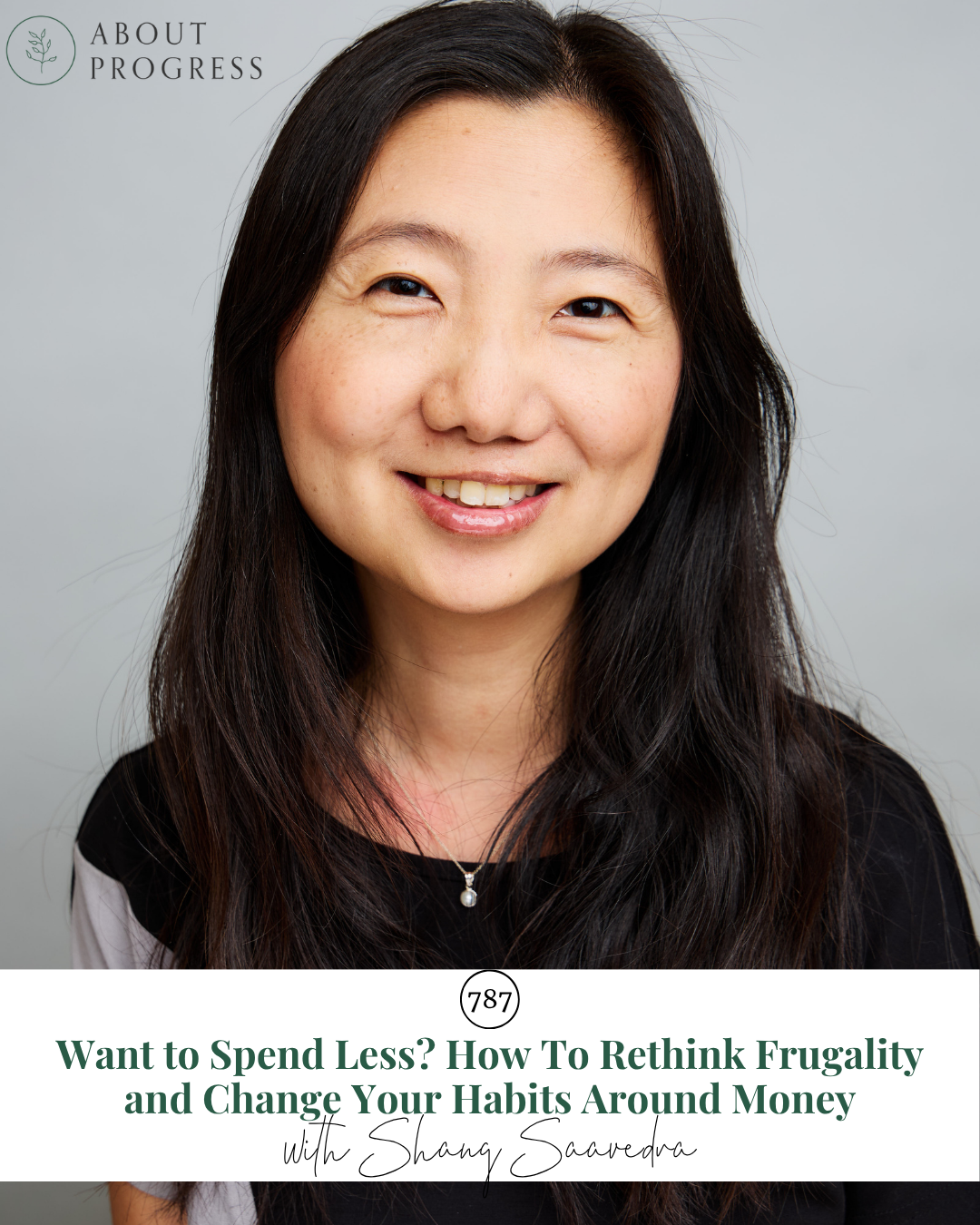
Shang Saavedra is a personal finance expert who helped me rethink frugality in a liberating way. Our conversation explored the emotional roots of our money habits, revealing how mental health significantly impacts financial literacy. Shang shared her personal story of living off 20% of her income during her twenties, not out of scarcity, but with the goal of buying time and freedom later. This approach was truly eye-opening, showing me that frugality can lead to joy when it's aligned with our values. Shang's inspiring and compassionate approach left me feeling more empowered and hopeful about my financial journey, and I hope sharing her insights will motivate you to embark on your path to financial freedom too.
Shang's free investing guide, Instagram, website
Referenced IG post
Preorder Sticky Habits book today!
Join the Book Launch Committee for behind-the-scenes and first peeks at all things book.
Join the Supporters Club to keep About Progress around for good.
Get the Best Summer Ever Workshop at half-off old pricing!
Recent episode on a similar topic: https://www.aboutprogress.com/blog/you-re-not-bad-at-money-how-to-build-a-system-instead-of-a-budget-with-rebecca-palmer
About a few other things...
Sign up for the Go Getter Newsletter to get Progress Pointers in your inbox every Wednesday.
You can listen to the episode below, on Apple Podcasts, or on your favorite podcast app. If you like the show please share it, subscribe, and leave a review!
SHOW NOTES
Access exclusive supporter benefits
Sign up for the next Sticky Habit Intensive
Book Launch Committee
Leave a rating and review for the podcast!
Lend your voice and experience + be featured on the show HERE
Join Monica on Facebook and Instagram
Songs Credit: Pleasant Pictures Music Club
Get your AirDoctor purifier for up to $300 off with the discount code “MONICA.” Get your teen Knix with code “PROGRESS.” Go to Quince for free shipping on your order and 365-day returns.
TRANSCRIPT
Shang Saavedra: They're like, wow, Shang, I could never do that. Or, that looks like a really poor unfun life.
Monica Packer: Yeah.
Shang Saavedra: And I think it's because that's you trying to put yourself into the context of what I was doing, but without knowing what the end goal was for me, my frugality, was buying the ultimate.
Most expensive resource in the world time. I truly believe that for all of us, time is the most expensive thing that we can buy,
Monica Packer: Hi, this is Monica Packer and you're listening to About Progress, where we are about progress made practical.
I know money is on a lot of our minds right now with gas prices going up, groceries never seeming to come back down after big rises. It seems like all of us are really worried about our spending habits. And at the same time, I think there are few more vulnerable topics than money. For a lot of us, even the word can immediately bring up fear or shame or guilt or even just this quiet simmering worry that we're not doing it right.
To help lessen the stress that money is creating in your life and to provide realistic ways you can spend less without becoming so scarcity bound, I interviewed Shang Saavedra, a personal finance expert, about how to think wealthy, yes wealthy, and live more frugally in today's ever-changing financial climate.
Money is surprisingly emotional, so that's actually where we start, by getting clear about the emotional roots of our money habits, how our childhood experiences, perfectionism, stress, and even mental health can shape the way we spend, save, avoid, or obsess over money. And then we also talk about how to practically change those money habits.
This episode helped me rethink frugality in a way that felt freeing instead of fear-based, which is a very rare approach in the financial world. Since I interviewed Shang, I have found myself making more simple shifts to how we spend and as a result feeling freer about our money.
My own money cycle is changing and I definitely credit this conversation with Shang as part of that. Shang Saavedra is the founder and CEO of Save My Cents, a nationally recognized personal finance expert and a book author. Shang finished saving for her retirement by the age of 31, and is America's leading expert on saving for retirement with joy.
Previously, Shang was a corporate strategist for several Fortune 500 companies. She received her bachelor's degree in economics from Harvard and her MBA from the University of Chicago Booth School of Business. Her book, Wealth Is a Mindset, was published in January 2025, and I highly recommend you check it out.
If you've ever wished you could feel more calm, intentional, and empowered financially, this conversation is going to meet you with a lot of compassion and some really practical wisdom as well. I encourage you to share this with a friend that you have been talking about money with or your spending habits with.
I know it's gonna help them. Copy the URL while you're listening and text it to them right away. That interview is coming up after a quick break for our sponsors.
Monica Packer: One of the things I did not have on my almost 40 bingo card is more allergies. Since I already have some kids who tend to struggle with allergies in general, I am now joining them in noticing the great difference between having good versus poor air quality.
This is why we love Air Doctor in our home. It's the only air purifier we use , and we are in good company. Air Doctor won Newsweek's Readers Choice Award for best air purifier with Air Doctor, we notice reduced allergy symptoms as an entire family, fewer odors around the home,
the cleaner air for my kids brings me a lot of peace of mind, as does the extra protection during wildfire season, air doctors, powerful three stage filtration captures particles about 100 times smaller than what typical air purifiers can remove.
Air doctor captures airborne contaminants that you do not want to be breathing in. Dust, pollen, mold spores, pet dander, wildfire, smoke, bacteria, viruses, odors and more, it has a whisper, quiet operation.
It's not loud like others on the market. And the auto mode feature is a big favorite of mine because it automatically kicks into different modes as needed, as well as an easy change filter reminder. So I don't have to guess when it's time to change my filter.
We are part of the 98% of Happy Air Doctor customers who say their home's, air feels cleaner, safer, and healthier. Head to air doctor pro.com and use promo code Monica to get up to $300 off today Air Doctor comes with a 30 day money back guarantee.
Plus a three year warranty. An $84 value free get this exclusive podcast only offered [email protected]. A-I-R-D-O-C-T-O-R-P-R o.com using promo code Monica
Monica Packer: Summer is fast approaching. If you are a mom who has had summers only about survival, it's time to instead create a summer for the scrapbooks. To help you do that, sign up for my $17. On-demand workshop the best summer ever. Workshop in 60 minutes with me. You'll get clarity on what you want the summer to look and feel like.
Create a personalized plan for realistic routines, rhythms, and household rules to make your summer sing and establish a path to still prioritize self-care. All with the printable workbook. To boot. Go to about progress.com/workshops to get the best summer ever. Workshop today and then watch it when you're ready.
And while you're there, check out my other available on-demand workshops, how to dream again and new rebuilding a relationship with me. All workshops are currently priced at over half off my typical workshop pricing because times are tough, but you still deserve support. Again, get a workshop or two tailored designed for you, especially the best summer ever.
Workshop now at about progress.com/workshops.
Monica Packer: Shang Saavedra, welcome to about Progress. I.
Shang Saavedra: I'm so glad to be on here. Thank you so much for having me, Monica.
Monica Packer: I think we all want to get better at this area in our lives, saving money, spending it wisely, but it's even more a topic that I think we are interested in these days, thanks to the rising prices, what we're seeing on our receipts and in our bank accounts. be talking about financial literacy in a different way today, beginning with something I've noticed about how you do so you argue that financial literacy is not just about knowing how to budget and how to invest, and that people forget to include a very important part of financial literacy. Let's start there. What is that and why does it matter?
Shang Saavedra: So newsflash, the way that I think about it has almost nothing to do with your math skills or your intellect and everything to do. With your mental health because financial literacy uses a part of your brain that easily, uh, suffers from mental health issues, and that's where we gotta start.
Monica Packer: I mean, that's right there. The what? That's like the screeching tires. What? What do you mean? Like our finances are about mental health. What's
Shang Saavedra: Yes. If you think about the skills that are required in managing your money, well think about what they might be. You have to be able to think ahead. You have to use analytical skills. Mathematical skills, executive function, all of that happens in the cortex part of your brain, the most advanced part of your brain.
But if your brain suffers any kind of mental health issues, be it depression, anxiety, mood disorders, et cetera, et cetera, that's the first part of your brain that loses blood flow. And when it loses blood flow, your brain cannot function optimally. Just like if one of your organs got sick, it's not gonna function at the highest level.
And that's why if you experience mental health issues, so too do your finances suffer as well.
Monica Packer: For those who are listening who are like, well, I haven't been given the diagnosis of like depression or
Shang Saavedra: I.
Monica Packer: anxiety or like bipolar disorder, but I do find there is like a connection with the way I am doing mentally and how I'm thinking about things, but I need to understand that a little bit better.
You speak to our money story and that's what really hooked me in your book. Because I'm not really a math person like you shared again that, that those things go right over my head and so I don't often find myself reaching for finance books. But when you talked about the roots of what is informing our mental health surrounding how we spend and save our money, that's when I was like, I need to learn way more about this.
How
Shang Saavedra: Yeah. I started diving into what I call are the root causes of your money problems through my own coaching business. So I had been coaching people through their personal finance struggles for about eight years now, focusing primarily on helping people get out of debt and start investing and saving for their financial future.
And I would start asking people, tell me about what money was like growing up. You know, did you feel like you grew up in a poor household, a well-to-do household? Who did you see manage your money? What was it like? And over and over and over, I saw the same patterns resulting in the same outcomes among my coaching clients, and I distilled it down to three most common root causes.
You may relate to one, two, or all three of these. They're not mutually exclusive, and they're called feast and famine. Adverse events and scarce immigrant and my book kind of dives into the personas of each of these and what it may result in. Now I'm gonna pick on one that I think your audience may relate to a lot, which is called the Adverse Events.
So growing up, you may have experienced adverse events such as divorce in your family, death of a loved one, and also you may be experiencing. unreasonable expectations of you as a person. For example, maybe you are parentified by your single mom having to take care of all of your other siblings, or maybe you may be getting pressure from your parents to succeed.
Succeed, make money, do well in school, be the perfect person. Growing up and growing up, you were given basically an impossible task of meeting these. Standards that are not coming from within, they're coming from outside of the world. You are being told this is your identity. People growing up in that adverse event environment, as an adult, what happens financially, you struggle to establish an identity that is wholly your own and then it shows up in your finances where.
I call it identity seeking behavior. You're gonna start spending money or spending your time and resources in the area where you're struggling to try to define yourself. So I actually applied to myself 'cause this is what I, uh, felt growing up. Growing up. My parents wanted me to be perfect. They're. Get the best grades, be number one, get into Harvard, which I did.
I did all of that under an immense pressure cooker environment. But once I become an adult, it was the, the pressure was gone and I didn't know what to do. And I was like, okay, well I do what I always knew, which is to be perfect, to do what at work. But that meant that I kept thinking I have to show up.
And look perfect. So I spent a lot of money on outfits. I really lusted after luxury goods, and I also spent an immense amount of my personal time trying to improve my career. I mean, which is not a terrible thing, but that was my whole identity. It was wrapped up in this career, and this is all coming out of that childhood of adverse events, of being held up to impossible standards.
Monica Packer: Hmm. Thank you for sharing about your story. That was another part of where I was like, Ooh, she has us here with your own tale of perfectionism and how that actually influenced the way you spend money, which is again, an a connection. I don't see being made like ever outside of you. I think this is specifically a Shang connection. Uh, you know, as I was reading through those root causes, I had this kind of question mark for me because I personally didn't experience those. Three categories, but I could see how my parents did. And I think that's another thing I wanted to hear a little bit more about, if they're not specifically thinking, well, I didn't grow up in a feast or famine household, maybe my parents did
Shang Saavedra: Yeah,
Monica Packer: I didn't experience adverse events that impacted my relationship with money, but my parents did. Or same thing with the immigrant category too.
Shang Saavedra: Yeah.
Monica Packer: How can people still know this is still impacting the way you see yourself how you live that out with the way you money?
Shang Saavedra: Yeah. If you think about it, many of the things we do as adults, adulting skills are taught to us or. Not taught to us by our parents. And I actually consider personal finance just another adulting skill. People think it's like this really daunting thing that you have to learn, but ultimately, uh, I find it as a, a, a a similar in, in kind of the scope as learning to vacuum, learning to do laundry, learning to cook.
And so the way that your parents went about or did not go about personal finance is the number one influence in how you too also decide to go about personal finance. Because if you saw your parents do it in a certain way, and because money is such a taboo subject. In the United States, although thankfully it's getting better then as an adult right now, especially assuming the ages of your audience, 30 to fifties, we didn't grow up in an environment where school taught us anything about personal finance.
So the first thing we're going to do is either model exactly what our parents did, or maybe some of us do exactly the opposite of what our parents did, and that's usually the starting point.
Monica Packer: Okay, so if they're trying to unearth what their root causes are, they can begin with their own story, but also their parents' story and even how they were educated on financial literacy growing up.
Shang Saavedra: Absolutely it's, that's why people say money is a generational issue. It literally gets passed down in the behaviors that we see from grandparents to parent to ourselves.
Monica Packer: Okay, so once they can identify a root cause, then they have information more. I think that removes that self-blame kind of cycle we get caught up in with money. Especially like once we understand why we spend the way we do, then we can make some changes to it. Is that, is that the goal?
Shang Saavedra: Yeah, I have this framework where I I call trigger action reward. Basically trigger is an outside circumstance or an inside emotion that causes you currently to do an action that probably works against your personal finances. So, for example, my own trigger, feeling bad or getting stressed out at work about myself, it makes me feel unworthy.
My first action is to go online shopping for an outfit to make me feel better. My old reward is that, okay, I temporarily feel better dressed, but it doesn't solve my underlying stress about work. And once we realize that that's the cycle that's going on. What we do is we change our action. You're like, Hey, I now know when I get triggered into doing something that's probably not helping me with my finances.
For me, it's work stress. Then my action is what can I do to actually solve the underlying issue, the real problem. So it gets me into a better situation. But for me, I was realizing, wow. I need to exit my toxic workplace. I need to start networking and interviewing, and also let's set aside and save more money so eventually I don't have to work in a soulless corporate environment.
That was my ultimate goal. And then, so now that I realize my true triggers are stress related, I address my underlying stress not by shopping, but by doing something that's really getting to the heart of it all and in my eventual reward, which for me personally was. Having enough money to quit corporate in my thirties, which is amazing.
And it's not that I'm saying everybody needs to quit corporate in their thirties, but this framework I think can be applied to anybody who feels like they're in a cycle and we're gonna break the cycle and help you reach a different state.
Monica Packer: Mm-hmm. I'm glad you'd speak to that cycle terminology, because that is what it feels like when you're living in it and it's one that you almost feel shackled to, like, this is just how I spend. I don't understand why, but with your framework there, that's how they cannot own. Only understand why, but the specifics of in the moment too, to understand the, the undercurrent that's informing these choices so we can change them. Um, and that's why I like how you then go into ways we can change. Because too often we read things or we learn things where we get the changes first instead of
Shang Saavedra: Yeah.
Monica Packer: the why. So I'm so glad we could start there. speaking of the
Shang Saavedra: Yeah.
Monica Packer: you think about frugality. In a different way. So much of it is fear-based. That's probably why I don't pick up many financial books because I don't wanna feel the fear. Uh, how do you see frugality as a way to freedom?
Shang Saavedra: Yeah, because a lot of people, when they learn about how frugal I was in my twenties.
Monica Packer: Yeah.
Shang Saavedra: I was living off of 20% of my base pay. I was pretty much living like a college student. They're like, wow, Shang, I could never do that. Or, that looks like a really poor unfun life.
Monica Packer: Yeah.
Shang Saavedra: And I think it's because that's you trying to put yourself into the context of what I was doing, but without knowing what the end goal was for me, my frugality, which I was okay with, was buying the ultimate.
Most expensive resource in the world time. I truly believe that for all of us, time is the most expensive thing that we can buy, and also when I reframe it as not being cheap or scarce, but rather I'm being intentionally under consuming in my life so I can buy years of my life back. It's a crazy big goal then.
It's not cheap. It's actually really freeing. It's allowing me to reach. Basically, whatever my heart desires, that brings me joy. And when I recast that as this is my path to joy, I no longer feel uncomfortable or shameful over how I choose to live my life.
Monica Packer: Hmm. make the choices and actually make them instead of feeling like you have to.
Shang Saavedra: Mm-hmm.
Monica Packer: kind of speaks to, I think another misinterpretation of frugality is scarcity. Like it's not just about fear, it's about. scarcity way of viewing money, like it's always going to disappear. Um, that's how I grew up.
My dad was a medical physician, but he and my mom were children of farmers growing up. And so they lived like they were farmers still. And I'm so glad I grew up in a frugal household. I learned so much about that. But the way as an adult, I held onto my frugality was about that fear driven scarcity,
Shang Saavedra: Yes.
Monica Packer: caught me into cycles of feast or famine too. For myself that I'm still trying to work on. I wanted to hear how you would frame frugality as more of an abundant thing. You were kind of getting at that here, but how can
Shang Saavedra: Yeah.
Monica Packer: reframing the way they see frugality as a way to wealth and abundance?
Like it's a, it's about, it's enough.
Shang Saavedra: Monica, your family does kind of fit that, um, root cause of scarce immigrant, even if they're not technically immigrants because they landed into, you know, a vocation where it, it, it's you. You don't know what you're going to get. It's a huge risk, right? They take you, when you're a farmer, you take a really big risk each year with your crop.
And then, so they had to be frugal because there's no other way to be financially survive. And so it's also very likely that you inherited that frugality, but you didn't realize that, that that was the risk profile that your grandparents and your parents had to live under. That that was what they had to do.
And then, so in, in these contexts, and I see this amongst. Immigrants all the time. They take a huge risk and therefore they had to be frugal with their money because they don't know if they're going to get it, and then their children misinterpret it as, okay. Frugality and scarcity are the same thing because my parents feared so much.
Therefore, if I see someone who's frugal, then that's also likely scarcity mindset. In reality, scarcity is not about how much you spend. Scarcity is about how you approach risk. Somebody who is scarce is somebody who is very afraid of taking risks, and this is very similar for a lot of immigrants. They took a big risk by immigrating or farmers took a big risk by becoming farmers.
They don't want their children. To experience that same risk. So they keep telling their children, don't do what I did,
Monica Packer: mm.
Shang Saavedra: but they can't explain it in the terms of risk versus reward. And that is why, um, if you want to move more towards abundance, the first step you have to allow yourself to take is I'm gonna try something that makes me uncomfortable, that makes you feel scared.
Monica Packer: Hmm.
Shang Saavedra: But the last sentence in my book, do it scare, but do it anyway. That's the model. I'm gonna try it. I'm gonna do it anyway. And it's okay if it doesn't work out. That's abundance.
Monica Packer: Okay. So it's being willing to understand why the fears are there and, and to validate them in some ways, but not stay stuck in them
Shang Saavedra: Yeah. Yeah. And it doesn't have to be the biggest risk you take in life. Like one of the smallest risks I remember ever taking to, to experience risk taking for the first time was actually went through an obstacle course as part of a school. Um. Orientation. Yeah, it was during business school, I had to go to this obstacle course and I had to like dangle like high up, um, on a, on the tether, and I was freaked out.
I was like, I'm gonna die. I'm gonna die. And when I knew I had a tether and I realized, yeah, I was afraid, but when I took the couple of steps, I had it to get to the other side, I was like, oh, now I know what it's like to do something really, really scary and I can do it again.
You are not bad at habits. You've just been using the wrong method. My first book will be published this fall. It's called Sticky Habits, A Woman's Guide to Reclaim Happiness Ditch Perfectionism, and Create Habits That Last. It's set to release September 8th, but you can pre-order the book right now for three special bonuses.
This book is not about. Doing more. It's about building habits that survive real life, creating routines that flex instead of break. Letting go of perfectionism that keeps you quitting and learning how to keep promises to yourself. Again, even on hard days. In a world of self-help. That too easily ignores the invisible labor women carry. That changes everything because women must do habits differently. Sticky habits will teach you how to do so. Please pre-order the book now and check out the special pre-order bonuses by going to sticky habits book.com that's linked for you in the show notes.
I'm so thrilled for this book to be out in the world. It is several years in the making and I know it will change so much for you. Again, go to sticky habits book.com to pre-order the book now.
Monica Packer: I love that story so much, but I'm also like, why'd they make you do that? But I get it. I get why there was a deeper reason. Um, one other question I have about frugality then, and I think that can hold us back from engaging with. Living a frugal life is, um, the morality we attach to money too. Like, you know, a frugal household has this mindset of like, we are attaching the way we spend our money to who we are as people, which you've already made that connection, but how that can also lead to a lot of fear, like you said, and not saving, actually, a lot of people don't save money because they're afraid or they don't invest or they don't budget, and it's all out of that fear. How c an unattaching morality money actually helps us live a more wisely, frugal lifestyle. That's such a complicated question, but I know you're really smart, so I'm sure you're gonna get what
Shang Saavedra: Oh,
Monica Packer: it.
Shang Saavedra: I do, I love the, I love the complexity of this question. Um. Because it, uh, going back to the cortex part of our brain, right? When our brain is healthy, at its optimal level, it can make decisions based on facts, data, rationality, and when it comes to money, those are the skill sets you need. There are other things that are not as fact based.
Like as, as a mom, you can't always use facts to raise your children. They're not gonna listen to you. You have to use emotions. But when it comes to money, you can be very fact driven. And so it's actually important you take the emotions out of it so that you get better at it. I often describe money as a knife.
If you use it well, it will feed you. If you use it terribly, it can kill you.
Monica Packer: Hmm.
Shang Saavedra: So money, money itself is actually a neutral resource. We as human beings, with hearts and minds assign emotional moral values to it, and that's where it gets murky. At the end of the day, it's a neutral subject, and if you can see it as neutral, it allows you to manage it better.
Monica Packer: Hmm. Yeah, I'm making that connection and I can feel myself already settling down some of that fear. Like if I don't, if I spend money certain ways, that means I'm not a good person. Or if I don't save in certain ways, I'm not a good person. When really if I see it as a resource, I am free to make the same choices, but them feel different because they're actually in alignment with what I more deeply want.
Shang Saavedra: Yeah,
Monica Packer: That's
frugality.
Shang Saavedra: I don't, think money makes you a good, good or bad person. A a lot of people with consumer debt, for example, and I hear from them in January of the year, they feel like, I feel guilt. I feel like I did something wrong. There's something terrible about me. I failed. I'm like, no. There's a lot of circumstances that led to your debt that have nothing to do with your morals or who you are as a person.
It's just circumstantial, and I know it's so hard to disassociate and forgive yourself for that, but forgiveness is actually the very first step that you need to get better with your money.
Monica Packer: And I believe you say that in your book, like you are not your debt,
Shang Saavedra: Mm-hmm.
Monica Packer: also are not like the number in your bank account or
Shang Saavedra: Yes.
Monica Packer: little you spend, even though that's can be a good goal, but if it, you're basing who you are off of having that. Internal, like leverage of like, I am such a good person because I don't spend any money on anything.
Nice. Then there's still a trap there too, right? That
Shang Saavedra: Mm-hmm.
Monica Packer: differently. So you talked about how in your twenties you lived extremely frugally in an attempt to build towards your goals of living more freely later on. So I wanna speak a little bit more to. Some ways people can do that now, maybe not as extreme as you detailed in your, in your book. Um, more so because I'm sure there are, people are like, I wanna be frugal so that I can feel more free to spend money in ways that I need and want to, and the ways I actually value. Um, what are some ways I can do that that you would suggest?
Shang Saavedra: These are some of the things that some of my co-coaching clients are doing right now, and they say it's actually some of the easiest changes they've had to make. 'cause it's not daunting at all.
Monica Packer: Okay.
Shang Saavedra: the first thing I do, I tell most people is do a review of all of your subscriptions, your streaming subscriptions, your beauty delivery subscriptions, and ask yourself, do I use this?
On a monthly basis. If not, cancel all the ones that you're not actively using and then resubscribe when you do need it. That can literally save you a couple dozen bucks each month. Super easy. The second one, which is very counterintuitive, but I tell most people, unsubscribe or, or pause Amazon Prime.
Because studies have shown over and over that if you are an Amazon Prime user, you have to spend way more money on Amazon than if you're not. And people are like, what about my free shipping? If you order over $35 of merchandise, you get free shipping. It's just a little slower. But by unsubscribing from Amazon Prime, what it does is that it.
It removes the grease on the your buying wheels, so to speak. Amazon Prime primes you to buy on Amazon, but now you're like, oh, I gotta get up to over $35 of merchandise. You now start to think about everything that's in your shopping cart. And I sometimes been able to help people literally like reduce their Amazon shopping by 50% just by doing this one thing.
It's incredible. Um, some of my other more funny ideas include, um, carrying snacks when you go out, not just for your children, but also for yourself. 'cause you're not eating when you're hungry
Monica Packer: Yeah.
Shang Saavedra: that helps with, um, not buying as much when you are eating out. And if you do eat out, which I do love, I love eating out.
I tend to do it for lunch instead of dinner. So smaller portions, lower prices, lunch specials are great. Um, and then if you wanna get a little bit more extreme, and this is where I actually started. I was like. What merchandise loses its value rapidly after you buy it new. This includes clothing, jewelry, cars, furniture.
Now I'm not buying cars all the time, but I do buy clothing, jewelry and furniture, and I started realizing if I bought secondhand, but really high quality, still great stuff, but for like one quarter of the price. So that's what I do these days.
Monica Packer: Those are such great examples. Thank you. I love the practical side of that. And I'll tell you right now, Shang, my goal this year is to only buy secondhand for clothing.
Shang Saavedra: Wow.
Monica Packer: of that reasoning, I actually like nicer things that last.
Shang Saavedra: Yes.
Monica Packer: so then that kind of both of my morals together of wanting to be frugal, but also wanting nicer things that last.
So
Shang Saavedra: it's sustainable for the planet because clothing manufacturer is actually one of the most destructive, uh, industries for the planet.
Monica Packer: Yeah. Thank you for bringing in that point too. Um, I wanted to also reference a recent video that you did. Now we're sharing this later on in the year, so I'll make sure I link to it in the show notes. But you kind of recapped your 2025 on ways that you spent your money. And I love that you didn't provide like commentary.
You weren't like, see, I did this and I saved for several years for this thing and, and here's why I chose this, a particular thing that I got and here's, you know, like you just let it. Play out, like this is how I chose to spend my money this year. Um, which to me also is indicative of that freedom benefit that we can get if we are living differently or if we're thinking differently about our money and, and relationship with it better. Can you tell us a little bit more about how you see money, how you spend money personally, the way you value it, and how that could play out to like a recap like that that really is indicative of your relationship with money and, and how it translates to how you spend it.
Shang Saavedra: There's a favorite quote that I constantly forget who said it, but they said, if you show me a stack of receipts and your calendar, then you, then I know what you truly value. And so with that, speaking to is where you spend your time and where you spend your money. If it aligns with your value system, then you feel like your true, authentic self.
So in 2025, my husband and I. Bought and paid for our home. All cash we bought and paid for our minivan 'cause we expanded the three children all cash. Our eldest child got into our dream private school and we're paying for that as well. And then some other smaller things like repairing and renovating our home.
Um, going on a trip to Paris and buy my very first luxury handbag. But what, like you said, what people didn't see is the 20 years of financial. Stewardship that led up to all of these decisions finally coming to a head. And of course, I will not be buying houses all cash going forward. Only one house is good enough for me, you
Monica Packer: Yeah.
Shang Saavedra: Um, just looking back on 2025, what is so incredible? It's like, yes, this is now the manifestation. Of all of those years of really, really being honest with ourselves and asking what is it that matters and spending where it does and saving and investing and buying back all this freedom, it's like, wow, it came to fruition and that I'm, I'm just very happy that we were able to do it for our family.
Monica Packer: So for those who are listening, they're like, I wanna feel that kind of freedom around it. But also the value, like those were things that you valued and you worked towards. I'm gonna reference 'em to your book, wealth is a Mindset, because you do give them ways to work towards that in the long term.
And that's something I really took away from your book too.
As I, I finished reading, I told my husband, I'm like, we gotta triple down on investing. And being really careful with the other ways we're spending our money on our subscriptions. That was one of the things we've been talking about. Um, but before we wrap this up, I wanna speak to the people who are listening to this and they still just feel a lot of shame. They feel a lot of shame about how they have been caught in cycles of the ways they spend save, use money. What do you want that person to know?
Shang Saavedra: I would love for you to be able to say to yourself, I am enough who I used to be. Who I am right now, and also the future version of me, because all of this comes from love. If you want to change your joy because you, you wanna love yourself into a better version. Whereas if you are beating down and guilting yourself, um, it's just gonna put you into a state of anxiety and negativity.
And as we know, when you're in that state, you don't make the best decisions. When it comes to money. So if anything, I wanna give you a big digital, virtual hug, um, bear hug because oh gosh, you need to be kind to yourself. That's where we have to start.
Monica Packer: Thank you for teaching that way. That's why I'm gonna be a Shang follower for life because that's how I feel. I not only feel that virtual
Shang Saavedra: I.
Monica Packer: feel more hope and also more. Motivation, but not in a bad way either. More like I can, I feel more
Shang Saavedra: Yeah.
Monica Packer: really.
Shang Saavedra: Yeah.
Monica Packer: that way.
Shang Saavedra: Oh.
Monica Packer: I want you to tell people where they should go to get the book and also to learn more from you.
Shang Saavedra: Of course. So my book is available wherever you purchase a book, so be it. Your local bookstore, birds and Noble Amazon. It's wealth is a Mindset. And then you can learn more about me on my website, save my cents.com. And I'm also most active on Instagram under the same username. Save my Sense.
Monica Packer: Yeah, you've got a really active community, uh, there, which is so fun to see how how much people enjoy learning from you. Um, Shang, we always end with a final question. What is one small way listeners can take action on what they learn today?
Shang Saavedra: I would love for you to have what I call the money happy hour. We're making it happy because we gotta start with a positive, right? Try to set aside one hour a week, maybe one hour spread over two days, but try to dedicate one hour a week to focus on your personal finances and it can be doing whatever it is you need to do, but put some time against your personal finances.
Do it, scared it. It will get better over time. I can guarantee that.
Monica Packer: Money, happy hour. I'm totally doing that I will report in on how
Shang Saavedra: Yes, let me know how it goes.
Monica Packer: let you know. Shang, this has been so informative, but also I keep coming back to the word empowering. Thank you very much for taking the time to be with us today. Thank
Shang Saavedra: you.
Monica Packer: That was amazing.
Shang.
I hope this episode gave you the hug and kick in the pants you need to grow. I'll now share the progress pointers. These are the notes I take so you don't have to, and those on my newsletter get them in an expanded graphic form. You can sign up at aboutprogress.com/newsletter. Number one, your money habits are often emotional before they are logical.
Number two, identify the trigger, action, reward cycle behind your spending. Number three, frugality is not the same thing as scarcity. Number four, small financial habits can create major change over time. And number five, shame keeps you stuck. Self-compassion helps you change. Again, the expanded version is gonna be emailed out with our newsletter.
Get it at aboutprogress.com/newsletter. This podcast is listener supported. Members of the Supporters Club make my work with About Progress free and available to all without me having to add a paywall. You can support the show by going to aboutprogress.com/support and check out the three levels of exclusive benefits we have for supporters.
Pretty soon, we're gonna be having our garden party at my home for all levels of supporters, so I hope you will sign up again at aboutprogress.com/support. You can always support the show for free. The best way to do that right now, and in a way that is desperately needed, is to share this episode with a friend.
We have always grown the show the best through organic shares. So do your part for free and help support the show by sharing this episode with a friend you thought of while you were listening. Thank you so much for listening. And now, go and do something with what you learned today
Monica Packer: I didn't experience adverse affect, you know, um, how did you word it?
I, I forgot the
Shang Saavedra: adverse events.
Monica Packer: you. I didn't experience adverse events