
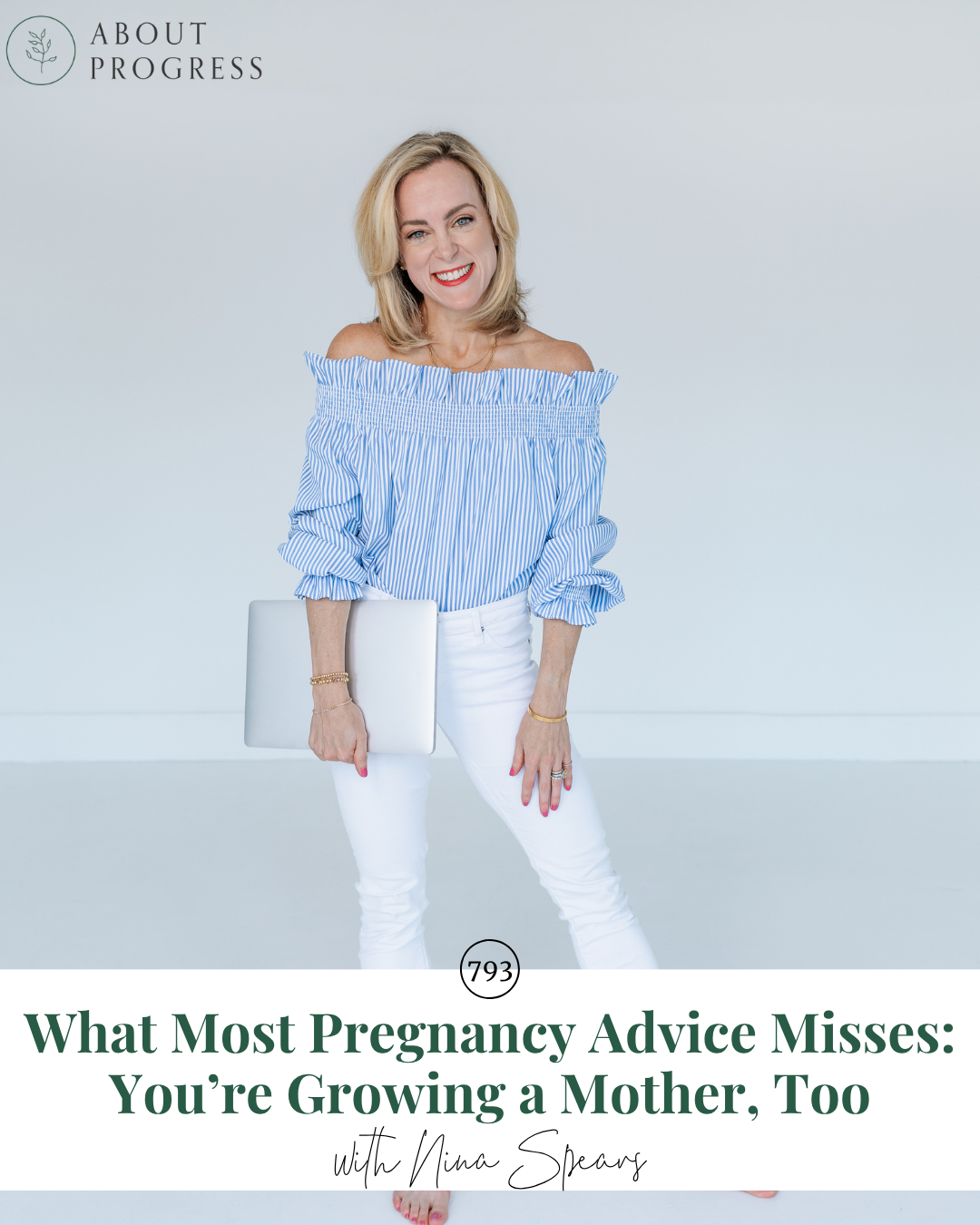
What Most Pregnancy Advice Misses: You’re Growing a Mother, Too || with Nina Spears
Jun 15, 2026
When I was pregnant with my first baby, I was consumed with preparing for the needs of the little one, spending hours reading books and researching products. But what I didn’t prepare for was the transformation within myself - a lesson that each pregnancy unveils a new version of who I am, shifting my identity, expectations, and even my understanding of motherhood.
In our discussion, Nina Spears emphasized the importance of preparing for the mother just as much as the baby. We often forget that with each baby born, a new mother is also born, requiring just as much care and support. This journey pushes us to redefine what success looks like, challenge our predispositions, and ultimately build a support system that acknowledges and nurtures the endless, often invisible labor we undergo. If there’s one thing I wish for expectant mothers to take away, it's this: you deserve to prepare and care for yourself just as much as you do for your child.
Preorder Sticky Habits book today!
Join the Book Launch Committee for behind-the-scenes and first peeks at all things book.
Join the Supporters Club to keep About Progress around for good.
Get 50% off last year’s More for Moms All-Access Pass with code LISTENER at checkout.
About a few other things...
Sign up for the Go Getter Newsletter to get Progress Pointers in your inbox every Wednesday.
You can listen to the episode below, on Apple Podcasts, or on your favorite podcast app. If you like the show please share it, subscribe, and leave a review!
SHOW NOTES
Nina's website, Instagram, Podcast
Access exclusive supporter benefits
Book Launch Committee
Leave a rating and review for the podcast!
Lend your voice and experience + be featured on the show HERE
Join Monica on Facebook and Instagram
Songs Credit: Pleasant Pictures Music Club
Get your AquaTru water purifier with the discount code “MONICA.” Get your teen Knix with code “PROGRESS.” Go to Quince for free shipping on your order and 365-day returns.
TRANSCRIPT
Nina Spears: with every baby, you are growing into a new mother
We're so focused on the baby because the baby is visible, but the mother is not visible because you're still the woman, but that mother is still being born, and please put in that time to get the support that you deserve stop asking to hold the baby.
Who's holding the mother, you know?
Monica Packer: . Hi, this is Monica Packer, and you're listening to About Progress, where we are about progress made practical When I was pregnant with my first baby, I did what I thought every responsible soon-to-be mom should do. I read the books, researched the gear, compared strollers, and spent way too much time trying to figure out what was the, quote-unquote, "right way to prepare for a baby."
But what I didn't prepare for was me. No one really told me how much pregnancy and motherhood would challenge my identity, my expectations, my relationships, or my sense of self. Looking back, that's what surprised me the most, not becoming responsible for another human, but becoming a completely new version of myself.
In today's episode, I am joined by Nina Spears, the founder of The Baby Chick and author of The Baby Chick's Guide to Positive Pregnancy. While we absolutely talk about pregnancy and postpartum, this conversation goes so much deeper. We explore what it means to grow into motherhood, how to build trust in yourself, and why preparing for a baby should also include preparing for the mother.
This is obviously a very niche topic and not one I have ever covered on the show. But my conversations with Nina and the friendship that we've formed online Has led me to see that preparing mothers for motherhood
Is a giant hole we have in the motherhood space. My podcast has primarily served mothers throughout my entire now almost 10 years, and it's time to actually talk about how pregnancy, postpartum affects moms and how we can do a better job of helping them through that. Even if this is long past the time when you have been pregnant or postpartum, this episode is going to help.
If you're currently pregnant or you hope to be someday, or you are years into motherhood and still growing alongside your children, I know you're gonna find something meaningful in this conversation. I've personally been lucky enough to have five kids. I wish I had had this information 15-plus years ago, but this conversation with Nina surprised me because it healed some of my own experiences in ways I did not expect.
If you think of another woman in your life who needs this episode, maybe a pregnant friend or one who has really struggled in her postpartum season, send them the link to this episode while you listen. Nina Spears, also known as The Baby Chick, is the founder and CEO of Baby Chick, a trusted platform supporting women through pregnancy, birth, postpartum, and motherhood.
She is the creator of the SOAR Birth Prep Challenge, a bestselling childbirth prep course, and the host of Chick Chat, The Baby Chick Podcast. Nina is also the author of The Baby Chick Guide to Positive Pregnancy and a certified baby planner, birth and postpartum doula, and childbirth educator who has supported over 800 families and attended more than 350 births That episode with Nina is coming up after a quick break for our sponsors
Monica Packer: I am never two feet away from my water bottle, and that's because I'm always parched. And what helps me maintain my habit of drinking water is not only does it taste good, but I know it is clean too. Did you know that three out of four US homes have toxic chemicals in their tap water?
Even though contaminated water looks clear, it could put you at risk for health concerns from fatigue, hormone disruption to cognitive decline. Surprisingly, standard fridge and pitcher filters do little to remove most contaminants, and bottled water contains microplastics.
So what's the solution? Get AquaTru like my family. It's a countertop water purifier, tested and certified to remove eighty-four contaminants, including chlorine, lead, forever chemicals, and microplastics. Its patentint four-stage reverse osmosis system goes way beyond ordinary filters. For pure, healthy water you can trust, no plumbing, no installation. We have had ours for a long while, and when we first got it, my kids were enthralled with it, mostly because of the taste.
I replaced the filters many times, and it's so easy to do. It also looks pretty good on the counter. Join ninety-eight percent of customers who say their drinking water is cleaner, safer, and healthier.
Go to aquatru.com now for twenty percent off your purifier using promo code Monica. AquaTru even comes with a thirty-day best-tasting water guarantee. That's A-Q-U-A-T-R-U y- A-Q-U-A-T-R-U.com, promo code M-O-N-I-C-A, aquatru.com.
Monica Packer: Last year, I embarked on creating the largest project of my entire career as a podcaster, an exclusive online conference for moms who are ready for more. Thousands of moms enrolled to the More for Moms conference, and I had some of the best conversations I've ever recorded with 25 world-class speakers, helping women access more in their happiness, habits, health, home, and hobbies.
As I now prepare for round two of this conference for this coming fall, You now have the opportunity to access year one's content as a self-paced course before it's archived this August. Imagine a year's worth of About Progress interviews, but all in one place, serving one clear purpose with zero ads and a private podcast to boot or videos and transcripts if that's what you prefer.
Speaker sessions range from super deep to extremely practical, with each one being tailored designed for any mom who has that inkling for more. You can get 50% off 2025's archive by using the code listener at checkout at aboutprogress.com/moreformoms.
That breaks down to just $1.34 per speaker session. Again, you can use the code listener for 50% off 2025's content archive at aboutprogress.com/moreformoms before it expires this
Monica Packer: Nina Spears, welcome to About Progress
Nina Spears: Oh my gosh, Monica, I am so excited to be here. Thank you for inviting me and to have this awesome chat. I'm, I'm pumped
Monica Packer: It's really needed. I never talked about pregnancy specifically with an expert, and I think that has not only done me a disservice, but all the women who are listening. Because we know some of the basics, you know, we go to the doctor, we, we try to, like, research with Google, whatever, but really, there's so much of pregnancy that we just think is a given.
Like, we just kind of think women all over are doing this, so many women are doing it right this second, it's just part of life. Like, and in some ways that negates what this experience really is like, and I think underprepares us. And I have learned more each pregnancy, and each one has taught me how much I do not know.
So I want to begin first with you just validating any person who is listening who is either pregnant or who has been pregnant recently too, and just thought, "What?"
Nina Spears: Yes, let me say, if pregnancy feels hard or harder than you expected, like girl, I hear you, I feel you, I see you, I get it, and you are definitely not alone. I, and like you said, Monica, like so many people do treat pregnancy as something that just, you know, happens every day, because it does. And yes, women have been having babies forever, but just because pregnancy is like common doesn't mean it's easy.
Like for some people, it's definitely not, and some... But for some it is, and both experiences are okay and normal. And, I think it's not just because it's physical. You're also experiencing emotional, mental, and relational transitions that you have never really experienced before, and each pregnancy can be so different, like you were saying, and bring up different things each time like so much is changing, not only in your body, but your hormones, your relationships, your priorities.
Even like your identity as a person now as a mother is changing. And you know, you're right, Monica, like most don't realize how much pregnancy challenges like the inner self, and I think many women suddenly just find themselves questioning things they've never really questioned before. Like, "Will I be a good mom?
Can I do this? will happen to my career? What's gonna happen to my marriage?" You know, "Will I ever feel like myself again?" You know, these are all really good questions, and when these things come up during pregnancy, I think it really exposes our need for certainty and control,
Monica Packer: Hmm
Nina Spears: and that can be really tough for people.
I know that's tough on me. I'm type A and a control freak sometimes, so having to learn how to like realize, oh, you can no longer fully control how your body's gonna feel. You can't predict exactly how labor will unfold. You can't control every outcome, and that's why I see pregnancy as like the time that really tries to teach us surrender and letting go,
Monica Packer: Hmm
Nina Spears: is, I think, especially important to learn labor even starts, and motherhood.
Because motherhood also look different than you thought it would. And you know, that's why I often say that pregnancy isn't just growing a baby, it's growing a mother, and mothers deserve just as much, if not more, care, preparation, and support as babies do
Monica Packer: There's so much to unpack there. But I wanna start with that last point you made because this to me is what I think is missing far and wide in pregnancy, childbirth education, is that this... So much of what we learn about, what we're concerned about, what we're striving for is the child inside of us, obviously, right?
Nina Spears: Yeah
Monica Packer: But we also forget that there's a person growing that person, and that's a person who's going through an awful lot,
Nina Spears: Yes
Monica Packer: much. And that sense of self-peace and the challenge of certainty and control and, and this whole, all the question marks and unknown. Let's, let's lean on that just a bit more. What do you wish more women knew about this process of growing themselves as a mother?
And I actually wanna speak to the people who've maybe had a pregnancy or two too,
Nina Spears: Yeah
Monica Packer: and how, you know, you talk how each one's different. You get older and it changes. Or the, who knows why, but your, your body is dealing with it differently, too. And, and your, you know, so your circumstances are shifting. So regardless of if it's their first or like their...
I was gonna say 10th, but I'm like, oh, what? Oh, gosh.
Nina Spears: has 10 kids, so yeah
Monica Packer: Oh, gosh, I, I might, yeah, everything like, wow. Um, but no, regardless, what do you wish more women knew about this time and how they're growing themselves, too?
Nina Spears: Absolutely. is, like, this quote. Essentially what this quote says is while birth is, yes, a holy experience, it's really the first year after that's one of the holiest experiences. And the contractions of birthing this baby, actually, the, the waves that you're going to experience when you become a mother can be even stronger as you push out selfishness, as you push out the things that you were once before.
Because now, this year after you have your baby, you are birthing the mother that is inside you. You are no longer this maiden, you are
Monica Packer: 嗯。 Hmm.
Nina Spears: can be stronger than the surges during labor, and I- that's why I think, you know, a lot of women are so fearful of the pain of labor.
But I want them to understand that that is such a short time in your life compared to motherhood. This is forever. And setting yourself up for a smoother transition and preparing for that first year of becoming a mother. And, and like you just said, with every baby, you are growing into a new mother you are now a, the mother to not just one baby, but two or three or four or 12, you know?
And that, that shifts your heart and changes, changes so much in you. So I think that, that's actually, I know one of the, uh, one of the things that I always tell women is that please, I know that we're so, we're so focused on the baby because the baby is visible, but the mother is not visible because you're still the woman, but that mother is still being born, and please put in that time to get the support that you deserve because, you know, I, I'm always like, you know, stop asking to hold the baby.
Who's holding the mother, you know?
Monica Packer: Ooh, that, that's it. Uh, so you talked about how this process is just as much about defining who you are as a mom as it is creating a- another child, like a- another human, right? So in that process, we are posed with moments and opportunities, and sometimes unpleasant ones, that force us to redefine who we are in order to better define ourselves as moms.
And I am thinking more to the women who are listening who may have these tendencies that are more perfectionistic in nature, who kind of equate their value with productivity, yeah, you know? Who, who value their, their worth on what they can get done in a day, the outcomes. That was the hardest transition for me as a mom, is knowing that most of what I did in the day was not visible anymore, and that really challenged my sense of self, and it ha- it forced me to redefine in many ways who I thought I was all along and then who I wanted to be from here.
Let's spend some time there with that redefinition piece and what women can expect to have to think through with that
Nina Spears: gosh. I think pregnancy forces women to redefine pretty much almost everything. Like, and like you just said, the first one, let's talk about it, productivity. Oh my gosh, so many women tie their worth to what they accomplish 'cause they're used to operating at, like, 100 miles per hour.
Monica Packer: Mm-hmm.
Nina Spears: pregnancy arrives, and is suddenly, like... And your baby says, "You know, we're gonna do things a little differently. You know, you're gonna need more rest. You're gonna have less energy. You may not be able to accomplish everything that you're used to." 'Cause, you know, pregnancy is really trying to help us slow down teach us that our value isn't based on our output, is a lesson I think so many women need to learn because that should have never been the gauge of our worth. And then speaking of worth, like, then there's self-worth. Like, many women spend years critiquing, gosh, their bodies, just everything. Like, and pregnancy just, again, asks us, I hope, to just to view our bodies through a different lens. Instead of asking, like, "How do I look?" it's more of like, again, I hope, asking, "What is my body capable of?"
Monica Packer: Hmm
Nina Spears: man, our bodies are incredible. Women are the portal to life. We bring life into this world through our bodies. Like, how incredible is that? So yeah, redefining our self-worth and success 'cause that, sometimes success also determines our self-worth. And success changes too. We have to redefine that because before pregnancy, success might look like promotions or achievements or checking off goals or whatever.
But during pregnancy, success might look like drinking enough water, taking a nap, asking for help, going to a prenatal appointment, or just setting healthy boundaries. Like, that's
Monica Packer: Hmm
Nina Spears: I see pregnancy as the time that really expands our definition of success. And then I also think pregnancy forces women to redefine expectations.
Monica Packer: Phew
Nina Spears: Because many women enter pregnancy with, like, a picture in their minds of exactly how everything is going to unfold. And then it doesn't exactly like that. Like, maybe symptoms are harder than they expected or, you know, their birth unfolds differently than they imagined. Or maybe, like, their baby doesn't sleep the way that they thought their baby was gonna sleep.
Monica Packer: Mm-hmm
Nina Spears: learning to hold expectations loosely is, I think, incredibly important. Um, and it can also be incredibly freeing. I... You know, we don't have to hit benchmarks to be a good mom. I, we just to show up to every circumstance with, with love, patience, and curiosity. And, like, that's enough. Like, you're doing a good job.
And then the last one I think I would add is boundaries. Redefining, yes. I mean, this becomes huge during pregnancy and motherhood. At like, you know, suddenly you realize when you're pregnant that, like, everyone has an opinion, and, and they're gonna tell you all about them.
Monica Packer: Yeah
Nina Spears: like, how you should give birth, and how you should feed your baby, and how you should parent.
And, you know, gosh, pregnancy just often becomes the first time women truly, I hope, learn to say, "You know, thank you so much for that information, but this is actually what feels really good for me and for my family." And I think, you know, learning that skill serves them for the rest of motherhood and their lives.
And that's why I just really encourage women to just gather their support system early. Like, talk to your partner, talk to your family, talk to your friends. Build your village, oh, my goodness, before you need it. And you may even have to buy your village, like
Monica Packer: Yeah
Nina Spears: pelvic floor therapist, a postpartum doula, a lactation consultant, what have you.
Because, again, like, motherhood was never meant to be done alone
Monica Packer: So much of what you just hit on about the ways that we are challenged, like the ways we equate our sense of self or who we think we are with these expectations and our productivity and our bodies and our boundaries, I really see as these, these challenges are also opportunities to really flesh out who am I truly and what do I really value?
What do va- what do I value about myself? What do I want? What do I need? And that's what I think a real mother does, is that she knows those things. Instead of always trying to fit whatever, you know, the wind blows in terms of what's right or wrong. With parenting, it's that self, um, trust and knowledge. And, and, and let's speak to that too, because I think my first pregnancy, I was, I was 24 most of my pregnancy.
I turned 25 right before I had my first baby. And now we look back and we're like, "Wow, we were so young. We just didn't know. We thought we were old."
Nina Spears: Oh,
Monica Packer: You know? Like, we were, we were adults, you know?
Nina Spears: Yeah, when you're 18, you think you know everything, you know?
Monica Packer: Yeah. And, and 25, I mean, you're like, yeah, I'm basically, like, been here forever, right? But I knew n- I, even though I was the fifth of seven kids and I babysat all grew up, I, like, basically knew nothing about babies.
And I remember reading, like, 10 books before we had our first, and my husband Brad read them with me, too. Not a single one, not a single one talked about anything you just talked about. And all of those things are what I found to be the most challenging in adjusting postpartum. And I had a very difficult firstborn, um, with a lot of issues, you know?
So I just wanna really emphasize for women that we're going back to what you talked about. You are growing yourself as a person, as a mom. So let's go to some of the practicalities, then, of how we can better support that self if we're growing that self in ways we n- may not have ever known before. How can we better do that?
You talked about having a village, but, uh, more of the practicalities I think would also be helpful, too. Like, so if we're acknowledging this is me, too, this, I'm a, I'm a, I'm allowed to be part of the priority here in growing a child, how do we better prepare for a, a more positive pregnancy and I would say postpartum, too?
Nina Spears: For sure. Well, immediately comes to mind two things. The number one is education. Like, the m- knowledge is power. Like, when you know what your options are, you then can determine what's best for you. But if
Monica Packer: Yeah
Nina Spears: just following along, like, it's so cute. I have worked with so many different women. I've worked- I've had the pleasure of working in person with over 800 families, and virtually thousands.
Monica Packer: That's amazing
Nina Spears: I have worked with... I've even worked with girls who were as young as 16 years old.
Monica Packer: 嗯。 Amazing
Nina Spears: uh, was a doula for a couple of, um, teen moms. And even, seeing how they were, even compared to women who are in their late 20s, really just doing kind of as they're told.
And
Monica Packer: Huh
Nina Spears: necessarily wrong with that, they're, this is their, usually their first time, and they're, and they're thinking, "I just need to do as, as I'm told and, and be a good girl," and 'cause that's what we're taught. We're taught to listen, to be quiet, to be the good girl. this is the time when you become a mother and you realize you are now a mama bear, that is when you roar.
That is when you educate yourself. That is when you have to advocate for yourself, because advocating for yourself is advocating for your baby. So I think the biggest thing first is education, and finding a good resource that you, that aligns with, like, your values and your goals, and trusting that, making sure that it's evidence-based, and, and again, it just feels like the right fit for you.
And learning, okay, gosh, there's so many different things that are available to me. And the beautiful thing, Monica, is that there's not just one way to have a positive pregnancy. There's not just one way to have a positive birth. There's not just one way to have a positive postpartum. There's, there's just your way, and your way can look very different than my way.
Like, for example, I had two home births, I love my home births, and they are, they were exactly what I needed. However, a lot of my clients, literally 99% of my clients deliver in a hospital, and that is what feels right and good for them. And y- but understanding what your options are and what things look like throughout the whole process really makes you realize, oh my gosh, there's so much more, and now I can have a voice to what works best for me and for my family.
And even if that doesn't go according to plan, now know that there is a B, C, D, and E option as
Monica Packer: Yeah
Nina Spears: So education is, I think, the first thing, and- You know, I'm talking a lot about birth, but also postpartum. Another thing that I highly encourage my clients to do is, yes, a birth plan. We now have, uh, research that shows that writing a birth plan actually does improve birth outcomes and experiences, like how you feel about it, but also writing a postpartum plan. w- sitting together with your partner and writing out a plan of how you're going to receive support. Who is going to do
Monica Packer: Hmm
Nina Spears: household responsibilities? Who can you call at, in the morning or at night if you're needing someone to just listen to you and hold space? You know, uh, who, uh... Is there a lactation consultant that you can immediately call?
Monica Packer: Of course, yeah
Nina Spears: this all written out while you're pregnant, and so that way you bring that with you once your baby enters the world. You can look at that and be like, "We've talked about this. We understand exactly how we're gonna support each other with getting enough sleep, getting enough nourishment." I mean, there's so many things that we can do.
So again, knowledge is the biggest thing. And then number two, We live in an atomized world right now. Like, you know, before we lived in communities and villages, and we used to learn from our aunties and our grandmothers and learning from that generational wisdom. And now we're all in our own little homes, and we're all having to learn on our own by ourselves.
The thing is, yes, there's social media, however, learning from someone that may... Like, your experiences could be very different than mine because we all have different babies, different bodies, different cultures, things that are important to us. Like, so I think the support that is good for you is so, so important, and then talking about your expectations, your needs, your boundaries, and making sure that people hold that space for you is incredibly important because, like, Monica, when in life do you...
Like, if you went and had knee surgery, there, there you get, like, so many post-op visits, physical therapy, uh, you're required to rest. No, no, no, but when you have a baby, which, you know, can be, it could be surgery, it could be a cesarean, it could be a vaginal birth too, both of these things are huge life changes, uh, not just physically, but hormonally as well.
Monica Packer: Mm-hmm
Nina Spears: also required to, to recover from all of this on minimal sleep, um, figuring out how to nourish yourself. Also, when you're on lin- minimal sleep, that's affecting your prefrontal cortex, which your prefrontal cortex really, it, that's what's controlling your decision-making, your empathy, like, your, y- uh, all of these things. So, so lining up your support and un- understanding like, "Oh, my goodness, maybe my mom is gonna come for the first two weeks and support me," and she understands that she's not just a guest. She's gonna be helping with cooking and cleaning. And my, my partner and I, we've really talked about things. You know, we've dece- we've established that at night I want to try and get as much sleep as I can, so I'm gonna pump while he feeds the baby because actually pumping is, is really, uh, been a lot faster for me.
Um, and I can get more sleep. Or, you know, actually, I'm gonna, I'm gonna do the first part of the night, and he's gonna do the other part of the night, or whatever it is. L- That could look so many different ways. There's no wrong way. It's just making sure that you receive the care that you deserve. So again, I think education and support are the two things that I am so, so big on.
I hope that answers your question.
Monica Packer: It does. And, and thank you for that because under each one there's, you know, all these other things that, again, we never think of because we're only thinking about what's the right product to buy. Like, I remember spending hours looking at car seats and, and then later, like, sippy cups before, well before I even knew my, my first would ha- have a sippy cup or need one, you know?
You're resea- researching all those things that you forget there's a person who's doing all of this, and that person needs to be cared for, and that person is me too.
You are not bad at habits. You've just been using the wrong method. My first book will be published this fall. It's called Sticky Habits, A Woman's Guide to Reclaim Happiness Ditch Perfectionism, and Create Habits That Last. It's set to release September 8th, but you can pre-order the book right now for three special bonuses.
This book is not about. Doing more. It's about building habits that survive real life, creating routines that flex instead of break. Letting go of perfectionism that keeps you quitting and learning how to keep promises to yourself. Again, even on hard days. In a world of self-help. That too easily ignores the invisible labor women carry. That changes everything because women must do habits differently. Sticky habits will teach you how to do so. Please pre-order the book now and check out the special pre-order bonuses by going to sticky habits book.com that's linked for you in the show notes.
I'm so thrilled for this book to be out in the world. It is several years in the making and I know it will change so much for you. Again, go to sticky habits book.com to pre-order the book now.
Monica Packer: This is something I never did. When you talk about that postpartum plan, you probably saw me go like this, like, and I was just thinking like, "Why didn't I do that?
Nina Spears: I
Monica Packer: Why?"
Nina Spears: I know. It's, it's, it's wild. But you know what? It's just so much easier to... I think, you know, capitalism doesn't really help with all of this. Like, it's
Monica Packer: Yeah
Nina Spears: much easier to package motherhood as like, "Oh, if you just buy this one thing, it's just gonna make life so much easier," and rather than doing the, the hard work, the hard... Like,
Monica Packer: Yeah
Nina Spears: about those things is easy. The baby shower, the nursery, the stuff, that's fun. But talking about mental health, talking about postpartum recovery, talking about relational changes, not just with your, like, spouse or partner, but, like, with your friendships.
Monica Packer: Oh, yes
Nina Spears: these, all of these things are not, like, the prettiest picture sometimes.
They can be really tough. So, so yeah, I think, I think it's just not discussed enough because they're not necessarily the, the prettiest and, and most pleasant conversations. But man, they can be so powerful and really change, I think, a mother's life
Monica Packer: You know I speak a lot about invisible labor, and I've just been sitting here listening to you and thinking pregnancy and postpartum has to be one of the weightiest burdens of invisible labor on Earth. So much of it is unseen and undervalued, and we as women go into it blind because of that. We don't fully understand what our own moms went through or the small decisions they had to make that mattered a lot about who was doing what postpartum or how,
Nina Spears: Yeah
Monica Packer: uh, if they had any support or not.
And also culturally, like, how that can, can shift from community to community. But, um, in many ways it's shifted so much dramatically over just m- most recent history that we're doing this independently, like, as you already remarked on, in ways that they never, like, women never did in the past. Um, one thing that is striking me is I think a lot of times the reason we don't think of these things is because of that, they're just unseen and undervalued, like we just said.
But also from good intention. Like, we just want to know... We wanna do things right,
Nina Spears: Yeah
Monica Packer: and that's kind of, like, out there in the ether. Well, like, if you wanna have a baby in a safe way, this is where you go. This is what you do. Or everyone here does it this way, or people would be shocked if I did it that way.
Or, like, everyone does diapers this way, or sleeping training, and you're always looking for the right way. And I'm going back to something that we talked about earlier on in the interview. It's much more about learning your way.
Nina Spears: Yes
Monica Packer: So I wanna end this with going back into the deep realm and talking about how a big part of who- how we are growing into mothers is growing our own self-trust.
How have you seen that play out with the women that you've worked with, and including yourself, if you wanna share?
Nina Spears: Oh my goodness. I think that that sometimes can take years for, for some
Monica Packer: Yeah. Yes
Nina Spears: not something that you just, you birth this baby and you immediately start trusting your intuition. There are some women that I have worked with, and they really are so sure and confident and, like, they just... Truly, I just see this elation and this just goddess glow on them. And I'm like, oh my gosh, this is so beautiful, and watching her now, like, advocate and protect and love this child. see that. But then I do also see... And this is me. This is me. It took me... You know, I am, I think, such a millennial that, you know, I was always taught to, like, you know, be seen and not heard, be quiet, be a good girl, follow the rules, don't, don't, you know, ruffle any feathers.
And when you become a mom, just have to realize, oh, I'm... You know, you're, you're messing with my baby? Like, no. Like, this doesn't feel right. You're gonna have an opinion on how I'm, you know, doing things with my child? No. Like, and that can take sometimes years to find your voice. So, uh, being... I think the people pleasers, that's the word I think I'm, I'm...
If you identify as a people pleaser, I- 'cause I certainly... I'm still working through that, Monica. Um, But I, I think that w- when we start recognizing that, if you're not gonna do it for yourself, do it for your baby. Like, speak up for, for your baby. And I think that's when people are like, "Oh, wow. Yeah. I, I'm gonna start, I'm gonna start doing things differently and speaking up for myself." and, and, and like, if you're like me, don't feel guilty that it took you some time. Like, we all go at our own pace. We're all learning. We're all growing. Motherhood isn't like a race to a finish line, and you're at that finish line and you just know everything and you're an expert mom.
Like,
Monica Packer: Yeah
Nina Spears: motherhood, you're always growing and evolving and learning because along with your child, because they're growing and learning and evolving. And as soon as you hit one milestone, yes, we achieved it. Oh, then another hurdle comes you know? Another regression, another issue. And, and so we're growing alongside our babies. so be, be kind, be gentle, be... You know, give yourself some grace along the way. So, yeah. I hope that helps.
Monica Packer: It does because, I mean, my experience was the same. And, and any time I've shared that, I have been surprised by how many women are like, "Wow, me too." Like, I didn't feel like I was mom, you know, in quotes, until my fourth kid, where I felt like I knew what I was doing and I could trust myself or, or follow my own intuition without being afraid, is, is this right or is this wrong, or should I be doing it that way?
And that still changes. Like you said, it's still evolving now that I have teenagers and, and the same kind of, you know, you're learning that self-trust again. So I love your, um, one, being real. Like, it takes time, and it's okay, and it changes, and it evolves, and be kind to yourself.
Nina Spears: We're all learning. L- but at the end of the day, I totally love what you're saying. Like, I think that's the lesson that we all have to learn is, like, listen to our gut. There's a reason why we're given that, that guttural instinct of something is off. Like, there, there's a reason why we call it, like, mother's intuition, you know?
Monica Packer: Yeah
Nina Spears: just truly do have a connection with our babies that is just indescribable. So, like, if you feel something's off or you feel this isn't right, you know, speak up and, because,
Monica Packer: those little inclinations, those little thoughts. Okay. And that's another way, again, to, like, gradually build that trust in yourself. Beautiful. So Nina, you've written a really important book, and I'm gonna say every woman needs to read this, um, not just people who, you know, are pregnant, but i- you know someone who is.
Pass this on to them after you read it too, because I wish I had had this. I want you to just tell us a little bit more about what is in your book, The Baby Chick's Guide to Positive Pregnancy, that they can expect that may be different than a traditional kind of educational book on pregnancy and postpartum
Nina Spears: Yeah, absolutely. So I found that a lot of the book, you know, there's so many amazing books out there, and I wanted to write something that I just saw that I feel like my clients and the mothers that I work with needed, 'cause they were asking me the same questions. So really, my book is essentially like a baby planner and a doula in book form. And what that does is it walks you through month by month, week by week, things that are going on with your baby and with you, and each week it also gives something for your partner to think about and do. I'm a true believer that sometimes the, the invisible load for motherhood, it doesn't start when the baby's born.
It starts during pregnancy, having to make all of these decisions and think about everything and all of these choices. And I feel that if we start incorporating partners from the very beginning and put... and making sure we share that responsibility, like partners take ownership in that, you know, then she's not feeling like she's carrying the whole pregnancy on her own. So each part, it has different partner tips and, and what they should be doing and
Monica Packer: Easy
Nina Spears: Um, and so it really walks you through what to think about throughout your pregnancy that you may not have even realized is available to you. And then also, I mean, I wanted it to be interactive as well, so it actually, in the book y- it has a link that you can go to, and it's f- completely free.
It gets you into my app, and you then have different recipes that are good to really have throughout your pregnancy that are good for you and your baby. It then has different workouts that you can be doing, could be doing, that shows the different videos of how to do each one. It also has meditations because, again, my whole philosophy is really helping women holistically mind, body, soul, and l- relationships, like those conversations of what to have with your partner, with your care provider, those kind of things, because I f- I just felt like those things are not talked enough about, and I wanted women to have a more positive, healthier pregnancy because that can really lead to more positive, healthier births and postpartum.
Monica Packer: And knowing you too, I think the other part I'm just gonna double down on is it's, your title is not Perfect Pregnancy. You know, you're very real and honest about, you know, this is gonna, it, every single pregnancy will take you for a ride. Hopefully not as wild as, as maybe you fear or sometimes life can happen, but
Nina Spears: Yeah
Monica Packer: this is about being yourself through your pregnancy and supporting that self.
So I'm so glad that you wrote this book, and I'm so proud of you. It's coming out June 30th. Where should they go if they want to pre-order it right now if they're listening before June 30th, and after too, I'm sure they can still go to the same spot. Where should they go?
Nina Spears: Absolutely. They can go on my website, baby-chic.com. You'll be able to see, buy the book, click there, and you can buy it from any major retailer. Um, and yes, if you submit, uh, your receipt beforehand, you can get entered into some, uh, our amazing giveaway and get some awesome bonuses. So we're, we're so excited and appreciate your support on this.
Thank you so much, Monica
Monica Packer: Oh, I'm so happy to give it. I do also want to point them to your Instagram, which we will link in the show notes.
I wanna end with a final question we ask each guest, and it's what is one small way listeners can take action on what they learned today?
And we are gonna be more niche with this and speak specifically to pregnant moms or moms who believe they will be pregnant soon
Nina Spears: Yes, absolutely. Okay, so for expecting mothers, gosh, I would encourage you again to shift some of your energy that you're putting into preparing for your baby putting that time to prepare for yourself.
I know you, you're spending so much time and energy just preparing for this beautiful baby that you are growing, and I'm so excited for you. But I really want you to also put some time aside to really prepare for yourself, like we've been talking. Yes, the nursery, the baby registry, and all that stuff is good and important, but yeah, Monica, here's what I really wish women understood, is just that the baby is not the only one being born.
You know, the mother is being born, too, and unlike pregnancy, there isn't a finish line. You know, motherhood is a lifelong journey of learning, growing, adapting, and loving. So please spend some time preparing for her. Like, yourself questions. What kind of mother do I wanna be? What values do I wanna pass down?
What support will I need? conversations do I need to have with my partner now, and the people who I want support from? What boundaries do I need to establish? What are my hopes for this next chapter of my life? And, and gather your support system, learn your options, communicate your needs, advocate for yourself because, you know, when we only prepare for the baby, we're really missing, I think, a bigger part of the picture, and we need to be preparing mothers and fathers, too.
And with that, I actually wanna give, you know, one thing that partners can do, um,
Monica Packer: That'd be great.
Nina Spears: know? For partners, I want to encourage you to take That is my big thing. Like, don't wait for her to become the expert on everything and then tell you what she needs. Like, please do your own research, learn about pregnancy, learn about birth and postpartum.
Go to the appointments, ask questions. You know, start conversations. Don't wait until she brings things up. Like, pay attention. I think one of the biggest challenges many mothers face is, again, carrying the weight that we call the invisible load, and that mental responsibility of just remembering everything, planning everything, researching everything, and just it all, that can actually start during pregnancy, not when the baby arrives.
And, and parenthood is a shared responsibility, and the best partners don't just help when they're asked. They show up, they notice, participate, they anticipate, they listen, and they ultimately support. And You know, if you're wondering, like, where to start, you know, that's one of the reasons I included partner tips throughout every week of my book because I just wanted partners to feel confident and equipped Because when partners are informed and involved, like, everyone benefits. I'm so big on, like, mothers are the foundation of the home. They are the nervous system of the home. And if, if our, the partners and people, our villages, like, protect and nurture and care for the mother, gosh, we will have thriving homes, thriving babies.
Like, everyone benefits. And when we have thriving homes, we have thriving communities, then we have thriving countries, then we have a thriving world. So I believe world peace starts with the mother
Monica Packer: Mm. Best ending. Best ending we could have had to this conversation. Nina, I feel the passion of your work, but I also have benefited from your expertise. Even though the ship has sailed for me in terms of pregnancy, you've almost convinced me, I'm like, "Maybe we can have a sixth child," but this has still healed a lot of things I didn't expect to, this conversation, of my own experiences and, and things I wish I had done differently but I can also honor now and move through because I'm still learning, you know, how to be a mom
Nina Spears: We all are. So I feel that. I feel that, Monica
Monica Packer: I appreciate you and your time so much, especially your time, 'cause we know this was the second time we had to record this, so thank you for that too. I really appreciate your willingness to do that with the tech issues we had before, but more than anything, just grateful for what you're doing in the world and how you're supporting women.
Thank you again, Nina
Nina Spears: Oh my goodness. I feel the exact same way for you, Monica. All the amazing things that you are doing is just incredible. It's inspiring, and I'm just so honored and grateful to be here. Thank you so much for having me
Monica Packer: I thought Early was good. I mean, I am, I'm not glad the first one didn't
I hope this episode gave you the hug and kick in the pants you need to grow.
Before I share the progress pointers, you heard me say thanks to Nina for recording this twice. We had a major tech issue where for the first time in, I don't know, maybe over 600 interviews, I somehow lost the entire footage of the interview, and we had to record it all over again. And the second time felt even better than the first, and honestly, so many of my own personal light bulbs were in this version of the interview, so I'm really grateful for Nina that she took the time.
Here's where I'm gonna share the progress pointers. This is where I share the notes I took, so you don't have to. And those are my newsletter. Get them in a graphic form each week. You can sign up at aboutprogress.com/newsletter. And this is a simplified version. The newsletter will have an expanded version.
And most of these apply to obviously pregnancy and postpartum, but the expanded version is more than just that. Number one, when preparing for birth, prepare for the mother, not just the baby. Number two, create a postpartum plan before you need one.
Number three, redefine what success looks like to you. Number four, build your village early. And number five, practice trusting yourself. Again, get the expanded version by going to aboutprogress.com/newsletter. If you miss it, you can always email me and ask for a specific episode's Progress Pointers and we'll send you the graphic.
I should also be on Nina's podcast soon. It's The Baby Chick Podcast, so make sure you go and search for that in your podcast app and go listen to the interview I recorded with her. She was a very generous host and is an extremely good interviewer, and I basically fire-hosed for an hour.
So I think you're gonna really like it. Again, it's The Baby Chick Podcast. This podcast is listener supported. Members of the Supporters Club make my work with About Progress free and available to all. In exchange, you get access to three levels of exclusive benefits, from more time to more content with me.
Being part of the Supporters Club is not a charity. You get so much in return. Check out the benefits, including my private premium podcast, More Personal, by going to aboutprogress.com/support. You can always support the show for free. The best way to do that right now is to simply share this episode with someone you know.
Maybe a friend had a really hard postpartum experience. Maybe another is anxiously awaiting her first or second or third child. Copy the URL of this episode from your app and text it to them right now. Thank you so much for listening. Now, go and do something with what you learned today
Monica Packer: How have you seen that plane out, played out in the world? Sorry, let me say it again. How have you seed that... One more time. How have you seen that play out with the women that you've worked with, and including yourself, if you wanna share?