
A Surprising Truth About People-Pleasing + How to Stop Without Feeling Guilty || with Michelle Gauthier
Aug 24, 2026
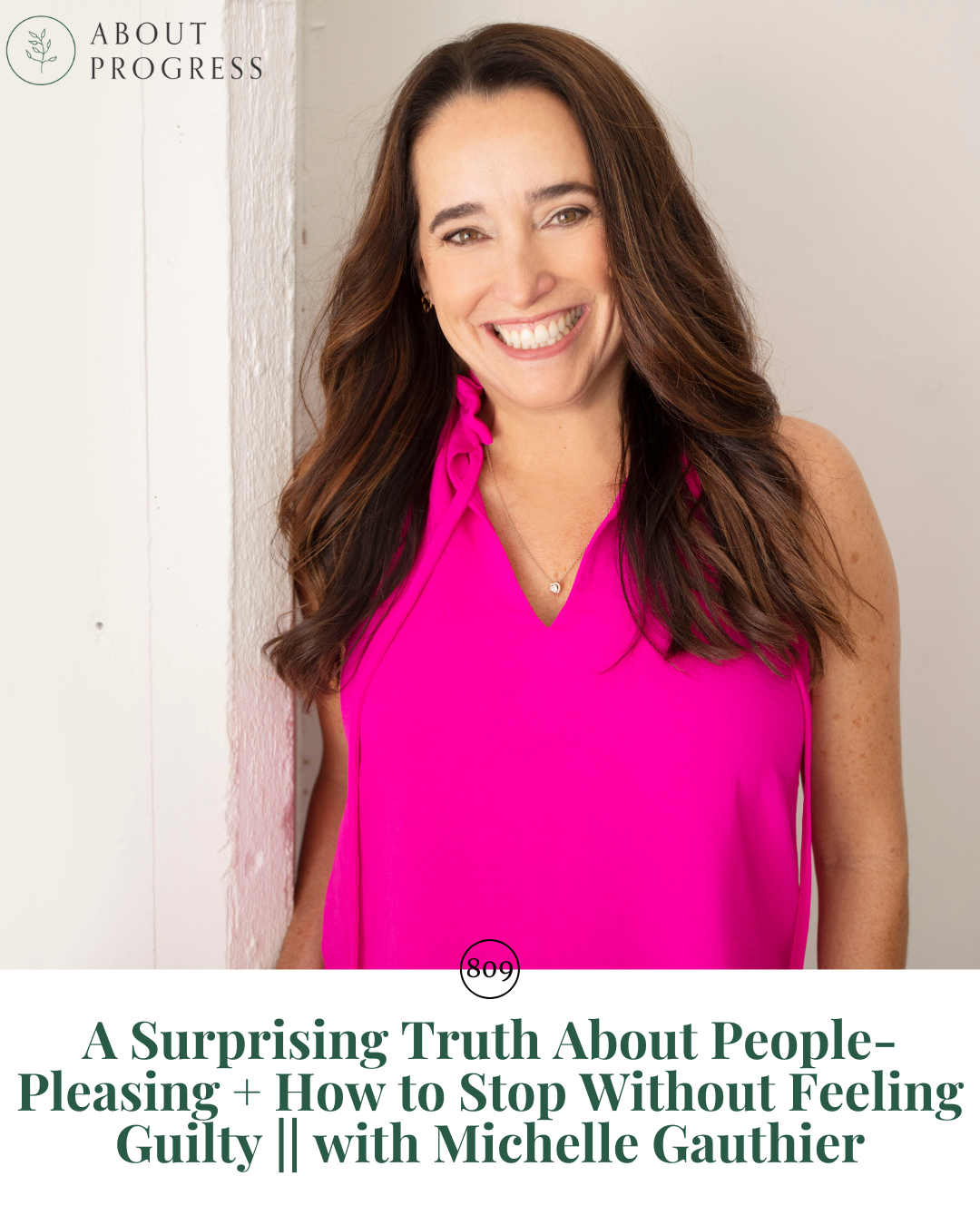
I'm sitting down with life coach Michelle Gauthier to unpack people-pleasing — that thing so many of us do disguised as just being nice. Michelle drops a reframe that gave me a full-body reaction: people-pleasing isn't really about kindness, it's about trying to control how others see us.
The real gift of this conversation is Michelle's Love and Fit Test — two simple questions that help you pause before automatically saying yes: Do I absolutely love this idea, and does this fit into the type of life I'm trying to create? We walk through real examples, from lunch invitations to setting boundaries with family, and explore how making yourself part of the equation doesn't mean you're the only factor — just that you finally count.
LAST CHANCE to claim your ticket for About Progress LIVE.
Preorder Sticky Habits book today!
Join the Book Launch Committee for behind-the-scenes and first peeks at all things book.
Join the Supporters Club to keep About Progress around for good.
Michelle's podcast, free consultation
Go to Quince for free shipping on your order and 365-day returns.
Your next favorite find is waiting at fromrebel.com.
About a few other things...
Sign up for the Go Getter Newsletter to get Progress Pointers in your inbox every Wednesday.
You can listen to the episode below, on Apple Podcasts, or on your favorite podcast app. If you like the show please share it, subscribe, and leave a review!
SHOW NOTES
Access exclusive supporter benefits
Book Launch Committee
Leave a rating and review for the podcast!
Lend your voice and experience + be featured on the show HERE
Join Monica on Facebook and Instagram
Songs Credit: Pleasant Pictures Music Club
TRANSCRIPT
[00:00:00]
Michelle: people don't love when I say this, but I do think at its core, when we people please, we sometimes think we're being nice, but I think what we're being is controlling, and I say that because we're trying to control the way that other people are seeing us
Monica Packer: Hi, this is Monica Packer and you're listening to About Progress, where we are about progress made practical
People pleasing can look a lot like being a good or nice person. You're really helpful, you're dependable, you're easygoing, you show up, you say yes, and you try not to disappoint anyone. But what happens when keeping everyone else happy consistently comes at your own expense?
Today I'm talking with Michelle Gauthier about the sneaky ways people pleasing shows up in our lives, and why it's often less about being [00:01:00] nice and more about trying to control how other people see us. We talk about how to spot people pleasing, its connection to perfectionism, and a simple tool that can help you stop automatically saying yes and start making yourself part of the decision-making process
This episode came at the right time for me. I'm in a place of a lot of overwhelm, a lot of tasks. I've been saying yes to a lot of people, and some of those yeses I was navigating in the middle of preparing this episode. So I was so grateful that I had this information on my side as I navigated through some of those question marks.
Before we listen, I want to remind you that this is your last chance if you're listening on the date this airs to sign up for About Progress Live. It's my first live podcast recording I'm hosting on August 31st in Salt Lake City, Utah. It's a free event, and it's to celebrate 10 years of About Progress [00:02:00] and the book, and you can buy a copy of the book there a week in advance of publication.
I'll get to sign them. I get to meet you. We have light refreshments. It should be a wonderful evening. You can get your free ticket at aboutprogress.com/live, and you can bring a friend or two or three or ten. Just make sure they each sign up so that we can ensure we have enough seats and enough refreshments.
So again, aboutprogress.com/live. And one more thing. As we're listening to this episode, I know someone is gonna come to mind for you. If you find this information helpful make sure you copy the URL of this episode and text it to them as you listen. My conversation with Michelle Gauthier is coming up after a quick break for our sponsors
Monica Packer: You are not bad at habits. You've just been using methods designed for men. My first book will be published this fall. It's called Sticky Habits: A Woman's Guide to Reclaim Happiness, Ditch Perfectionism, and Create Habits That Last. It's [00:03:00] set to release September 8th, but you can pre-order the book right now for three special pre-order bonuses, from a listening companion guide that took me hours and hours to create to a free pass to my online course, Finding Me, and our exclusive virtual launch party on September 8th with some special guests, This book is not about doing more. It's about building habits that survive real life, creating routines that flex instead of break, letting go of perfectionism that keeps you quitting, and learning how to keep promises to yourself.
and that's even on the hard days. In a world of self-help that too easily ignores the invisible labor women carry, that changes everything, because women must do habits differently. Sticky Habits will teach you how. Please pre-order the book now and check out the special pre-order bonuses again by going to stickyhabitsbook.com.
That's linked for you in the show notes. I am so thrilled for this book to be out in the world. It is several years in the making, and I know it will change so much for you. Again, go to [00:04:00] stickyhabitsbook.com to pre-order the book now
Monica Packer: Michelle Gauthier, welcome to About Progress.
Michelle: Thank you. Thank you so much for having me. I love what you're putting out into the world
Monica Packer: Well, same. I mean, everything that you talk about with your work is something that I personally gravitate to and that I know is gonna really help my community today. We are going to specifically talk about people pleasing, which is kind of one of those dun, dun, dun topics because so many of us have those tendencies, and they're interwoven with other tendencies, and it's still a really hard thing to notice and to weed out.
So I wanted to begin with kind of a, a biggie, but I think is really important to note that women in particular seem especially prone to people pleasing, and I was really curious about your perspective on why that may be the case
Michelle: [00:05:00] Yes. First of all, I totally agree with you. I have been a coach for eight years, and this is one of the big issues that all of my clients have. And so I can safely say in those eight years that I've never met a woman who isn't a people pleaser who didn't work to get there. Like, I think by default, every woman has some sort of people pleasing because that's just, in my opinion, the way that we are raised societally.
And I think no one ever sat down and told us that probably, but I feel like women are really valued for being caretakers, and by nature of being a caretaker, you often put other people in front of yourself. I also think that we like to feel, or we do feel more safe when other people are happy with us and like us, and you can often create that feeling of safety, like fake emotional safety, by being agreeable or agreeing to do things that are really against your own will. So I feel like we're, we are sort of just [00:06:00] raised to be that way, , in my experience
Monica Packer: So when you say safety, it's our own safety that you're talking about? Okay. That's so interesting
Michelle: Yes, I think it's interesting too, and just recently I've been reading a lot about the idea that being a people pleaser can almost be like a response to a trauma or trying to avoid any kind of conflict situation. I don't think it's always that deep, but I think just in general, in fact this might be good if I just back up a step and say this,
Monica Packer: Yes
Michelle: defining people pleasing in the first place is essentially doing something where you're putting something ahead of yourself to the detriment of yourself.
So sometimes, I know you're a mom of five kids, I'm a mom of two kids, lots of times you put your kids ahead of yourself and it's just fine 'cause you're choosing to do it, but not all the time. Or if someone asks you to do them a favor and you're like, "You know what? I have the free time. It's part of my values.
I [00:07:00] wanna help someone," that's not the same as like thinking, "I'm so busy. I really don't have time to do that, but I'm gonna feel bad if I don't, so I'm just gonna say yes." So I think that's what people pleasing really is, is doing something to the detriment of yourself
Monica Packer: I really love that qualifier because it's often hard, I think one of the most common pieces of advice we get, especially as moms, is put on your own mask first.
Michelle: Mm-hmm
Monica Packer: And I'm like, if I'm in an airplane and it's crashing, I am gonna put the mask on my kid. Like, I'm sorry. That's a terrible analogy. And, and but in real life, it's also really hard to differentiate when am I being selfish and when am I being selfless to the point of hurting myself
Michelle: Yes. Yes, exactly. And I do feel like if you, and I know this is something that we're gonna get into, but it's figuring out exactly when you are people-pleasing, noticing it, and being able to evaluate that. Like, am I actually... Do I really wanna do this, or am I going [00:08:00] against myself or my values or my own time, my own peace?
Monica Packer: I think those qualifiers are gonna be really helpful for people. First, I wanna hear more about how you even grew to understand this tendency was part of your life and to what extent, and why you chose to start working on it
Michelle: Yes. Great question. So I personally am the oldest daughter, so I feel like that's, tells you something right there. And I learned when I was growing up that I got a lot of great positive feedback for achieving things and being nice. Those were, like, the two things. And
Monica Packer: Hmm
Michelle: what that created for me, again, my parents didn't sit me down and tell me this, but what that created for me was I want that positiveness.
I want people to like me. And so I just learned that being nice and working really hard and getting ahead was the way to win at life. And what happened is I ended up, you know, post-college, getting married, um, tried to have a baby for a really long [00:09:00] time. It didn't work out. Eventually ended up adopting our two kids separately. And I had this life that I really always wanted. I had these two kids, and not being a mom until I was 33 gave me a lot of time to work and advance into my career. And so I reached this point where, in theory, I had everything I ever wanted. I lived in a beautiful house. I had these two kids. I had this amazing job.
I had a handsome husband. I had just everything you could ever want, but it didn't feel good inside. Like, something just didn't feel good about it, and it was because I was burning the candle at... If the candle had 17 ends, I was burning them all. Like, I was just trying my hardest at absolutely everything, trying to make everyone happy, except for paying attention to myself.
So I just got to the point in my life where, and this is really common, so if you're feeling this way, don't feel alone or despair in it. A lot of times we just work really hard for things, and we get to that point and we're like, "Wait, this [00:10:00] doesn't feel like I thought it would. This
Monica Packer: Hmm.
Michelle: really wanted."
And I realized it was because I had created my whole life based on, like, what I should be doing and, um, working tons of hours so that I could get that next promotion or that my bosses would like me and volunteering in my kids' classroom. I had no business being, like, the room mom, but I wanted to be, like, the mom who was always there.
So I just ended up spreading myself way too thin and thought, "There's got to be a better way. Like, this can't be it."
Monica Packer: Was that a series of moments for you, or was there one kind of more definable moment for you that helped you see this is actually a problem? And all this people-pleasing may be making other people happy, but because it's hurting me to this extent, it actually is hurting those same people that I'm trying to please
Michelle: Yes. Yes, exactly. Well, you just get to the point, and I would say it was a series of moments where there are a
Monica Packer: Mm-hmm. Okay
Michelle: where I can picture myself [00:11:00] not being my full true self. Or once I had... It was my birthday, and I really love birthdays, and I just ended up the entire day from the time I woke up till the time I went to bed working.
My friends had planned this really nice lunch for me. I went to the lunch. I was just thinking about how I had to get back to work 'cause I had so much to do at work, and then I worked until I was finished for that day, and then my family was supposed to take me out to dinner, and I went out to dinner, and it was fun, but I was like, "When can we get these kids to bed so I can go back to work?"
I mean, it was just nonstop, and I realized I have been running around all day. I haven't stopped and enjoyed or been present for, like, a single moment of my life. And I remember thinking that was a pretty big deal. And, like, I had no idea what to do about it, I knew it was a problem
[00:12:00]
Monica Packer: Okay, even that example alone, I'm sure there's so many women who are like, "Oh. Oh, like that's, that's me and that's me often." But it also seems really sneaky, people pleasing, especially because it often is guised under good intentions. , It can be shared so much with our roles and responsibilities, especially for our moms who are listening when so much of motherhood does come down to you h- uh, meet other people's needs.
You know, and then it gets confusing about when am I doing that to the extent where it's detrimental to my own. Can you h- help us see some qualifiers of what we should be watching for, um, and, and kind of to go with how you found that for yourself, what kind of things could they watch out for that will help them see, okay, this is people pleasing for starters, and it's a problem
Michelle: Yes. I'll tell you [00:13:00] a really great place to look, which might sound funny at first, but is your calendar.
Monica Packer: うん。
Michelle: you look at your calendar and think, "How did all of these things get on here?"
Monica Packer: Yeah
Michelle: pleasing can cause a very overfull calendar because it's really hard to say no. So that's someplace that you can definitely notice something is going on here.
Let me back into this. How did I get to have this meeting for two hours every other week for a committee that I'm leading that I don't even wanna be on anymore? You know, those kinds of things. So it definitely shows up there. It also shows up a lot of times in exhaustion, and I really believe that our body is always to our mind and our stress and all those things.
So of the type of exhaustion where even if you get a good night's sleep, you still don't feel well-rested. It's just kind of a constant low-lying exhaustion, I would say is another one. Um, even, this is a small specific example, but if you go to someone's house for dinner and you... [00:14:00] I don't eat dairy as an example, and there's something that you don't eat or you just don't feel like having dessert or whatever, even people pleasing eating.
Like, I don't, I can't not eat that 'cause she made it, and then I'll feel bad. So it's really, if you just think about over the course of a day, there are so many things where you have the opportunity to people please.
Monica Packer: Okay.
Michelle: yeah, I think, I think a busy schedule for the women who I work with is one of the biggest
Monica Packer: Mm-hmm. I wanna make a connection with my, like, recovering perfectionists who are listening, which will be everybody, but, uh, one thing I often say about perfectionism is the misplacement of identity. We're accidentally placing who we are on our outcomes. But I see a lot of crossover there with people-pleasing, of course.
I, I too, you know, I don't think there's a single client who hasn't been a people-pleaser as well as
Michelle: Mm-hmm
Monica Packer: struggling with perfectionism. I wanted to... This, this is going with the qualifier thing. I think a lot of that safety piece you brought up, that safety seems to be because you're getting [00:15:00] a self reflected back to you in people's happiness or pleasure or contentment with what you've done to help them feel that way.
So it's almost like you're getting the, like, "See, look, this... Like, you're a good girl," or, "You're a good mom," or,
Michelle: Yep
Monica Packer: a good employee." Like, so, so how can that become something for them to watch for too? Like, I wanted to understand, like, how that ties into our sense of self, people-pleasing, and how that can be also something that they watch for
Michelle: Yes. Yeah, because I think in that example, which is perfect, and I feel like if we were to go one layer deeper
Monica Packer: Yeah
Michelle: I think it's exactly what you're talking about, which is believing unconsciously often, I'm sure you help your clients realize that they're doing it too, but that their enoughness comes from how much they produce,
Monica Packer: Mm-hmm
Michelle: they show up, how much people think that they're a straight A student and a good girl and all those things.
And so, for example, if you didn't believe that and if you knew that you were [00:16:00] already enough, I'm not sure you would even have the desire to people please. So I guess to your point, I think there's a big connection between those two things because when you're trying to, and you believe at some level that your enoughness comes from people being happy with you and seeing you as successful and seeing that you're doing a good job, you're trying to do everything you can to create that, like you said, reflected back at you, that you can look in a mirror and you like the image you see 'cause it's a person who's made somebody else happy or done something for someone else.
Monica Packer: And even maybe the fear of the reverse of that. Like, I think about your dairy conundrum. Like, if you're like, "How do I tell them that I can't eat these
Michelle: Yeah.
Monica Packer: ' cause n- it's full of cheese?" And, and then partly why you, like, don't say anything is 'cause you don't want them to think of you as someone who is picky, right?
Or who is too much, or making up a health issue. Like, people kind of roll their eyes with gluten intolerance, you know? Like, they're like, "Ugh, another..." You know. So I feel like that's part of it too. It's [00:17:00] almost the fear of trying to resist an identity, that you're like, "Please don't put that on me. No, I'm not that person."
Michelle: Yes, exactly. I think it just comes down to, like, if we had to put it into one sentence, it just comes down to worrying about what other people are thinking about us and trying to control that narrative. So
Monica Packer: Oh
Michelle: by being agreeable and eating something that's gonna give me a stomachache for the next four hours, I have succeeded in being seen as agreeable.
Maybe. That's the, that's the other problem. We can't know what people are even thinking. She might think I'm a huge pain in the neck anyway, you know? Who knows? Or she might not think that. But I do think, people don't love when I say this, but I do think at its core, when we people please, we sometimes think we're being nice, but I think what we're being is controlling, and I say that because we're trying to control the way that other people are seeing us
Monica Packer: Okay, I've had like a clearly a bodily reaction to that because it feels so true, [00:18:00] but so surprising. I never would've thought, like, my people-pleasing tendencies is actually me trying to control people. Light bulbs
Michelle: I actually think that it can help slow down and stop the people-pleasing once you have that epiphany because to say, "Well, I'm just nice, and I'm trying to be nice," but if you're like, "Well, I'm just controlling, and I'm trying to be controlling," then it's like, "No, I don't wanna be that. I don't aspire to be that."
Monica Packer: Yeah. Okay. Yeah, I'm sure there's gonna be people who are listening who are like me, like mouth open, you know, doing the poet snaps here, because that is really ringing true, and it's such a... I'm glad you're speaking the truth to it, because like you just said, once we actually are able to understand it, then we can better decide, "No, that's not for me," because that's not, one, possible, but two, not who I wanna be.
And since you shared about you having those series of moments, in particular that, you know, singular day where it was you weren't able to stay present for a [00:19:00] single moment of what could have been a really wonderful day, um, let's get to the how a bit then. Because identifying it, I'm sure, is one thing, but then how do you actually shift away from these tendencies?
If you can share how you did that personally, and then also how they can start to do so, I'd really love to hear.
This is a really huge moment for About Progress. Not only are we celebrating 10 years of the podcast this November, It's also right around the same time that my first book is getting published, Sticky Habits.
To celebrate both of these milestones, I am hosting a free event on August 31st, one week prior to the publication of my book. It's called About Progress Live, and it's a live podcast recording. From podcast to page, we are gonna celebrate 10 years of progress. We're gonna do behind the scenes of the podcast, behind the scenes of the book, lessons I've learned, , funny stories along the [00:20:00] way, And I don't wanna celebrate this alone.
So you can register for this event. It's free at no cost to you, but you do need to register as seats are limited. Go to aboutprogress.com/live, L-I-V-E, and that will take you to register for About Progress Live. Again, seats are very limited. It's in Utah in Salt Lake on August 31st , in the evening. We have a fantastic host who's gonna emcee the night, Julie Rose, who is a very accomplished talk show host, and I'm so pleased she's gonna be there, and I'd love to have you there for the live podcast recording.
Again, About Progress Live. Register at aboutprogress.com/live
Monica Packer: Because identifying it, I'm sure, is one thing, but then how do you actually shift away from these tendencies? If you can share how you did that personally, and then also how they can start to do so, I'd really love to hear.
Michelle: Yes. Yes. Well, now I have like a nice, neat, put-together answer because I
Monica Packer: [00:21:00] Sure
Michelle: out and I teach it to my clients. But the way that I figured it out was a very messy, I don't wanna say the messiest, but a pretty messy way. I ended up all in one month's time, I had quit my corporate job 'cause I had started studying to become a life coach and I wanted to start my own business.
So I quit my corporate job, I got separated from my husband. We owned two houses. We sold those houses. I bought a new house. We renovated it and I got a puppy.
Monica Packer: Oh
Michelle: kids, and I was a single mom and my ex-husband lived out of town. So I, um, I definitely took like the burn it all down path first, and then started going up from there, which I would not recommend to, uh, uh, to do all that at the same time unless you have to.
Monica Packer: Sure
Michelle: your situation, you know, unless you have to. But what I did, I tried, I feel like I tried everything. Like I did a morning routine. I did meditation, yoga, life coaching, therapy. You name it, I did it [00:22:00] and I feel like they all worked. Read self-help books, all that stuff. They all worked and they all helped me a little bit, so there was not like this one silver bullet.
But coaching was the thing that I liked the most because I felt like it was really helpful for me to be able to understand what was happening and what beliefs that I had in my body. Like I have to always put other people in front of myself and I have to get a straight A and I have to be seen as successful.
You know, all of those, that I could change those and be more gentle to myself and then start acting in a different way. So the, the long answer is I did a whole bunch of stuff and then I ended up with mindset really being the thing that made me be able to stop people-pleasing. And I created this tool for my clients called the Love and Fit Test, which can be a really simple way to figure out if you wanna say yes or no to something because what we're talking about with people-pleasing is learning how to say no when you don't wanna do things.
But what I [00:23:00] realized is perfectionist, people-pleaser types aren't even noticing that we're saying yes. Yes is like the automatic default answer. So I created this process called the Love and Fit Test where the first thing you have to do is not say anything right away and pause and you can buy yourself some time by just saying like, "Thank you for thinking of me.
I'll have to get back to you." You know, practicing something like that. But the Love and Fit Test is essentially asking yourself two questions in the moment and one is, do I absolutely love this idea? So if someone's inviting you to do something, do I absolutely love this idea? And then number two is, does this fit not on my calendar but into the type of life that I'm trying to create?
Monica Packer: Okay. Hmm
Michelle: So the type of life that I'm trying to create, and everybody's answer is different, but the type of life that I'm trying to create as a single mom of two teenagers is one that is very calm not over and is joyful and all those [00:24:00] things. And so for example, my friends for a long time would ask me, "Do you wanna go out to lunch on a workday?"
And I love the idea of that, but it doesn't fit into the type of life that I'm trying to create because first of all, all my clients wanna see me on their lunch hour, and that's what I'm here for, and I work really hard during work, school work hours so that I can be free in the evening. So
Monica Packer: Yeah
Michelle: level of thinking ahead.
So although I loved the idea, it just didn't fit in the type of life that I'm trying to create. So maybe we go for a walk on a Saturday instead or something. But it just helps you pause and see, is this a fit for me? And it's surprising how often... Like, I had a client, I just was giving you this example, but I had a client who was in charge of this committee that she wasn't even interested in, and when she asked herself the question, "Do I absolutely love this idea?"
She's like, "I never loved the idea. I never loved it at all, and I don't... It doesn't at all fit into the type of life that I'm trying to create." So I think we put ourselves in those [00:25:00] situations where we have two nos and, but we've said yes 'cause we just haven't taken that pause and really thought about it.
Monica Packer: Okay, so does that mean it should be a yes for both of those questions?
Michelle: I'd say, yeah, like if it's a yes and a yes, easy. Easy yes.
Monica Packer: Uh-huh.
Michelle: and a no,
Monica Packer: Easy, no. ' Kay
Michelle: no. I don't know if there's an easy no usually, unless people
Monica Packer: Sure
Michelle: Now I would say it's an easy no. But if it's a combination, you just have to think about it. Just
Monica Packer: Okay
Michelle: the time to think.
Like my lunch example was a yes and a no, and so then I was like, "You know what? I think this is gonna be a no." And then my daughter did horse lessons for ages. Do you have any horse riders?
Monica Packer: No, but I, I know it's in- it's intense and,
Michelle: Yes,
Monica Packer: and, and pricey. Yeah, mm-hmm
Michelle: intense, it's lots of hours. She absolutely loved it. I loved it like, uh, 1 to 10, I loved it like a 0, and she loved it like a 10.
And so do I absolutely love this idea? [00:26:00] No. But does it cr- is this the type of life that I'm trying to create? Which is I want my kids to be able to find out what they love and be passionate about things and whatever. So that was a no and a yes that I decided to, to take as a yes. Like, okay, I'm gonna do this.
I'm still gonna take her to the lessons, and you know, I would try to better them for myself by like listening to a podcast and taking a walk or something. But so it doesn't mean that you don't do it, but I think there's a huge difference between being bitter that I have to take my daughter to these stinking horse lessons every week, or saying, "It's not my favorite, but I choose to do it 'cause she loves it so
Monica Packer: 嗯。
Michelle: and that's the way that I wanna encourage my children."
Monica Packer: I think this is great because it goes with one of the qualifiers, what, you know, was the choice factor. Like, are you making, how are you making choices? Is it, are, like, do you consider yourself at all, or is it only about the other person or people?
Michelle: Yep
Monica Packer: and with this, you become part of the equation instead of absent of it.
Michelle: [00:27:00] Yes
Monica Packer: it doesn't mean you're the only factor, too.
Michelle: Right
Monica Packer: more realistic to me than the put the mask on your face first, kind of how that gets translated to, like, only worry about yourself, when it's like, no, it's actually no. Like, you're just part of the equation now, and now you make choices with you being part of that equation
Michelle: I, I totally agree. That's a great point 'cause if you think about, like, what would you fill in for the type of life that I'm trying to create? Is yours, like, a balanced family and work life? Or, you know, what would your, what would your answer be for that, the type of life that you're trying to create?
Monica Packer: Okay, and that's what I think a big part of people pleasing is you dismiss your own desires, your own wants, your own needs. So it may be something that they're really out of practice of even considering.
Michelle: Yeah
Monica Packer: do you have any advice for that person who is like, "I don't know. What's life? What's wants?" Like, what, h- how, [00:28:00] who, what?
Like, they're just like, "Whoa, I'm so out of practice." Are there any kind of prompts or ways you can gently help them begin to even answer that question for themselves so they can then m- you know, decide better?
Michelle: Yes, I think that's a great point and a great question, and oftentimes I'll say, "Well, what do you like to do for fun?" They're like, "I don't know." I mean, when you're in, totally in service of the entire world above yourself, you never get to the part where you're like, "Oh, I have 30 minutes. Should I read a book?"
And so I always encourage people to say, " If you had two hours where you were at home by yourself, what would you want to do?" And not, don't make it like cleaning or something that you feel like you have to do. Like what sounds like fun? Do you wanna call a friend? Do you wanna go for a hike? Do you wanna whatever?
And sometimes they have to go back, a lot of times for moms, pre-kids, like years and years and years ago, and say, "What is it that I used to like to do?" I was just telling you before we started recording that I used to love to sew, and I haven't done it in so many years, and I just [00:29:00] got a sewing machine, and I'm getting back into it 'cause it was something that I really miss. So I would, I would suggest that people do that. Like think about what do you really like to do and what's important to you, and then if you look at your calendar and say, "Where is any of that stuff on my calendar?" And it's nowhere, just work on something tiny. Like for example, if you love reading books and you can read for 15 minutes one day a week, you're still putting yourself on the calendar, putting yourself in the equation.
Monica Packer: My listeners on the Do Something list can definitely help them explore that, but I think that's an amazing way to frame it. Like, if I had responsibility-free time, what would I be drawn to? And when I think about what you described as the life that [00:30:00] you want to live, , and that you're trying to create, y- you know, you talked about, was it chill, relaxed?
Michelle: Yeah,
Monica Packer: relaxed, calm. So those are all feelings.
Michelle: Yeah
Monica Packer: So if they can't even think about how they wanna spend the time, maybe they can start by thinking of, "Well, how do I want my life to feel then?"
Michelle: Yes, and then if you want to feel like that, like yesterday I had an afternoon where I didn't have anything going on, and I was thinking, "What could I do to make my life feel more calm this week?" And I decided I'm gonna clean out my jewelry area and, like, my underwear, bra, sock drawer because it's gotten a little chaotic. It's such a small thing, but it made me so happy. And when I opened it this morning, I was like, "Oh, my life is so good. My- all my earrings are in order." You know, just small things like that that you can do to get, like, tiny steps toward the type of life you're trying to create, you'll get there
Monica Packer: Beautiful. I love that example. I'd actually like to have one other example here, maybe f- for you or a client [00:31:00] where they've done this work, they've better been able to, uh, put themselves, make themselves a part of the equation. They, they are in practice of knowing what they want their life to look and to feel like, and they've had a moment now where they get a choice presented to them, and they make a choice that m- better matches those two things.
I'd love an example
Michelle: Yes. Oh my gosh. First of all, that is the best when somebody will text me and be like, "I just said no, and I'm not even sweating." I'm
Monica Packer: Yeah
Michelle: it. You did it. It's amazing." The person who comes to mind is a client who had a very difficult, um, family and she had several members in her family who she felt like always took advantage of her and that she had a hard time having good relationships with them, but because it was family, she felt like she just had to put up with it.
And she really learned how to, with love, just stop hosting everything.
Monica Packer: Yeah
Michelle: call her and say, "What are we doing for the 4th of July?" She'd say, "Oh, I don't know. What are you guys doing?" And she just [00:32:00] would not pick it up, would not do the thing, and they always would ask her to drop everything and take their kids, and she was like, "I'm not available," with no explanation. That's when you've really mastered it, when you don't feel the need to give a million explanations. And so what she gained in that is obviously a lot of time, peace for her own little family, 'cause her family of five was suffering, so she got peace for her own little family. And then just the, the worry and the guilt and trying to control how they were thinking about her and making sure that they still thought she was a good sister, all that was just gone.
Like we worked through the idea of what if they don't think you're a good sister? What will happen? It's like nothing. Like, it'll feel uncomfortable, but nothing. It's not dangerous. It's not gonna ruin your life, and we have no idea. We never know what anybody's thinking about us anyway. So she really got a lot of, number one thing I would say is peace of mind, and number two thing is [00:33:00] actual time on her calendar to spend with her family
Monica Packer: Yeah, both of those things, I feel like that exhale, you know, for myself. Like, that just feels like, whew
Michelle: Yes, and you know when you're carrying around something in your mind like that, it's so hard to concentrate on anything else if you're upset with someone or worried that they're gonna be upset with you. Just becomes such a focus, so when you, you get the, gain this ability to not care what other people think of you, it just frees up so much time in your mind
Monica Packer: And, uh, and I love the literal time too
Michelle: Yes.
Monica Packer: so,
Michelle: actual time,
Monica Packer: yeah, talking about two birds, one stone, that, that's one right there. This has been very illuminating, but also extremely tactile. Like, I feel like I'm gonna be able to better identify how this is sneaking into my life and aim for that exhale, especially through your love and fit test.
I think that's just fabulous.
Michelle: Great. I'm so glad you liked it
Monica Packer: Oh, I loved it. [00:34:00] Well, Michelle, we always end with a final question, but before we do that, I wanna make sure we are directing people to where you want them to go. So where should they go if they wanna learn more from you and connect with you?
Michelle: Okay, great. So my website is michellegauthier.com, and if you go to my website, a great place to start is the overwhelm quiz. So I work with women who are overwhelmed. My podcast is called Overwhelmed Working Woman, and one of the things that people report to me is they don't even know where to start with their overwhelm.
So we have a quiz that will tell you the number one driver of your overwhelm and the first step for what to do about it. So for example, the answer could be people pleasing, or it could be time management, or it could be negative self-talk. There's lots of things that can really cause overwhelm. So that's where I would recommend that people go, um, is to take that quiz and find out a little bit more about their own overwhelm and a free step for what to do with it
Monica Packer: That's amazing. I'm gonna take that test. Like, as soon as we get off, I'm gonna go home and take that test and find out so I can work on [00:35:00] it. Um, okay, Michelle, our final question is what is one small way listeners can take action on what they learned today?
Michelle: Oh, I think that a great question. I think the main thing is to just maybe for the next 24 hours, I don't know what time of day you're listening to this, but for the next 24 hours, just pause any time you have the opportunity to say yes or no to something, and try to think about, "Do I love this idea, and does this fit into the type of life that I'm trying to create?"
And if you don't get that far, even just noticing you are pausing to think about if you wanna say yes or no is a huge win in the right direction
Monica Packer: Yeah, I feel that one to my bones too. So many light bulbs, um, so many things that I know I'm gonna take away from this conversation and, and work on, like, right away. Um, Michelle, this has been so wonderful. Thank you very much for coming on About Progress.
Michelle: Yes. Thank you for having me. It was so great to meet you, and it was, took us a while to get here. We had, like, a sick
Monica Packer: Edit
Michelle: and a graduation and back and forth, and here we are. We made it.
Monica Packer: We made it happen
Michelle: [00:36:00] We persevered.
Monica Packer: and we wanted it. I mean, that's, that's the, the ticket right there. This is
Michelle: the Love and Fit test big time in my book.
Monica Packer: Same. Same girl, same. Well, that was fabulous
I hope this episode gave you the hug and kick in the pants you need to grow. I'll now share the progress pointers. These are the notes I take so you don't have to, and those on my newsletter get them in an expanded graphic version. You can sign up at aboutprogress.com/newsletter.
Number one, pause before you automatically say yes. Number two, use the love and fit test. Number three, make yourself part of the equation. Number four, stop trying to manage what other people think of you. And number five, start rediscovering what you actually want.
I had so many ahas in this episode, especially about how people-pleasing was a form of trying to control what other people think of me. That was super illuminating. I love Michelle, and I get to [00:37:00] be on her podcast soon, so make sure you go and listen to her podcast
And stay tuned for an episode where I am her guest. Your do something challenge this week is to go back to the first progress pointers. Pause before you automatically say yes. I think that's such a simple but very important skill set we can all work on.
This podcast is listener supported. Members of the Supporters Club make my work with About Progress free and available to all without having to put the podcast behind a paywall or add a lot more ads. In return, members of the Supporters Club get access to three levels of exclusive benefits from more time to more content with me.
I'd love to have you check it out by going to aboutprogress.com/support. You can always support the show for free. The best way to do that right now is to text a link to this episode to that person you thought of as you were listening. Please go and do that. And an extra bonus one is to leave a rating and review on Apple Podcasts.
We have had very few left this year, but our upcoming [00:38:00] ten-year anniversary giveaway is coming up this fall. And to enter that, you have to just have left a review on Apple Podcasts sometime in 2026. So if you do that now, you get to enter for our upcoming giveaway too. Thank you for doing so. And thank you so much for listening.
Now go and do something with what you learned today
Monica Packer: me saying your name because this is an issue I've had since a young child. I, I just mispronounce everything. So is it Michelle?
Michelle: get it done
Monica Packer: Yes. Yeah. Michelle, I know, I'm sure I'm not getting that part wrong, but is it Gauthier or Gauthier?
Michelle: Yes.
Monica Packer: Oh, it is
Michelle: nailed it. Yes. Nobody ever gets it right the first time. There you go.
Monica Packer: I am,
Michelle: your childhood.
Monica Packer: I just healed a part of my childhood trauma right there. Gauthier, I said it. I'm so proud of myself. Okay. Well, if I say it wrong when I introduce you, please just say, "Nope," and then we'll start that part over.
Michelle: [00:39:00] Okay, sounds good
Monica Packer: All right, here we go.