
How to Rediscover Your Style as a Mom: Dressing for Yourself Amidist Identity and Body Shifts || with Julie Allen
Jul 06, 2026
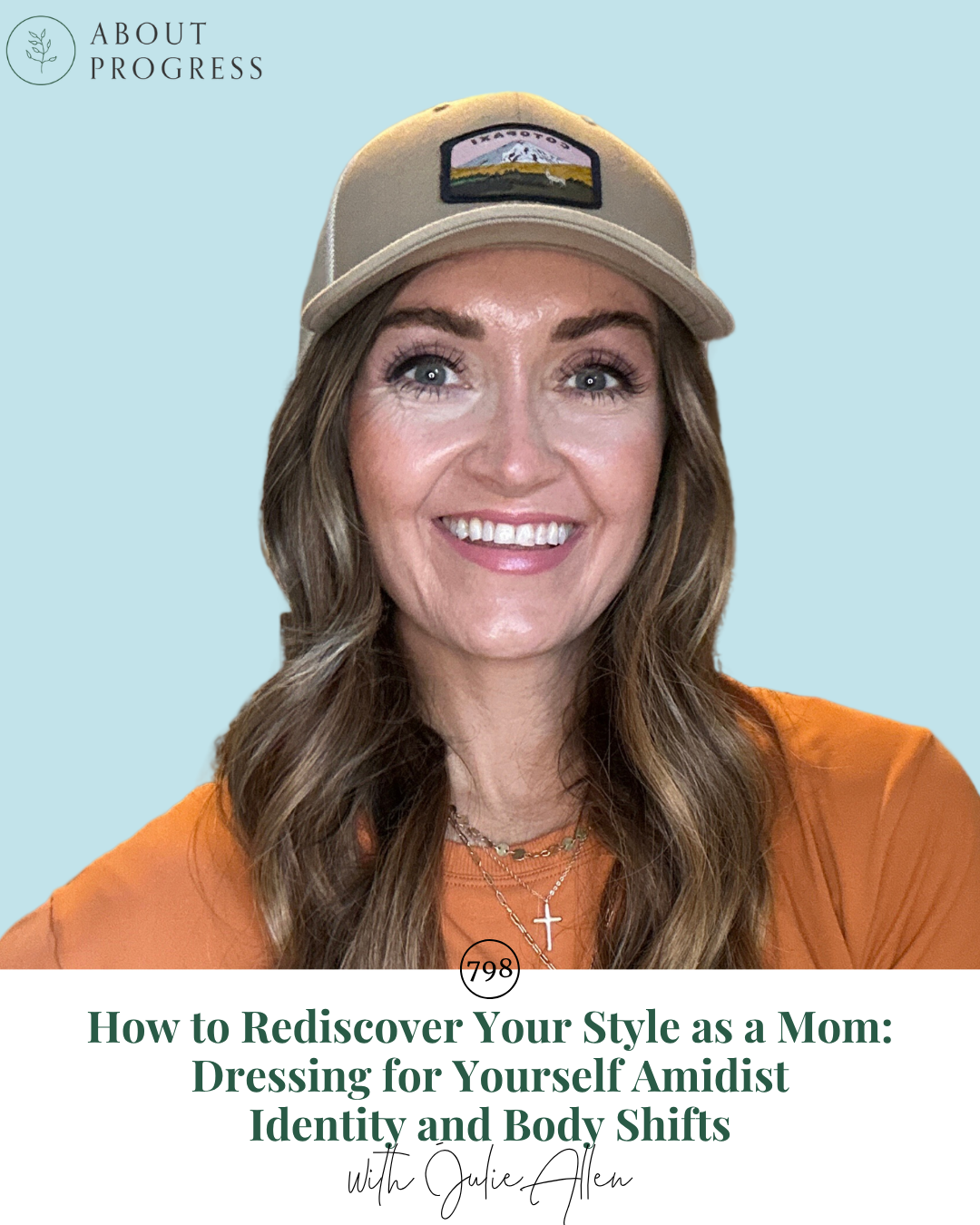
Recently, style expert Julie Allen from the More for Moms conference and I explored how style is not just about what we wear but a pathway to reconnecting with who we are, especially as moms navigating life's changes. Julie shared powerful insights on seeing style as a tool for self-discovery and joy, urging us to break free from societal expectations and embrace our unique identities. Julie highlighted the fun and freedom in using style as self-expression, offering practical steps to incorporate creativity into our daily lives. Her perspective on prioritizing personal joy and value is something every woman can benefit from. For a deep dive into our eye-opening conversation, tune in to the full episode.
Julie's TJG Summer Style Guide, Instagram
Get 50% off last year’s More for Moms Archive Pass with code LISTENER at checkout.
Preorder Sticky Habits book today!
Join the Book Launch Committee for behind-the-scenes and first peeks at all things book.
Join the Supporters Club to keep About Progress around for good.
Complementary episodes: Recent episode with Angela Foster on How to Dress Yourself as Your Body Ages
About a few other things...
Sign up for the Go Getter Newsletter to get Progress Pointers in your inbox every Wednesday.
You can listen to the episode below, on Apple Podcasts, or on your favorite podcast app. If you like the show please share it, subscribe, and leave a review!
SHOW NOTES
Access exclusive supporter benefits
Book Launch Committee
Leave a rating and review for the podcast!
Lend your voice and experience + be featured on the show HERE
Join Monica on Facebook and Instagram
Songs Credit: Pleasant Pictures Music Club
Go to Quince for free shipping on your order and 365-day returns. Get your teen Knix with code “PROGRESS.”
TRANSCRIPT
Monica Packer: Hi, this is Monica Packer. This month on About Progress, I am bringing you a special series featuring select sessions from last year's More for Moms conference.
Last year, I created this online gathering for mothers who know there's more available to them than simply surviving motherhood. More happiness, more fulfillment, more fun, more progress. This conference was born out of my own experience as a mom who loved her family deeply, but still found herself feeling depleted, at times resentful, and almost always disconnected from herself.
I have learned that when moms have more in their lives, they have more to give, not because they're sacrificing less, but because they're finally including themselves on their own priority lists. Right now, this month, I am neck deep in prepping for the second round of the More for Moms conference.
So throughout July, I am sharing a small handful of some of my very favorite sessions from last year's conference right here on the About Progress feed. These conversations are practical and encouraging. They are deeply relevant for any mom who wants to feel more like herself again. If you love what you hear, good news.
You can get instant access to all twenty-five conference sessions from twenty twenty-five's conference with the archive pass. This includes lifetime access to all videos, transcripts, a private podcast feed, and speaker resources, all ad-free, which will be different than what you hear this month as I have to put ads on any episode that airs on the About Progress feed.
You can use the code LISTENER right now at checkout at aboutprogress.com/moreformoms to get an additional fifty percent off the archive pass, which has already been discounted, so it now amounts to ninety-four cents for each speaker session. The content for 2025's conference is set to officially archive this August so I can make room for 2026 content.
Use the code LISTENER at checkout at aboutprogress.com/moreformoms to get lifetime access to all of the soon-to-be archived content. I cannot wait for the new content coming your way, and also hope that you'll take advantage of this discount and get that archive pass.
It's linked for you in the show notes. \ It's now time to share one of my favorite sessions from last year's content. That speaker session is coming up after a quick break for our sponsors Julie Allen, a big welcome to the More for Moms Conference.
Julie Allen: Thank you. I'm so excited to be here.
Monica Packer: I'm excited 'cause I'm ready to learn from you. Sometimes I share my outfit to Instagram because it's been something I've been trying to explore more for fun. I often get messages from women who are like, what do you do if you hate shopping? Or you dunno what your style is? Um, and I'm like, I don't know. I don't know.
Follow Julie. But that's who we're talking to today. It's the people
Julie Allen: Yeah,
Monica Packer: stuck with like, Hey, I lost my style. Can we begin
Julie Allen: real,
Monica Packer: is this a common thing? if so, why do you think it is?
Julie Allen: I would say it is the most common, uh, DM that I get
Monica Packer: Yeah.
Julie Allen: I just don't even know who I am anymore. I don't know how to dress myself anymore. So yes, if you are feeling that way, just. I, I, welcome to the club, right? You are part of a really broad spectrum of women who are feeling the exact same way. And honestly, I don't find it surprising because I've been that person before and I think, uh, talking to women and kind of trying to understand more of where that comes from, I've nailed it down to I think a few specific things.
Number one is that your body has changed. Uh, because of motherhood or because of middle age or whatever it looks like, letting go of traditional beauty standards, even your body changes. And it's hard to, um, sort of get to know that new body in a way that, uh, feels fun to dress it. So I think that's the, probably the most common one.
Uh, second is that your role has changed. So we, our role when we were teenagers or young adults was really different from our role as, uh. Parents as PTA members or whatever it is. And that role change does require sometimes a different, uh, way of addressing ourselves. And it can feel sort of like, if I don't really understand the role or I don't understand myself really well, how do I know how to dress myself?
So I think that's a big one. And then, um, this is one that I think is specific to if you got married young or became a mom young. We sort of jumped from that early stage where we were just doing what everybody else was doing right into motherhood and then spent the next 15 to 20 years in that motherhood place and we, we sort of bypassed that era of getting to know ourselves really well.
We just became a mom and that required us to be outward focused all the time looking at someone else and not thinking about ourselves, especially during those young years. And so we sort of. Missed that stage where we got to know ourselves. And now a lot of us are in this next phase of life where our kids are maybe not in diapers anymore, and it's not that constant physical need, and we are all of a sudden realizing like, I don't, I don't even know who I am.
And dressing yourself is a part of that puzzle.
Monica Packer: Mm-hmm. It is so fascinating to me that you went right to the heart of it, because I think that's really what they're asking. It's not just like, how do I dress, it's how do I know who I am and how do I like way that's represented on the outside? And then we've got the factors too, of, you know, everything we wore in high schools, coming back in fashion now with our younger kids, and then we are like, well, we can't dress like them.
But I also don't wanna dress like
Julie Allen: Yeah.
Monica Packer: my mom
Julie Allen: Yeah.
Monica Packer: like a, a grandma. So what do I, how do I do it? Let's go back to that identity piece a bit
Julie Allen: Okay.
Monica Packer: because that is such an important factor that I don't think most people would connect the dots with. So why? Why is style a reflection of identity? Like how are the two actually more connected than maybe women are thinking?
Julie Allen: I honestly think this is right at like the meat, the heart of this whole thing. I feel like there are two things that women in our specific society get told, and number one is that your appearance shouldn't matter to you, right? Like you shouldn't care about outward appearance and about how you look.
But also subliminally, we are told that our value is directly tied to how palatable we are in appearance to other people. So there's this huge push and pull between, well, I shouldn't care, so I'm, I, I'm a bad person. If I care about getting ready or if I care about style, I'm shallow, I'm vapid, I'm all of those things.
But also. I need to appear as small as possible or as slender as possible, or just as palatable as possible in order for me to have value or power in the world. And that's a really tricky thing to make sense of, especially when we don't really know ourselves.
Monica Packer: Mm-hmm. I would like to know how you made sense of that and how it relates to your own story of perhaps being in a, you said earlier that you've been that person who feels like they've lost their sense of style and by extension, maybe a sense of who they are. So how were you able
Julie Allen: Yeah.
Monica Packer: to deal with that inner conflict and also come to terms with what your style was after all?
Julie Allen: You know, I, I feel like I didn't come into really a sense of style confidence until my late thirties, even into my early forties. That really was a time of undoing a lot of the thoughts that I had about. Womanhood about femininity and about even, I mean, not to go right into the weeds of this, but even about patriarchy.
Like just, it was a time of really starting to question a lot of things that I had just bought into. And I wish it was as simple as put some really fun clothes in your closet and you're gonna feel confident. But there is inner work that has to be done. To sort of start breaking down those barriers.
But the good news is it actually goes hand in hand, like starting to play with style and redefining it as not how can I be the most palatable to other people, but how can I. Give myself this time and this gift, how can I play, how can I be creative through this is actually one of the really actionable things that you can do to start to undo some of that kind of brainwashing that we have or that air that we've been breathing, um, as women.
So it's, it's not the answer, but it's a piece, it's a practice that will help you to sort of shake some of those beliefs loose.
Monica Packer: I love that you went right to the elephant in the room because that is, that is there and it's, and it's true.
Julie Allen: Yeah. I dunno how to not go there.
Monica Packer: And it's also really encouraging to hear that you figure this out in your late thirties, early forties. I think a lot of women are in similar life phases and just feeling like, well, if it's, it's too late for me.
Now,
Julie Allen: Yeah,
Monica Packer: when you, when you think of being palatable, so was that kind of how you dressed before? Like it was just
Julie Allen: absolutely.
Monica Packer: okay,
Julie Allen: Yeah.
Monica Packer: you tell us more about what that looked like for you and what it may look like for them?
Julie Allen: It looked like a lot of different things depending on the phase of my life. So I would say the first thing that it looked like was dressing so that, um, boys would like me, right? That was when I was younger. That was where my validation came from. I didn't have an inner sense of worth, so I dressed in ways that I thought boys would like.
Um, then when I. Like I got married right after I served a church service mission, and so I had gone from this really defined like wardrobe that I was supposed to wear right into being married, and I had no idea who I was, and so I just started dressing. Like I thought everybody else was dressing. So my sisters-in-law are all pretty casual, crunchy.
They just wanna wear like Patagonia and things like that. And so I started to buy things like that because I thought, well, that's what mature, like really great people wear. But then I would go other places and I would be wearing that and I would fill out a place there. And I would feel like I didn't fit in in that place.
And so then I'd try to buy like the skinny colored jeans and the scarf and I'd wear that, but then I'd go somewhere with my family and I would fill out of place.
Monica Packer: Mm.
Julie Allen: And it was this maddening game of trying to make other people happy. Or comfortable with me, right? Like I was just trying to, and I don't think style is the only way that we do this, but it was a really obvious way for me.
I was trying to fit in and trying to dress in a way that made other people feel comfortable and. As I got older and my body started to change, then it became how can I make my waist look as small as possible? How can I make my legs look as long as possible? How can I make my boobs look as palatable as possible?
Right? And it wasn't for men anymore, it was for other women. I was dressing for other women and dressing to, , just dressing to be pleasing to the eye. Take up as little space as possible and be as just easy to consume as possible. And that changed for me when I started to realize, oh, I don't know myself, and this isn't fun to always be trying to please other people.
I'm not even having fun and. That I, I'm, I'm an Enneagram seven, so fun is very important to me. And I think that was one of the first sort of indicators like, oh, you need to get to know yourself better because this is no longer fun.
Monica Packer: So what was the tipping point then for you? in your late thirties, begin to explore
Julie Allen: I.
Monica Packer: it meant to dress as yourself instead of to make other people happy with the way you looked or to make them comfortable.
Julie Allen: I think one of the most, uh, significant things that happened, it, I can't say it was like a specific moment, but it was a mindset shift and the, the phrase that I kind of come back to over and over again was I decided to think of myself as a person who was worthy of my own time. So. I would give. I was willing to give my time to so many people, but I wasn't giving that to myself.
And so giving myself time to get ready yet, that's where it started, was just every morning, if my kids needed to watch TV so that I could get ready, it wasn't, I'm gonna get ready so that I look good for other people. It was so that I could tell myself, I am worthy of my own time. I am a person who's worthy of having a spot on my calendar, and that shifted so much for me because I started to just.
You know, I wasn't getting, I wasn't getting ready only when I was going out. I was getting ready to be at home all day. And then when my kids went to school, I was still getting ready all day, or even though I was going to be home all day. And I realized I'm here by myself and I'm still enjoying this. I'm still, um, valuing this act.
And then I think this is one of the fun things about kind of reaching this next phase of our life is you have just a tiny bit more time. Right. You have 15, 20, 30 minutes that you spend on social media or you spend playing a game on your phone. Just making that shift that you're not gonna go out and serve somebody else.
You're gonna actually just serve yourself. Have fun in your closet for 20 minutes, put together outfits that may or may not work, and just start to decide what is actually fun. To wear or what makes me feel powerful or what makes me feel, um, creative or playful or I I, that big moment for me when I stopped thinking about what looked flattering and instead started to think about what looked like the person that I felt like that day or the mood that I wanted to capture or the me that I wanted to share with the world that day.
Game changer for me. Like letting go of the idea that every outfit needed to flatter me in some way, and instead that it was a creative exercise. Life changing
Monica Packer: And it does sound life changing. 'cause again, it wasn't just about what you put on your body, it was about an an, an extension of who you are. you know, before we get to some of the practical tips that
Julie Allen: for,
Monica Packer: for the women listening,
Julie Allen: yeah.
Monica Packer: maybe it would even help to describe. What is style?
Julie Allen: I love that. Actually. I think that's a great question. Um, I'll tell you, let's start it by the most annoying way.
Monica Packer: Okay.
Julie Allen: style isn't right? Style is not having the same clothes that everybody else has.
Monica Packer: Hmm.
Julie Allen: Style is not, , chasing. The trend that's happening right now, so that you're part of the crowd, right? , Style is an expression.
That's what style feels like to me. The people that I'm the most drawn to are people who are just doing, doing things on their own terms. Like I can tell that they're having fun, that they're expressing themselves, that they're doing it because it. Brings them joy. Think about like the old ladies that, I don't know if you've ever seen like, oh, what are they called?
It's like New York Broads or something like that. And it's just these older women in maybe their seventies, eighties who are walking the streets of New York and they're just wearing every color and every fabric and every cool pair of glasses and necklace and. They don't look silly. They look so cool and they look cool, not because they opened up Instagram and saw whatever Amazon link somebody was sharing.
They look cool because they're dressing their personality. They're expressing the thing that they wanna share that day. Uh, I just started following a, a lady. I don't know why I'm so drawn to these older women, but I think it's because they have stepped into a place of confidence and power
Monica Packer: Mm-hmm.
Julie Allen: I'm watching them dress whatever body they're in, in whatever way they want to.
And it's, some of them are more classic and subdued, and some are more outlandish, but you can just feel that style, that confidence, that what they're wearing is about them, not about everybody else. Oozing out of every po and it's so exciting. It's this representation of everything that I wanna be as a woman in a package of clothing.
Monica Packer: Yeah. I, I love following older women online too for, for style stuff, for those very reasons. But I think you pinpointed there, it's their confidence. It's their settling into who they are because they each dress quite different, which,
Julie Allen: Yeah.
Monica Packer: I love too. I get ideas, but. Let's speak now to the how
Julie Allen: Okay.
Monica Packer: for that woman who is maybe in your early thirties, like when you were there.
Maybe they're not at that exact age. Maybe they're much earlier, much later. It doesn't matter, but, and they're, but they're in this place of being like, okay, I wanna own that. I can prioritize myself, that I can serve myself in this way, and I desire it, not because other I should, because other people want me to, but I desire it. can they go about rediscovering what their style is? can they go about rediscovering what their style is?
Julie Allen: I love that. Um, some of these are a little more ethereal and some of them are more practical. Let's start with some ethereal ones. I really think there is value in saying out loud before you get dressed what your goal is. Really like saying, my goal today is to have an outfit that's creative, or, my goal today is comfort.
Or my goal today is power, whatever that looks like. Because I think our default is going to be, my goal today is does this flatter me or does this make my waist look, make my belly look as flat as possible or whatever. I think that's just gonna be so many of our default. So just,
Monica Packer: word you said? Like a
Julie Allen: yeah,
Monica Packer: Okay.
Julie Allen: Find a feeling.
Define a goal for your outfit. Um, that can be as simple as, my goal today is to be as unflattering as possible. Right. Just, just to play around with it and really start to shake those thoughts loose. So I think that's number one. Number two is to really try to make it fun. Like we're not trying to be groundbreaking.
I'm not trying to reinvent the concept of style or outfits. Um, I'm just trying to have fun. That can look as simple as putting on a mismatched stack of necklaces. Honestly, like if that's, if that feels like a big step, that's your big step. Just put on something that doesn't necessarily work with your outfit and just go for it and go out in the world and try it out.
Uh, the next is if you are not ready to take it outside the door, wear it around your house. You're trying something new and you're just still trying to get used to not worrying about other people's opinion. Just wear it around your house for two or three hours and then take it off and put your sweats back on.
Totally fine, but just like peek in the mirror every once in a while and give yourself a compliment or snap a picture and just give yourself a second to, appreciate what you've done, appreciate the outfit that you put together, and appreciate that you gave yourself some of your time. So those are kind of the maybe slightly ethereal ones.
The next is to really think about basics. So every outfit. Starts with a foundation, I think a pair of jeans that just make you feel like a million bucks. And I don't care if that's a pair of straight leg jeans or skinny jeans or barrel jeans or wide leg. I don't care what's in style. I care that you feel like a million bucks in it.
10 energy. I am a 10 when I wear these jeans. Um, a button down shirt that fits you in a comfortable way. You don't feel like the armpits are constricting or that the buttons are popping. Y don't worry about the size that's on the inside. Really think about how it fits you and how it, how you feel in it.
Um, a great t-shirt, like an oversized t-shirt or a nicely fitted graphic tee. Just some basic items like that. A great pair of sneakers that aren't your workout shoes. A pair of strappy sandals. Even like they don't need to be heels, they can just be a leather sandal. So just some kind of basic items that you can use to add onto, because we want to start in a place that we feel confident, right?
We wanna start in a place that feels comfortable and. Familiar when we're trying to add new things or when we're trying to explore, it's okay to start with what you're comfortable with. So really thinking about basics in your closet. Um, I have a few things on my Instagram that talk about basics. But really just thinking about what are some foundation pieces that I'm noticing as I'm watching other people that they're wearing over and over and over again. So, start there. Really try to build some basics, and your basics might be different from somebody else's, honestly. Like if you live in a place with a hot climate, maybe jeans are never going to be your thing, but a great pair of shorts or a great skirt that you love, or something like that.
So think about your life and about the practicality of your life and build a foundation. And then the next is to really think about creativity. I mean, honestly, like, I think this is really important to practice playing. It's okay to get things wrong and to make outfits that don't work like you'll never wear again.
It's totally fine. Like do, do we really think that Van Gogh was painting masterpieces the first time that he tried? No, he was learning, he was making mistakes. He painted like 120 self portraits of himself that looked different every time. Right? And maybe some of those were his favorite and others he didn't love.
But we love to look at them now as this. , Catalog of who he was and what he was exploring. So don't make perfection the goal of your outfit. Make creativity the goal of your outfit. You are learning about proportions. You're learning about what you like on your own body and what you wanna express.
So those are kind of some simple ones. And then my last one would be to use social media and Pinterest to your advantage. So don't use it as a shopping. Uh. Spot, even though it can be, that can be useful, but when you see somebody wearing something that you like, dissect it, pay attention to like, what are the elements of this that I'm liking and what patterns am I recognizing that I like?
When, like over and over and over again, what am I draw? What am I drawn to over and over That can really help you kind of have a starting place for your creativity. You may not end up there, you may not like it on your own body, but you enjoy it on somebody else, but it gives you a place to start. , I'm drawn to color or I'm drawn to more oversized things, or I'm drawn to that classic, um, kind of east coast vibe of a loose button down in jeans.
Or maybe I'm drawn to all of it. Depending on the season and my mood, but really use those as an exercise in like dissecting and starting to recognize things that you're drawn to so that you don't feel like you're just starting from whole cloth as you're exploring this.
Monica Packer: That is such a fantastic series of steps, and I love that it's both. Deep and practical because as you stated from the beginning, it's an, an extension of who, of who you are and how that goes hand in hand and, and building up that, shoring up that confidence to explore. I I, I wanna speak to two of the biggest obstacles I think women may face even as they're going through this process.
And each of these could be a full hour long chat and of themselves, so we'll just know this is the nutshell of what you would want to say to them. first is, for those who are afraid of messing up. Like you make it seem so fun to be creative, but I know it probably hasn't been fun every day, or especially in the beginning, like maybe there was some anxiety or some discomfort. So can you speak about that messy middle to the people who are worried about messing it up?
Julie Allen: Absolutely. Um, honestly, the biggest thing is to have a sense of humor. I, I made a reel maybe a year ago of old outfits that I have worn over the years, and I love to look back at those terrible, like objectively terrible outfits and remember how much fun I was having wearing them, how great I felt in the moment, and really kind of embrace that sense of humor that I'm not, I'm not going to love every decision that I'm.
Making in my life, but they're all steps toward the me that I want to become. So really that sense of grace, but a sense of humor is a great place to really try that. The messy middle is, it's just messy.
Monica Packer: Yeah.
Julie Allen: honestly, I don't know that I've left the messy middle of style yet because I'm an ever evolving creature, and I'm gonna look back at some of the things that I'm wearing right now and think, wow, I'd never wear that again.
But I love the person who gave it a go. I love that girl for giving herself freedom and space to give it a try.
Monica Packer: Oh, that's such a good answer. The next big conundrum I think, for women is that body. Change that we talked about, like just changes to the body, whether it's health or menopause or birth or postpartum or just life. I think a lot of people too, I was realizing this other day, I'm like, when I was 21 I was still like a teen basically.
Like I
Julie Allen: Yeah.
Monica Packer: wasn't a woman yet. Okay.
Julie Allen: Yeah,
Monica Packer: So I can't like compare back to like college,
Julie Allen: it's true.
Monica Packer: body-wise, of course. But we forget that. So what would you say to that woman who, that's honestly her biggest obstacle?
Julie Allen: Yeah, I, this is a really sensitive place that I want to just acknowledge that I live in a small body . My body's been a lot of different sizes along the way. But I'm aware that I've always been able to shop in a, in a regular, like I've always been able to find my size in a store when I go shopping with friends I know.
So I wanna just first acknowledge that. So this is my best answer coming from having had my body change a lot, but knowing that I haven't lived the experience of every single woman, but my. I am gonna get emotional, but it's been so amazing to listen to women talk about using style as a rebellious act.
Against what you feel like your body is supposed to be. Um, and that goes right back to this concept that flattering is not my goal, right? And it's something that I'm really trying to, to teach and share on my page that flattering is not the goal of every outfit. Um, and it is such an act of joyful rebellion to start giving yourself permission to be.
Creative and sexy and smart and powerful in this body. The body that you currently are part of, and I, I shared something recently that resonated in a way that, was really special to me. I, I had someone, this is an interesting thing that the world does to us. I, I received a comment about my body that I wasn't dressing to flatter my small body, that I was wearing clothes that were too big.
And isn't that interesting that no matter what, people are going to have an opinion, right? We, we genuinely cannot control the opinions of other people. As much as it would be nice to be able to do that, right. But as I sat with that comment, I realized how far I'd come because I had this moment of just realizing my body doesn't belong to that person, it doesn't belong to her, even though I've shared it on the internet.
This body belongs to me, and I love it. I love what it's created. I love what it's, um, experienced. I love what it allows me to do, and I want to love it back. And that can look like so many things, right? It can look like exercise, it can look like acceptance. It can look like neutrality. So many things. But dressing this body that you have.
Is such an act of love, not saying When my body, when I have less of my body, then I'll try this. When my body is smaller, then I'll give it a go. But just saying, Hey, thank you for being my constant companion. I love you. Let's give this a try. Again. It, it is such an inner work, but creativity instead of like, I think neutrality or acceptance or positivity is sometimes really hard.
Creativity feels a lot more fun and accessible to me. It's
Monica Packer: Yeah, I thought of it that way. Of course, you know, we hear about body positivity and even body neutrality, which I think is actually very helpful as people
Julie Allen: right?
Monica Packer: I mean, largely that's my goal is just neutrality
Julie Allen: Yeah.
Monica Packer: someone who's, you know, recovered from eating disorders and all that goes with that.
Right. Um. But creativity is a way to almost surpass all of that, or as a way to move through it. Even
Julie Allen: Yeah, I think it's a means toward neutrality and positivity because it stops being about. Oftentimes it's our perception of how other people are viewing us. That creates a lot of that noise in our head, right? Um, and creativity is all about you. And I just feel like it's like, it's like one little sneaky way to get in there and start to kind of chip away at some of those really deeply ingrained, uh, beliefs that we've been fed.
We breathed them our whole life. So I have no judgment for any of us for struggling with this. I mean. It's, it's in our programming to struggle with this, but it's, it's rebellious and joyful and wonderful to just think of it in a new way.
Monica Packer: I'm, I'm ready to rebel and I'm ready to get creative more. You have earned your moniker of being the internet's big sister, Julie. This has been both wise. Well, yeah, but you're so, it, it truly has been so wise and empowering. Uh. And it's given me a lot to think about. Like I'm like, oh, I have so much to think about and not to do and to try. we ask our final question, we gotta talk about what freebie you are giving everyone who was part of
Julie Allen: Absolutely.
Monica Packer: It's the fall style guide. can you tell us what's, what's in that?
Julie Allen: Yes, this is a freebie for all of my newsletter subscribers. It's a multi-page kind of living document, so it's got outfit formulas, it's got advice for dressing for the different kinds of weather that you might experience. It's got like aesthetic inspiration. So thinking about Ralph Lauren fall or the Jackie O or.
Just finding like Joe March as inspiration and ways to use, um, things around you to inspire your outfits. And a new addition for the fall style guide that I'm so excited about is I have a friend who fits into the plus size category who is going to be doing it with me. So there will be pictures of outfits on different bodies from mine, and just really fun ways to start making use of your closet.
And some really good basics, like links to quality basics that you can add to your wardrobe so that this can be fun and simple. It's like share's closet from Clueless, but in like a PDF form.
Monica Packer: I cannot wait for that.
Julie Allen: It's so fun.
Monica Packer: excited. I'm so excited. So you'll link to where they can get that as well as to your Instagram, that Julie Girl, anywhere else they should go, or are those the two
Julie Allen: Those are the two places that I probably spend the most quality time.
Monica Packer: Awesome. Let's ask that final question then.
Julie Allen: Okay.
Monica Packer: is one way you are currently seeking for more out of your life?
Julie Allen: So I love this question. I actually sat down and wrote like a mini essay about it. Um, this is sort of my unintentional year of effort. I sort of fell into this idea. Um, I realized that I have six kids. I've been, you know, it's been a season for me of a lot of demand on me, and as my life has slowed down in the kid department in that like physical demand department, I noticed that I was keeping some of those.
Ways that I had simplified, but I was now giving that time to my phone. It was this kind of rude awakening that like, oh, I'm spending all this extra time I've given myself. Doom scrolling. So I decided to start putting some effort into things. Some kind of simple ones that I've been doing is making sure that I get up and actually make a real breakfast for myself and eat it. I know that's so silly, but for me that's a big deal. Um. When I invite people over, instead of using paper plates, using real plates and cloth napkins, and then spending that time that I'm cleaning up, reflecting on how fun it was to spend that time with people, right?
Instead of just dumping things in the garbage can and moving on, really giving myself the gift of effort makes things special. It makes things really feel special. Uh, spending more time, purposeful time with my kids working on projects that aren't necessarily fun for me, but realizing that the effort that I'm making to spend that time with them is meaningful and fun instead of just going for the easiest thing.
Um, making time to actually engage in the hobbies that I love, you know, putting time into doing them rather than thinking that it's, it's complicating my life to try to pursue those. So my scenes of an effort is how I'm seeking for more, more meaning, more memories, more purpose in the way that I spend my time.
Monica Packer: Sign me up. I think we all want you to be our big sister Paul, also our next door neighbor. I'm sure I'm not alone in feeling those feelings. Julie, this has been so impactful. Thank you very much for being willing to be here, for being so prepared and for helping us in ways that really count.
Julie Allen: I really appreciate that. It's an amazing thing to kind of be able to be considered in company with women like you. Um, it means that the work that I'm trying to do. Is what I'm actually doing, and that's so thrilling to me. So thank you for the invitation and the opportunity to do this.