
Why You Keep Reaching for Your Phone (and What to Do Instead) || with Ruby Ryba
Oct 19, 2026
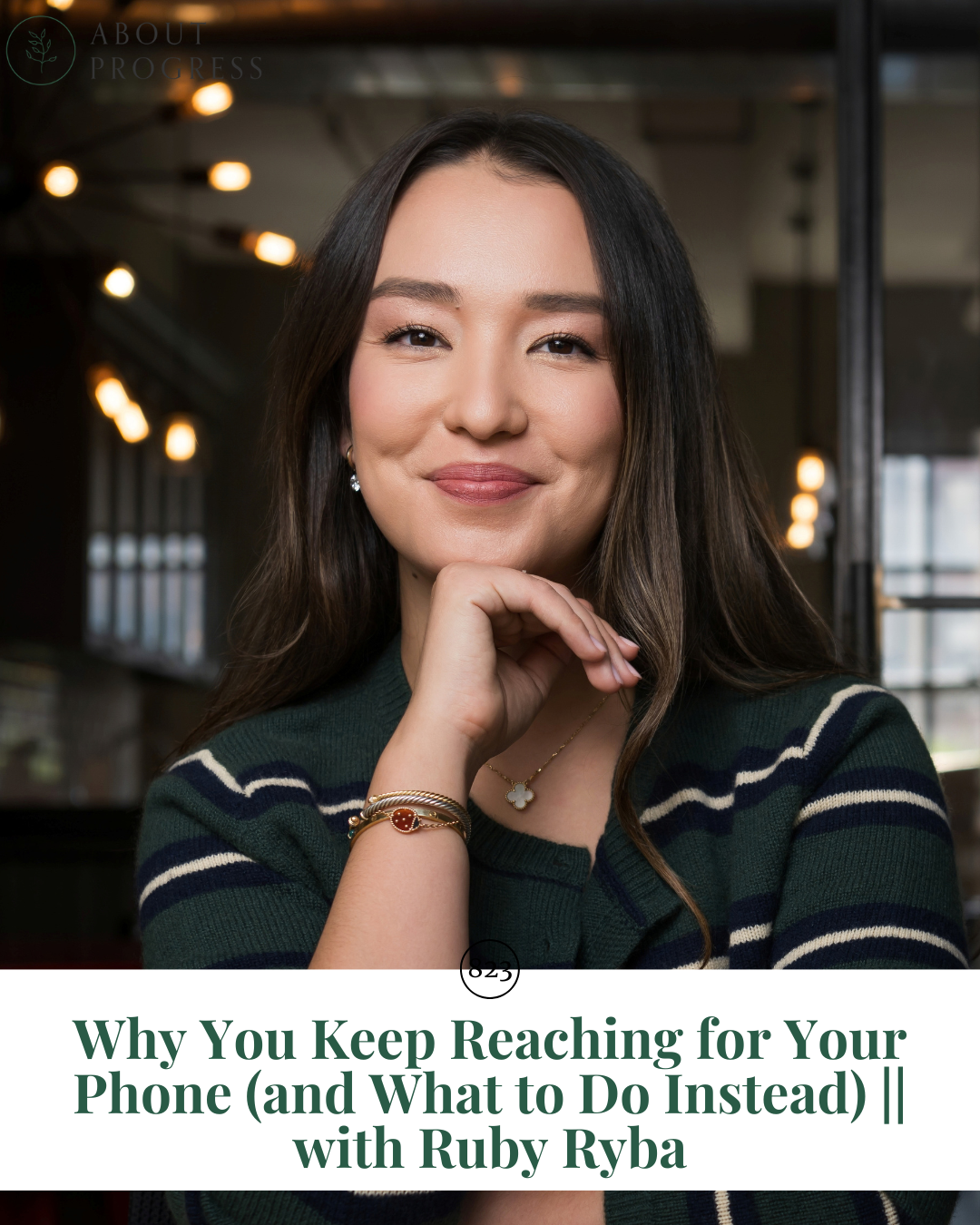
How many times have you caught yourself scrolling and immediately thought, "Oh no, I did it again. I seriously need more self-control"? I've done this too. We all do. But what if scrolling isn't proof that you lack discipline? In this episode, I talk with Ruby Ryba, author of How to Stop Scrolling, about a much more compassionate way to use our phones less.
Instead of shaming ourselves or swearing off our phones entirely, Ruby teaches us to get curious about what our scrolling is really giving us, design our lives so our phones have less power over us, and fill that reclaimed space with things that actually meet our needs. Because the goal isn't just to spend less time on your phone—it's to spend more time actually living the life you choose.
Order Sticky Habits (now available as an audiobook!)
Leave a review of the book
Get the Archive Pass for the More for Moms Conference with $10-off code: “LISTENER.”
Join the Supporters Club to keep About Progress around for good.
Watch this episode on Youtube
Complementary episodes: The Practice of Attention: How to Stop Scrolling in a Distracted World, with Cody Cook-Parrott; How Screens Are Changing Childhood, with Catherine Price
Go to Quince for free shipping on your order and 365-day returns at https://www.quince.com/monica.
About a few other things...
Sign up for the Go Getter Newsletter to get Progress Pointers in your inbox every Wednesday.
You can listen to the episode below, on Apple Podcasts, or on your favorite podcast app. If you like the show please share it, subscribe, and leave a review!
SHOW NOTES
Access exclusive supporter benefits
Leave a rating and review for the podcast!
Lend your voice and experience + be featured on the show HERE
Join Monica on Facebook and Instagram
Songs Credit: Pleasant Pictures Music Club
TRANSCRIPT
Ruby Ryba: [00:00:00] this one life is such a gift, and it's so important for me to live it as fully as possible and to get to make my own choices and not to live on autopilot. Only using our phones as they serve us when we want to, for the reasons we want to, it enables us to live the life that we want to live and that we choose.
Hi, this is Monica Packer, and you're listening to About Progress, where we are about progress made practical
How many times have you caught yourself scrolling and immediately thought, "Oh no, I did it again. I seriously need way more self-control"? I have done this too. We all do. But I want you to think about, and myself as well, what if scrolling isn't proof that you lack discipline? What if scrolling is trying to tell you [00:01:00] something?
Maybe you're exhausted, maybe you're overstimulated, or lonely, or bored, or anxious, or you could just desperately need five minutes where nobody needs anything from you. One of my favorite reminders from this conversation you're gonna hear today with Ruby Ryba is this: scrolling is a signal, not a setback.
Today I'm talking with Ruby Ryba, author of How to Stop Scrolling, about a much more realistic and compassionate way to use our phones less. Instead of shaming ourselves or swearing off our phones entirely, Ruby teaches us to get curious about what our scrolling is trying to give us, design our lives so our phones have less power over us, and fill that reclaimed space with things that actually meet our needs.
The goal is not just to spend less time on your phone. The goal is to spend more time [00:02:00] actually living your life. If you don't know why you keep reaching for your phone, this episode will help you understand in ways that transcend self-blame and provide practical solutions to lessen your phone's draw.
Ruby Ryba is a Columbia-trained and former New York City high school math teacher. Her background and training, along with her personal interest in psychology, have shaped her research and writing interest, the intersection of optimization, habits, and intentionality.
She is the author of the book How to Stop Scrolling, which is available in paperback, Kindle, and audiobook. You can find her book, blog, and weekly newsletter, The Scroll Shift, on her website, rubyrybawrites.com. Ryba is spelled R-Y-B-A, so that's rubyrybawrites.com. As you listen, I want you to share this episode with your friend that always tells you, "I don't know how I get so sucked into my phone."
We [00:03:00] all relate, so send them this episode. My conversation with Ruby is coming up after a quick break for our sponsors
I have fantastic news for you on the book front. First, if you didn't hear, . My book, Sticky Habits, A Woman's Guide to Reclaim Happiness, Ditch Perfectionism, and Create Habits at Last, was published September 8th of this fall. And now the audiobook is out too.
Since you are a podcast listener, I am sure you would love to listen to the book. And I have to tell you, I am incredibly proud of the audiobook. It thrilled me to hear just the other day from someone who was already nearly finished listening to the audiobook that she is loving it.
She told me, Monica, I have read countless books on habits. This is the best one by far. It's a 10 out of 10." I'm hearing from other listeners that listening to the audiobook has been a wonderful way to learn the material, to implement it, and [00:04:00] also to have the friendly voice you are accustomed to hearing guide it all.
You can get the audiobook on Audible you can also check it out through your local library via apps like Hoopla or Libby. I'm also hearing Libro FM has it and Apple Books should as well soon. If you are an audiobook listener, or maybe this is your first time, I encourage you to check out Sticky Habits via audio form.
And if you love to read too, of course, get the bright pink book that everyone is loving anywhere books are sold. You can go to stickyhabitsbook.com right now to check out all the major online retailers, including an independent bookstore, or reserve it from your local library today. Again, the book is Sticky Habits, Whether you listen or you read, get the book today
Monica Packer: Ruby Ryba, welcome to About Progress.
Ruby Ryba: Thank you so much, Monica, for having me
Monica Packer: a trippy, today's a tricky topic, but a necessary one. You know, how to ensure that we are scrolling less and living more. And it's tricky [00:05:00] because, you know, it's easy. easy to scroll. And so much of how we can process our daily lives ways that are easiest include scrolling. so I wanted to begin with you sharing about how maybe that has been true for you, just so people know that you're not this angel coming down from, you know, heaven who's never struggled with anything ever before
Ruby Ryba: No, I've definitely struggled with many things. I'm also a recovering perfectionist, just like so many of your listeners. I think for me, I've always thought a lot about how to use time efficiently and, you know, how do we use time? How do we optimize it? How do we enjoy it? And so when phones became so prevalent and started taking up so much of my time, my husband's time, my family's time, it, it's something that I started to think about, and I felt like I wanted to solve this.
You know? Like, how... What are the best practices for phone use? And then I think also having kids really forces you to crystallize your [00:06:00] values, you know? Because you wanna have answers for them, but also for yourself. Like, what does ideal phone use look like for my family, for me? These are the questions that I wanted to make sure I had answers to myself, and so that's what really started my deep dive into this.
And then as I continued my research, I am the type of person that's always talking about whatever I'm interested in right now, and whenever I talk to people, they were like, "Whoa," like, "I need that, too." Like, "That, that's so interesting." Like, "I didn't realize that putting your phone on grayscale can reduce phone time, like, daily by 50 minutes," et cetera, et cetera, you know?
And so I realized that this is something that might be able to serve other people, too, not just my family, and I decided to turn it into a book. So
Monica Packer: Tell us the
Ruby Ryba: that's where I am. Yeah, it's called How to Stop Scrolling. Simple. Just exactly what you might need. So if you are someone that wants to use your phone less but you don't know where to start, that's where I come in.
Monica Packer: Well, uh, you know, I, I know the way we, um, you know, we're marketing our books might not necessarily be like the whole picture in one [00:07:00] title. So how to stop scrolling, but the way you present it is ideal phone use or phone practice, like a phone practice
that's right for you and your family.
Ruby Ryba: Yes
Monica Packer: bring that up because I think a lot of the information out there is to just quit cold
Ruby Ryba: Yes
Monica Packer: is to just throw your phone basically in a safe each
Ruby Ryba: Mhm
Monica Packer: um, or to pretend it doesn't exist.
Ruby Ryba: Mm-hmm
Monica Packer: you want a different path for people because I think y- you personally know that's not very realistic. So let's start there with this, um, of willpower alone
Ruby Ryba: Mm-hmm
Monica Packer: our phone use. Why doesn't that work?
Ruby Ryba: Yeah, willpower is, is not gonna work, first of all, because the other side has done such a good job. You know, think about your favorite candy. Could you carry that around all day and resist eating it? Probably not, right? And yet we carry our phones around all day, every day, and we expect not to use them. , So really it's more about design.
You wanna design your life in a [00:08:00] way that your phone is going to be aligned with what you want to be doing. And like you said, it's really not, , reasonable to just throw your phone in a box all day. I use my phone to pay for parking. There's parking these days where you literally can't park unless you have a phone, and what are you gonna do?
Get a ticket and say like, "Well, I don't use my phone"? You know, you can't... I went to the movies the other day, a couple weeks ago, for the first time in a long time, and you can only get your ph- your tickets on your phone. You know? So you need the phone. , but to sort of be intentional about and be able to differentiate when am I using my phone as a tool and when is it just sucking me in and distracting me and wasting my time and wasting my life when I want to be spending my time and attention on other things.
Monica Packer: Mhm
Ruby Ryba: starting out with that, , that awareness, and then using that awareness to design your phone, both in terms of your phone's settings and your physical environment, um, rather than relying on willpower. You know, willpower can be useful sometimes, but [00:09:00] it's not a great long-term solution.
Monica Packer: I wanna get more into the deep principles that you carry, like these internal shifts that we're making, and I'm hearing you saying a lot of them now in terms of recognizing why phone use matters to you, but
also how it can be done more in alignment. So starting there, I wanted to lean into that, the, the mindset shifts a little bit more before we go into the practical shifts. What other deep kind of principles can they embody or things they can be aware of to help them able to then go on , designing the practical side of this? What do they need to design internally first?
Ruby Ryba: Sure. So one of my three pillars is to be kind to yourself, and my slogan for that, if you will, is scrolling is a signal, not a setback. So whenever you find yourself scrolling, you might have the tendency to beat yourself up over it and say, "Ugh, I had decided that I wanted to use my phone less. Why am I doing this?
Like, stop." But instead, we wanna ask ourselves like, "Why am I doing this?" , [00:10:00] "Why did this just happen?" We wanna approach this with curiosity, not judgment. Because if we're curious about it, then we are going to c- be able to create design level solutions for this. So why did you reach for your phone? There can be external triggers and internal triggers, right?
So some external triggers are notifications. When your phone dings, you pick it up, and then even if you ignore that notification, you might then be like, "Oh, I wonder if someone sent me a text," right? Now you're on your phone. So there's notifications. Another really strong external, um, trigger is other people's phone use.
So if you're in the elevator and someone pulls out their phone, chances are you're gonna start reaching for your phone, too. It's automatic, you know? But if you just notice that, then you'll notice, wait, maybe this person does need to go on their phone right now, but maybe I don't, and I don't have to pick my phone up just because someone else did.
, so there's external triggers, but then there are also internal triggers. So discomfort, boredom, fatigue, , wanting to sort of like numb out and distract yourself if you're stressed, anxious, you know? And noticing those are really useful for two [00:11:00] reasons. Because one, it can help you to understand why you reached your, for your phone so that you might not do that going forward.
But second, if you understand what you're actually seeking, you can actually give it to yourself. Because if you are reaching for your phone because you want rest, chances are 10 minutes of scrolling later, you're not gonna feel rested. But do you feel physically tired in your body? Should you do some stretching, or do you wanna just sit and zone out for a little bit because you're so overwhelmed, you know?
So, so thinking about what it is that you need. If it's that you want connection, is scrolling going to give you that connection, or is calling a friend or petting your cat gonna give you that instead, you know? So by identifying what it is that you're actually looking for when it is an internal trigger, you can start to learn how to nourish that instead of just letting yourself run on autopilot.
[00:12:00]
Monica Packer: Mm-hmm. so glad you're starting here because as you know, us recovering perfectionists can be so hard on ourselves. And I have found that shame perpetuates behaviors like this, especially when they are so, um... You know, we, we, we want it to be different. We
Ruby Ryba: Ja
Monica Packer: desire for things to change, but the shame of not being able to just, quit it or
be in c- be in control or have self-discipline only perpetuates it.
So I love that's one of your main principles. , So with that, what other principles do you want
Ruby Ryba: Yes
Monica Packer: to embody? Or pillars. You were saying this
Ruby Ryba: Mhm.
Monica Packer: of your pillars. I,
Ruby Ryba: Gracias
Monica Packer: your others.
Ruby Ryba: Yes, so my, my first pillar was that be kind to yourself. Then next I have never leave a vacuum. So you-- when you remove the phone use, what do you want to fill your life with instead? And it doesn't have to be something grand, and that's something that I think is really important, especially for a perfectionist, including myself.
You know, it's you [00:13:00] don't, you don't need to stop scrolling and start reading Pride and Prejudice. You know, you can, but it's not like it's, it's those-- th- that's your only option. And so I think I like to think about creating a menu for myself, and it can be a physical menu that you write down, you know? Um, and the things you wanna take into consideration.
I Love a hamburger, but am I gonna eat a hamburger every single time? No. Sometimes I'm not hungry enough for a hamburger. Sometimes I want something fresher. You know, it depends on what you are seeking. Right? So same with your menu of activities. So think about what are you craving when you're tired?
What are you craving when you have energy? Um, like when you're energetic, you might not wanna sit there and read. You might wanna go for a run or a bike ride, you know? What about in the morning or in the evening? So first you wanna think about like your energy levels and kind of all the different dimensions of yourself, but then you also wanna think about time.
So how much time do you have? So if you only have five minutes or versus if you have an hour, you're probably gonna spend that time differently. The tricky thing about a phone [00:14:00] is that it can fill three seconds, and it can fill three hours. And so without any preparation, we're armed with a phone to pass any amount of time. Whereas when we wanna fill our time with other activities, a little bit of planning is required in the beginning.
But once you've done this planning and created this menu for yourself, then you're gonna be in a really great spot because you're gonna have these options. And I think another thing that I would point out with creating a menu in the be kind to yourself vein is don't wait until you've created the perfect menu, you know?
Because the only way you're gonna know if something works for you or not is to try it. So for me, for example, I always thought that coloring would be like a fun thing. Like my daughter loves to color. Sometimes my babysitters color with them. And I'm like, "I never have time to color. Like coloring seems so peaceful and relaxing," and blah, blah, blah.
So I like bought myself like nice coloring pencils and a nice coloring book, and I sat down to do it, and it was really boring, and I did not like it. And I was like, " Maybe this is just the wrong coloring book." So I like [00:15:00] printed out a different page 'cause I wasn't gonna buy another one, and I tried that and didn't like it.
Like coloring is just not for me. And there's no way I would know that by trying to refine my menu. The only way I could have known that is to try it, you know? So like r- slap down what you think for your menu, try it out, and if you end up on your phone, okay, let's back to the drawing board. Um, and then finally, the third pillar is design over willpower.
So these are all- All very interwoven, so we've been talking a little bit about that. You know, just creating a menu is a way to design filling the vacuum, et cetera. But that when something's not working, we wanna look at the design level, not the willpower, because willpower will last you today, whereas if you do some design today, then that's gonna last you much longer
Monica Packer: I'm gonna lean into some more tips on that, but I wanted
to just go back to that menu piece with a follow-up question. Um, how do you recommend people access that menu in the moment?
Ruby Ryba: It can be anything. , So some people do leave it as a note on their phone, which is [00:16:00] ironic but useful. Um, you could...
Monica Packer: on your,
Ruby Ryba: Yeah, it depends on where you use it, you know? So if it's something that, um, you might have different menus, like a different menu for when you're working from home versus, or working at the office versus at home.
In that case, you could also just have a physical notebook that has your list because it's easy to edit as well.
Monica Packer: out.
Ruby Ryba: Mm-hmm.
Monica Packer: doing this when I was a young, more of, like, my kids were really young
Ruby Ryba: Uh-huh
Monica Packer: and working on phone use, and I had it in the inside of my kitchen cabinet.
Ruby Ryba: Mm. Yeah
Monica Packer: my menu was... I didn't call it a menu then, but it was my ways, my non-tech ways of feeling grounded or feeling like myself.
Ruby Ryba: Nice
Monica Packer: but I forgot about that. It's been many
Ruby Ryba: All right. Something to bring back
Monica Packer: I haven't had that, so it's time to bring the menu back. So some people print it.
Ruby Ryba: Yep.
Monica Packer: different menus for different places. Sometimes people put on their phone. Okay. So in the moment they, or if they realize they're scrolling,
Ruby Ryba: Mm-hmm.
Monica Packer: they go to the menu, or
Ruby Ryba: Yes.
Monica Packer: pick up their phone, they
Ruby Ryba: Or yeah, they might go to pick up their phone and say, "Wait, what do I need right [00:17:00] now? You know, is it rest? Is it... And then how can I fill that instead?"
Monica Packer: What do I need? Yeah, you, you really are coming back home to, , we, we talk a lot about habits in this community,
and bad habits are helpers. They're
trying to help. So I,
Ruby Ryba: I love that
Monica Packer: s- in such admiration, and I love how this is so in alignment that you're, you're seeking us to find out what are we trying to fill
Ruby Ryba: Jasne
Monica Packer: and to, to meet those needs instead
Ruby Ryba: Mhm.
Monica Packer: knuckling our way through it.
And that's where I
Ruby Ryba: Ja
Monica Packer: you know, some of these well-intentioned detoxes or, you know, no phone use challenges be helpful maybe to trigger some changes and realizations, but aren't the, the, the way we can live our lives forever
Ruby Ryba: Yes. It, it reminds me of, um, in Nir Eyal's book Indistractable, he talks about progressive extremism. So when developing a new habit, so he talked about losing weight himself and He realized that these, you know, intense diets would work, [00:18:00] but then his, his weight would yo-yo back up, right? So that's a little similar to stopping your phone use for a week or whatever and then going back.
, And so he decided to change one small thing. , And he would only make the change if he felt like it was a change that he could make forever. So he started with switching from regular soda to diet soda. He said, "Okay, I think that's a switch that I can make forever." And then he added in that he'll have the diet soda, but not at home, that there won't be any soda stocked at home.
And so making these small, manageable changes, that can just feel like a life, like a lifestyle shift rather than, like, something that I have to deprive myself from. Because if you're depriving yourself, that means at the first opportunity, you're going to give it back to yourself because you feel like you're missing something from your life.
Monica Packer: Mm-hmm.
Ruby Ryba: And that's another reason why I think filling the vacuum is so important, because you can fill it with something that's actually better. It sometimes is harder to find that thing that you love and enjoy, and it can also change based on where you are in life, right? Like, maybe you [00:19:00] really love reading, but during really busy periods of work, you're just too tired and you don't feel like reading in the evening.
So maybe that means you shift what you're reading to something lighter, or maybe it means you switch the activity to something like crafting for a while, you know? So just... I think another really amazing thing about using your phone less is that it f- it invites you to get to know yourself better. I think for me, that was one of the most
mhmmm
Ruby Ryba: satisfying parts of this whole thing, is just I got to spend more time with myself and my thoughts and what do I want to do, what do I enjoy?
Monica Packer: Oh, that's everything. And, and it also helps the menu, so it kind of
Ruby Ryba: Yeah, exactly. It, it re- it really, yes, yes, exactly
Monica Packer: another way to say, um, you know, to fill the empty vacuum, it's
Ruby Ryba: Mhm.
Monica Packer: to fill the needs. Another word for vacuum is needs, like that's what you're really trying to do. Um, so let's lean into more of the practical side.
To use design over willpower.
Ruby Ryba: Mm-hmm.
Monica Packer: Okay, this one I'm so excited to hear more [00:20:00] about, like what are the practical ways we can design our phones and how they function, our use around them, that helps us show up to them differently without having to only rely on willpower?
Parenting courses abound, but what if there was a course just for a mom to feel more like herself? To feel like she could reclaim her life as her own, to experience more happiness, to have supportive habits, to increase her health, to improve her home life, and to have more hobbies.
Well, I have that for you. It is now the More for Moms conference ready for you in a course-like form, thanks to the archive pass. I've archived all of my 25 speakers from the general public, but you can get each of them with lifetime access With the special archive pass at aboutprogress.com/moreformoms.
For my listeners only, I have a special $10 off code as well. You can use the code listener at checkout. We just finished the live version of the [00:21:00] conference, and I had countless women who participated who told me this is the best online conference they ever attended, and that they loved to listen to the material, especially on the go.
With the archive pass, you can not only watch all the videos like a self-paced course, pick and choose whichever ones you want to see the most. You can do the same by listening on a private ad-free podcast feed we have set up exclusively for those with the archive pass. Again, get $10 off now with the code listener at aboutprogress.com/moreformoms.
If you're a mom, you deserve more
Monica Packer: what are the practical ways we can design our phones and how they function, our use around them, that helps us show up to them differently without having to only rely on willpower?
Ruby Ryba: Yes.
Yes. So I like to separate design into physical environment and phone configuration.
Monica Packer: Okay
Ruby Ryba: in your physical environment, it [00:22:00] basically just means to keep your phone away from you physically if you don't need it. And, um, that's actually a strategy that's used for a lot of addiction in general. Um, proximity is just very powerful.
But then how does that look like in real life? So I like to think about two zones that my phone lives in primarily. So one thing to really think about for everyone is where do you put your phone at night to charge? And I highly recommend that it's not in your bedroom because when it's not in your bedroom, it's gonna positively affect your life at two very important times, every single morning and every single evening.
You know, we often talk about... our evening scrolling because people say, "Oh, I stayed up much later than I wanted to," et cetera. But a lot of people don't think about the fact that many people are on their phone as soon as they wake up. You
know, they go to turn the alarm off, and then they're on the phone right away.
And so not charging your phone in your bedroom can change both of those things. And when you wanna think about where you're gonna put it, I would recommend that [00:23:00] you think about when you want your phone to enter the scene. So if you're thinking about your morning as, like, a play, it's like the main character wakes up.
The main character stretches and brushes their teeth. If your phone is on the bathroom counter, then the main character's probably gonna pick up the phone while they're brushing the teeth, you know? So where do you want it to enter your, your, your morning? And so for me, I have it in the kitchen because my kitchen's downstairs.
I get the kids ready for school, and then I usually take it with me when we're getting into the car. , And so there's, there's the bedtime, but then there's also where do you put your phone when you arrive home or when you're done working if you're, if you work from home? Because usually there's a place where we put our keys and our wallet, but a lot of people don't have a spot for their phone.
And if you don't have a spot for your phone, that usually means it's gonna ca- it's gonna travel around with you.
Monica Packer: Mm-hmm
Ruby Ryba: I think thinking about those two places that a phone can be, really powerful in terms of physical environment. Um, when you think about digital configuration, uh, I think one really easy thing to do is to just to delete any apps that you don't need.
They [00:24:00] build up over time, and a lot of them also often just give you, like, a notification once a week or once a day. And then even if you ignore that notification, that invites you to your phone. It, you know, it distracts you from what you are working on. It deprives you of the flow that you are in.
So many things. So deleting apps and then also eliminating notifications that you don't need, um, using do not disturb modes, automating those do not disturb modes so that they are on all the time because you can always turn them off, but often you'll forget to turn them on.
Monica Packer: What do you mean by automating them? Can you, uh,
Ruby Ryba: oh
Monica Packer: them for certain times of the day?
Ruby Ryba: Yes, exactly. So you can schedule them. Yeah. So do not disturb is, like, one of the best things, like, best thing since sliced bread. So depending on how many kinda different modes in your day there are, you can create different do not disturb modes. So I have one for work, which just allows, like, phone calls so that if, like, my kid's school calls.
I have sleep, of course. Um, even though my phone's not in my bedroom, I just still have a sleep mode. , What else do I have? Oh, I also have a date night mode, so if I'm out with my husband, then [00:25:00] all of my babysitters, even though I have, like, kinda like a Rolodex of babysitters, they can still call me because then I know that if...
I don't have to change the settings every time I go out. And so whoever's watching my kid, if they call me, my phone will ring, so then I don't have to keep checking my phone.
Monica Packer: That's good for those parents of, of, of teens too, who,
Ruby Ryba: Yeah
Monica Packer: they're at different practices or doing things, or they're at a late night rehearsal and they don't wanna put their phone in another room 'cause they need to ca- You know, so
Ruby Ryba: Yes
Monica Packer: do not disturb and maybe across the room, but with the setting that your child can at
least call you for
a ride home or
Ruby Ryba: Yes. Yes.
Monica Packer: That's
Ruby Ryba: so do not disturb modes are awesome. So I have mine automatically roll into another one. So mine goes from, like, sleep mode to work mode, work mode to sleep mode. I don't know.
Monica Packer: Like
Ruby Ryba: and then I...
Monica Packer: I'm sure you could
have a family
Ruby Ryba: yeah, I have a family mode that I sometimes use, and then I have, um, and then I have the date night.
That's the only one that I physically toggle on, but my phone is almost always just in a do not disturb mode
Monica Packer: I, I never knew this. Okay,[00:26:00]
Ruby Ryba: Awesome
Monica Packer: What, what are other things people are like, "What?" Like, they didn't know are practical things they can do with their devices that actually make a difference?
Ruby Ryba: I think also thinking about what actually needs to be on your phone versus what you can access on a computer. , So do you really need to, um, have your email on your phone? You know, some people do, some people don't. , And then that can also help you think about batching. So batching when you respond to emails or even when you respond to texts.
Like, I usually batch respond to texts. I don't respond to texts as soon as I get them because then I'm just gonna be stuck on my phone all day, you
Monica Packer: Yeah
Ruby Ryba: so I love batching. , There's also... You can create, like, a, a transition ritual. I think transitions are another really easy trigger for going on your phone.
Like, "Okay, I'm done working. I'm about to get up to go pick up the kids. Let me, like, slouch down on my phone for five minutes," you know?
Monica Packer: Mm-hmm.
Ruby Ryba: and so
Monica Packer: in the garage, or in the parking lot.
Ruby Ryba: exactly.
Monica Packer: I find that happening for
Ruby Ryba: rituals can just be, like, box breathing. Like, this kinda goes back to a menu. It's almost like a mini menu, you [00:27:00] know?
Yeah, I mean, just having, like, your little five m- It's, that's, like, I sometimes call it, like, my five-minute menu. Like, what can I do if I only have five minutes?
Monica Packer: yeah
Ruby Ryba: and then that's something that you can always go to, and I feel like everyone always says they wanna meditate more, so I'm just like, meditate or think recreationally.
I also love recreational thinking. Like, you can come up with... Everyone says they come up with their best ideas when they're showering, right? So you can recreate that. You don't have to be wasting water standing there, you know? Like, you can just have five minutes where you're thinking
Monica Packer: Yeah. It's so funny that we're at that stage of our online lives is recreational, but I, I
Ruby Ryba: Yes.
Monica Packer: what you're saying. It's
Ruby Ryba: Yeah.
Monica Packer: you just thought for a few
Ruby Ryba: Yes. Yes.
Monica Packer: What a, you know, what
Ruby Ryba: It's actually really fun.
Monica Packer: Yeah.
Ruby Ryba: Yeah
Monica Packer: Well, yeah, I, I... and I find, um, you, you like you said, it comes back to then you begin to, to know yourself better.
Ruby Ryba: Yes
Monica Packer: connected. You know, thinking helps you not just come up with ideas, but
just connect with
Ruby Ryba: Yeah, and you can even just [00:28:00] observe yourself. Like, "Oh, that's interesting that my thoughts went there. I guess I really care about that. You know, I keep thinking about that. I keep wondering about that. Maybe that's a project I actually wanna pursue 'cause I keep thinking about it," you know? And you... I also think that when you don't let yourself think, you don't give yourself time to process things.
You
know, everything that's going on every day, like, we need time to process, and with my kids, for example, I often hear them talking at night, right? When they go to bed, they're, like, talking to themselves, and I think they're processing the day, and if we're scrolling before bed, we don't give ourselves that time, you know?
I think that human brains just need breathing room, and we've filled up all that breathing room. We've kinda plugged it all up. , And so I wouldn't, you know, underestimate the value of just being
[00:29:00]
Monica Packer: Mm-hmm. So with this, Ruby, I'm sure you don't live this out perfectly, and I would love to hear what you do in those moments where you realize, "Oh, I've been scrolling for a while, like unintentionally, and I don't wanna be doing this."
How do you bring yourself back?
Ruby Ryba: Yes. So scrolling is a signal, not a setback. What do I need right now? Why is this happening? So the first thing that I ask myself is, is this a pattern? Is this something that's crept up on me? Am I doing this regularly, or is this a one-time thing? If it's a one-time thing, maybe I catch myself and there's no analysis necessary.
Like, there's not always some big, huge analysis of, like, actually, this is what I'm craving, blah, blah, blah, you know? Or sometimes there is. Like, I will admit right now, it's the beginning of the school year. My daughter's starting a bunch of new extracurriculars. My son moved up from the toddler room to primary.
Like, there's been a lot of anxiety for me, and I also feel like I check my email like a security blanket because I'm like, there might be, like, a message about what [00:30:00] they need to bring on the first day of school, you know? So I've definitely noticed that. So I've actually implemented a bit of a reset myself maybe four days ago.
, What I like to do, and this works for me, but it will depend on the...
Monica Packer: pattern.
Ruby Ryba: Yes, it depends on the person because it also depends on when are you scrolling. So I think I've noticed that I've been on my phone a little bit too much in the evenings recently. It's like researching different extracurriculars or checking my email.
And so I like to make sure to read at the, at nighttime and in the morning. I like to read fiction at night, and I like to read nonfiction in the morning. Nonfiction in the morning often, like, gives me, like, a nice way to... It just, like, motivates me for the day, you know, especially if I'm reading some sort of, like, self-help.
Right now I'm reading, um, Four Thousand Weeks.
Monica Packer: Oh, yes. Mm-hmm
Ruby Ryba: yeah. And, and then in the evenings right now I'm reading, um, My Friends, um, by Frederick Buechner.
Monica Packer: Uh-huh
Ruby Ryba: then I also like to journal. Um, and I also like to have silence. So those are my, like, three things. So it's like, make sure to have time for silence, and that's kinda like the recreational thought.
You know, I don't have to meditate, [00:31:00] or I can if I want to. I can think or I can not, but just time, especially moms. I feel like we're so overstimulated. I love silence. So I sit there in silence, and then order doesn't matter, but I also journal a little bit, and I read at least 10 pages. That's it. Like, it's so little, but...
And sometimes I'll read 50 pages, but that's just, like, that's something that I find when I'm noticing that my mornings or my evenings are feeling chaotic, I come back to this. And then I have my, uh, there's a chair in the bathroom. So I set up my nonfiction book and my journal next to the chair in the bathroom so that when I wake up without disturbing my husband, I go right there, I start reading, I start journaling.
And it takes less than 10 minutes, but it just completely has changed. You know, I'm, I'm kind of feeling more grounded again
Monica Packer: So you have these habits that help you reset
to come back, I guess, again, home to yourself,
Ruby Ryba: Yeah
Monica Packer: like you are in control or being, being able to be yourself and be intentional about these.
Ruby Ryba: Mm-hmm.
Monica Packer: you have any kind of... I mean, I know we started this conversation talking about how [00:32:00] these extreme measures don't often work, but
if you're noticing the patterns are creeping up in intensity and frequency, do you have any kind of practices of resetting your relationship with your phone if you need to, or do you advise people to do that? Not necessarily a detox, but maybe it would be something like that where they put, you know, where they just don't use their phone for a day or two, or for the weekend, or any kind of practices like that?
Ruby Ryba: Yes, I think so. , It's the phrase digital Sabbath has become more and more popular where people, you know, as a family or just as an individual, um, remove their phones for a period of time. It can be as short as four hours or a whole day. I think that those are great because I like to think of that not as like...
Like, I think if it's something like a week long or something, that's just not practical because you probably need your phone to function in this society.
Monica Packer: right
Ruby Ryba: I think having, like, four hours or so with your phone powered off can be really amazing. I usually, when I fly, I don't connect to the Wi-Fi because I think it's just a great way [00:33:00] to, to, to get a break.
So I think that's great. And then when it comes to... Because I also think that in, in that time you can-- you might notice you're, like, about to go on your phone, and it gives you the opportunity to practice over and over. "Okay, I wanna go on my phone, let me do something else. I wanna go on my phone, let me do something else."
You know? Sometimes it's just getting the reps in. But then if you notice that your phone use is creeping up in some way, I also would look at what you're doing., I had someone that I worked with that just said, "You know what? I, I can't moderate my use of dating apps. I'm just gonna delete them all."
You know? And so there might just be some things that you remove from your phone. Like, I don't have s- my socials on my phone. Um, and I know some people have to use socials for work, but even then, I encourage them as much as possible, especially if it's work, to use it, use your computer. And I know that there are some functions that you can only do on the mobile, the app, so, like, that's, like, a little bit more of a detailed conversation.
But I think just thinking about, "Is this serving me, what, what I'm, what I'm doing on my phone?" I, I think there's, there's nothing wrong with [00:34:00] quitting some things cold turkey that aren't helping you
Monica Packer: Mm-hmm. Okay. Uh, you know, it's striking me as one of the, um, analogies you kinda brought up is just, uh, you know, like the going back to Nir, like extreme diets weren't or sustainable, but small changes were. And
with this, it's kind of like instead of going to extreme measures, it's, it's about intuitively knowing what do I actually need?
It's more this like, uh, this, this way of, of intentionally and, and intuitively noticing, you know, this thing, this app does need to go off my phone now,
Ruby Ryba: Ja
Monica Packer: I am gonna take a digital sabbath every weekend, or,
Ruby Ryba: Yeah
Monica Packer: you know, um, I, I do wanna connect with so-and-so on Marco Polo and, you know. So kind of knowing that, that, that this is more of a, a self-trust relationship, too.
I think sometimes our fear of being on there and the shame can, can make it so we're just, again, um, it, it perpetuates the behaviors, too. So I'm so grateful for this conversation. I wanted to hear, , why this is worth it to you. [00:35:00] What about your life and not doing this perfectly, but to do so intentionally, use your phone to live more, why has this mattered to you personally?
Ruby Ryba: I just think that this one life is such a gift, and it's so important for me to live it as fully as possible and to get to make my own choices and not to live on autopilot. And so I really think that only using our phones as they serve us when we want to, for the reasons we want to, it enables us to live the life that we want to live and that we choose.
And so it's so important to me. You know, I believe so much in humanity and in, , the gifts that we all have, and I think that we can't access them if we're, we're spending so much time on our phones
Monica Packer: That sounds freeing
Ruby Ryba: Ja.
Monica Packer: Yeah,
Ruby Ryba: Ja
Monica Packer: life. So before our final question, I
want to know [00:36:00] where people should go if they wanna learn more from you, including your book. So tell them all the places that they need to
Ruby Ryba: Sure. Thank you. So my book is How to Stop Scrolling, and you can find it on howtostopscrolling.com. It's on Amazon, paperback, Kindle, audiobook, wherever you listen to your audiobooks. You can also sign up for my newsletter, , The Scroll Shift. So every Wednesday I send you a tip at my website, rubyrybawrites.com, and I also blog on my website
Monica Packer: Wonderful. Well, we'll make sure to link to those things in the show notes. Our final question today is, what is one small way listeners can take action on what they learned today?
Ruby Ryba: Yes. I would say it's to buy an alarm clock.
Monica Packer: Ja
Ruby Ryba: yeah, I think, like, you need to have an alarm clock. It just... It's life-changing because then you don't need to have your phone in the bedroom, and it can be the cost of a cup of coffee. Like, you don't need something fancy.
Monica Packer: No. Yeah, you really don't.
Ruby Ryba: Yeah. They've had clocks for a long time.
They all, they all work.
Monica Packer: Yes, they do. Thank goodness. Thank goodness. That, that marked a big shift for me. And I would say if there were two practical things, it was, yeah, not, not charging my phone in
[00:37:00] next to my head anymore,
Ruby Ryba: seriously
Monica Packer: an alarm clock of some sorts. I actually just use my Apple Watch now,
Ruby Ryba: How nice
Monica Packer: clock.
Um, also having a home for my phone
Ruby Ryba: Ja
Monica Packer: just in my main area. So I- whenever I drift, I come back to those two principles. Um, so thank you. This was so, , practical, it was so helpful, and I know it's going to change a lot for our listeners today, so thank you for being here.
Ruby Ryba: Thank you so much, Monica, for having me today
Monica Packer: Well done. That was great.
Ruby Ryba: That was a lot of fun
I hope this episode gave you the hug and kick in the pants you need to grow. I'll now share the progress pointers. These are the notes I take so you don't have to. And those on my newsletter get them in an expanded graphic form each week.
You can sign up at aboutprogress.com/newsletter. Number one, treat scrolling as a signal, not a setback. Number two, create a menu [00:38:00] of things to do instead. Number three, use design instead of relying on willpower. Number four, make small changes you can actually sustain. And number five, remember what you're making room for.
I was so grateful for this conversation with Ruby. It reminded me of two others that we've had this year, one with Cody Cook-Parrot, about the practice of attention, another with Catherine Price, more specifically about how our kids are showing up around devices.
I think those make excellent pairings, and I have linked to both in the show notes for you This podcast is listener supported. Members of the Supporters Club make my work with About Progress free and available to all without putting About Progress behind a paywall. In return, they get access to three levels of exclusive benefits, and these levels range from $2 to $7 a month, very affordable, and you can check it all out right now by going to aboutprogress.com/support.
You can always support the show for free. One way to do that [00:39:00] right now, which creates a win-win for both of us, is you leave a rating and review on Apple Podcasts. That is the only way you enter to win a favorite thing for my upcoming favorite thing giveaway in honor of our 10-year anniversary. I am pulling from reviews left in the year 2026, so the sooner you enter, the more likely you are to win.
So leave a rating and review on Apple Podcasts, and it's free for you to do so. Another free way to support this work is by sharing this episode with a friend. So whoever you thought of while you were listening, make sure you text them the link to this episode. Thank you so much for listening.
Now, go and do something with what you learned today
Ruby Ryba is a Columbia-trained stasis- statistician, stasis- sta- statistician, statistician, statistician, [00:40:00] statistician, and former New York City high